Kev @kev07713 and his wife had been talking about a trip over to Hickling Broad in Norfolk, with the main aim of seeing the black-winged kite, a species Karen had yet to encounter. There were several other sites in the area that could be visited if needed, so it promised to be a good day regardless. The forecast was dry, if decidedly cold. Kev got in touch to ask if I was free to join them and, after checking with my wife Charlotte, I replied to say that we’d both love to come along and make a proper day of it.
We set off early, planning to head straight to Hickling Broad to give ourselves as much time as possible and ensure everyone got to see the bird. Neither Charlotte nor Karen had seen a black-winged kite before, while for Kev and I it would be a welcome year tick. After a quick breakfast stop enroute, we arrived at the Visitor Centre car park at around 8.30am. We’d driven through some mist and fog earlier on, but this had cleared by the time we reached Cambridge. The sky remained grey, though mercifully not heavy or threatening. The car’s temperature gauge read 3.5°C, and a light ESE breeze greeted us as we set out.
Hickling Broad is a 600-hectare National Nature Reserve in Norfolk, managed by the Norfolk Wildlife Trust (NWT). It is the largest of the Norfolk Broads and is a landscape of shallow lakes and wetlands created by medieval peat digging and later flooding. Lying within the Upper Thurne Broads and Marshes, the Broad’s waters are slightly brackish due to their proximity to the coast. A rich mosaic of open water, reedbeds, woodland and grazing marsh makes the reserve one of the most important wetland sites in the region.
The black-winged kite is a striking small raptor, with pale grey and white plumage, bold black shoulder patches and intense forward-facing eyes that give it an almost owlish expression and before 2023, there were no accepted UK records of this species. A bird that appeared briefly in Mid Wales (near Newtown, Powys) in April that year went largely unpublicised, but in July 2023 a black-winged kite was discovered at Hickling Broad, becoming only the second confirmed UK record and the first ever for Norfolk.
The species is typically associated with open grasslands, savannahs and semi-arid habitats in sub-Saharan Africa, tropical Asia, and increasingly south-west Europe, particularly Spain, Portugal and southern France. Although classed globally as Least Concern, it remains an accidental vagrant in the UK. More recently, from late 2025 into early 2026, what is thought to possibly be the same individual, has been repeatedly reported around Hickling Broad and the wider Norfolk Broads, including regular sightings near Stubb Mill Raptor Watchpoint and the Horsey area. During this winter, the bird has stayed for an unusually long period, including appearances at Ludham Bridge, where Kev and I visited in December to catch up with it (report here).
We chose to follow the grass track towards the Raptor Viewing Point, a walk of around 20 minutes, and were treated to plenty of wildlife along the way. A couple of muntjac deer crossed our path, while the surrounding marshes held an assortment of ducks and wildfowl, along with small flocks of tits and finches flitting through the hedgerows.
On reaching the viewpoint, we found another birder already in place. He confirmed that the black-winged kite had been active earlier, hunting over the area to the left, and had recently been seen perched in some distant trees. For the time being, however, the bird was out of sight.
We set up our scopes and began scanning, concentrating on the area where the kite had last been seen but also sweeping the wider vista, keen not to miss it should it drift through unseen. At least four marsh harriers were in view, quartering the reeds and grassland or perched in nearby trees. As time passed, the cold began to creep in, made more noticeable bas we stood quietly scanning with scopes and binoculars.
After around half an hour, I picked up a bird hovering high and distant - it was our bird. I quickly alerted the others, Kev swinging his scope into position while Charlotte and Karen raised their binoculars. Although the kite was clearly visible through the scope, especially once we increased the magnification, it remained frustratingly far off. Photographs were never going to do it justice; the only real hope was that Kev might be able to stay on it long enough to capture some video through his scope.
The species’ hovering hunting style, reminiscent of a kestrel, combined with its elegant, unhurried flight over the open marshes made it a dramatic and compelling sight. Its striking pale and black plumage, vivid red eyes, and agile aerial movements set it apart from any other raptor we’re used to seeing in the UK. Photos are unfortunately only for the record.


We lost sight of the bird, which reappeared two or three times before disappearing completely. After a further 15–20 minutes, Kev eventually managed to pick it up again - now seemingly in the next county, perched in the furthest line of trees from the viewing platform. By this point, photographs weren’t just poor, they were entirely pointless. Several other birders had now joined us on the platform, and we shared the bird's location.
I attempted some video of my own through the scope, clearly something I need to practise if I’m going to improve, while Kev’s effort, though still limited by distance, was noticeably better and at least captured the essence of the bird (see on X here).
We waited in the hope that the bird might drift closer to feed but eventually accepted that we’d had good views through the scopes and there was no sign the bird would come closer any time soon. If we were going to make the most of the day, it was time to move on, ideally somewhere we could also grab some lunch. Sea Palling felt like the obvious choice: close by and holding an Iceland gull that had been present since 20 January.
Before long we were pulling into the car park, quickly clocking a couple of food options - the café in particular looked very tempting. After feeding the meter, we headed beyond the sea wall and along the steps that run parallel to the beach, passing other birders along the way, some heading out and others returning. They confirmed that the Iceland gull was showing, and it wasn’t hard to guess where: a small cluster of scopes and long lenses was visible a few hundred yards along the steps.
We started in that direction but soon paused to watch a group of sanderlings scurrying across the sand. They moved in restless bursts, pausing for barely a heartbeat to probe the wet shoreline before racing on again, their constant motion conveying a sense of urgency and purpose. These were our first of the year, making them a very welcome tick. Beyond the sanderlings, three purple sandpipers were also feeding - distant, but another year tick and a pleasure to watch through the binoculars.


We reached the other birders and set up our scopes. When we asked about the Iceland gull, no one seemed to know its exact location, only that it had been in the bay recently among dozens of other gulls. Strangely, no one appeared to be watching it.
We began scanning, and within a couple of minutes I managed to pick it out from the jumble of juvenile gulls that kept drawing the eye but weren’t what we were looking for. I shared the location, and a few people peered through my scope to confirm the bird - a juvenile itself, apparently.
The Iceland gull is a medium‑sized, pale “white‑winged” gull that draws birders whenever one shows up. Despite its name, it doesn’t breed in Iceland - its breeding range is further west and north, mainly along the rocky Arctic coasts of Greenland and northeast Canada, but the name has stuck. These gulls are scarce but regular winter visitors to Britain and Ireland. During autumn and early winter, many young birds disperse from their Arctic breeding grounds, and a few head south and west - sometimes reaching the UK from November through April. Unlike common coastal gulls such as herring or lesser black‑backed gulls, Iceland gulls tend to occur singly or in very small numbers within mixed gull flocks. Their pale plumage and comparatively graceful appearance make them prized finds.
While scanning further, I also picked out a couple of adult Caspian gulls and another that I couldn’t confidently age - I’m not that skilled at gull identification.
A few moments later, a dog walker appeared, and their off-lead dog charged across the beach, flushing the gulls into the air. While I couldn’t relocate the adult Caspian gulls, I had tracked the Iceland gull across to the far side of the bay, where I watched it preen before settling down to rest on the sand.


A quarter of an hour passed as we watched the gull intermittently lie down or stroll slowly across the distant sand. During these quieter moments, we scanned out to sea and spotted passing red-throated divers, another first of the year for me. Eventually, the Iceland gull moved closer, joining an advance party of black-headed gulls in the nearer bay. There it began stalking up and down, feeding over a patch of what appeared to be seaweed just breaking the surface of the water.


Apparently there is no limit to the number of photographs you can take but I eventually managed to break away from the Iceland gull, and we were then entertained by three purple sandpipers working along the rocky breakwater at the foot of the steps. They worked parallel to us as we walked back along the steps to the slipway from the village to the beach. They crept across the rocks with quiet intent, their slate-grey plumage blending seamlessly with the sea-dark stone. They pecked methodically at the surface, tapping and probing, pausing just long enough to prise a morsel before moving on. Each movement was deliberate and economical - a quick jab of the bill, a half-step sideways, then another peck.


We reached the café we’d passed earlier and decided to stop. The men went for sausage baps, while the ladies opted for French onion soup. Warming up after our time on the beach, we chatted over lunch and discussed where to head next and in the end, we settled on a site that regularly hosts short-eared owls, hoping for one in flight - our earlier encounter this year had involved a bird buried in a bush. There was also the added bonus of a possible barn owl, which Kev and Karen were still missing for the year.
As we approached the site, we passed a couple of cattle egrets and pulled over to watch them at close range - so small when you get up close. With no optics to hand, we simply enjoyed the view through the car window before moving on. Arriving at the car park, we found a small group of birders already in place, clearly thinking along the same lines. We were told that a barn owl had been out on the horizon about five minutes earlier.
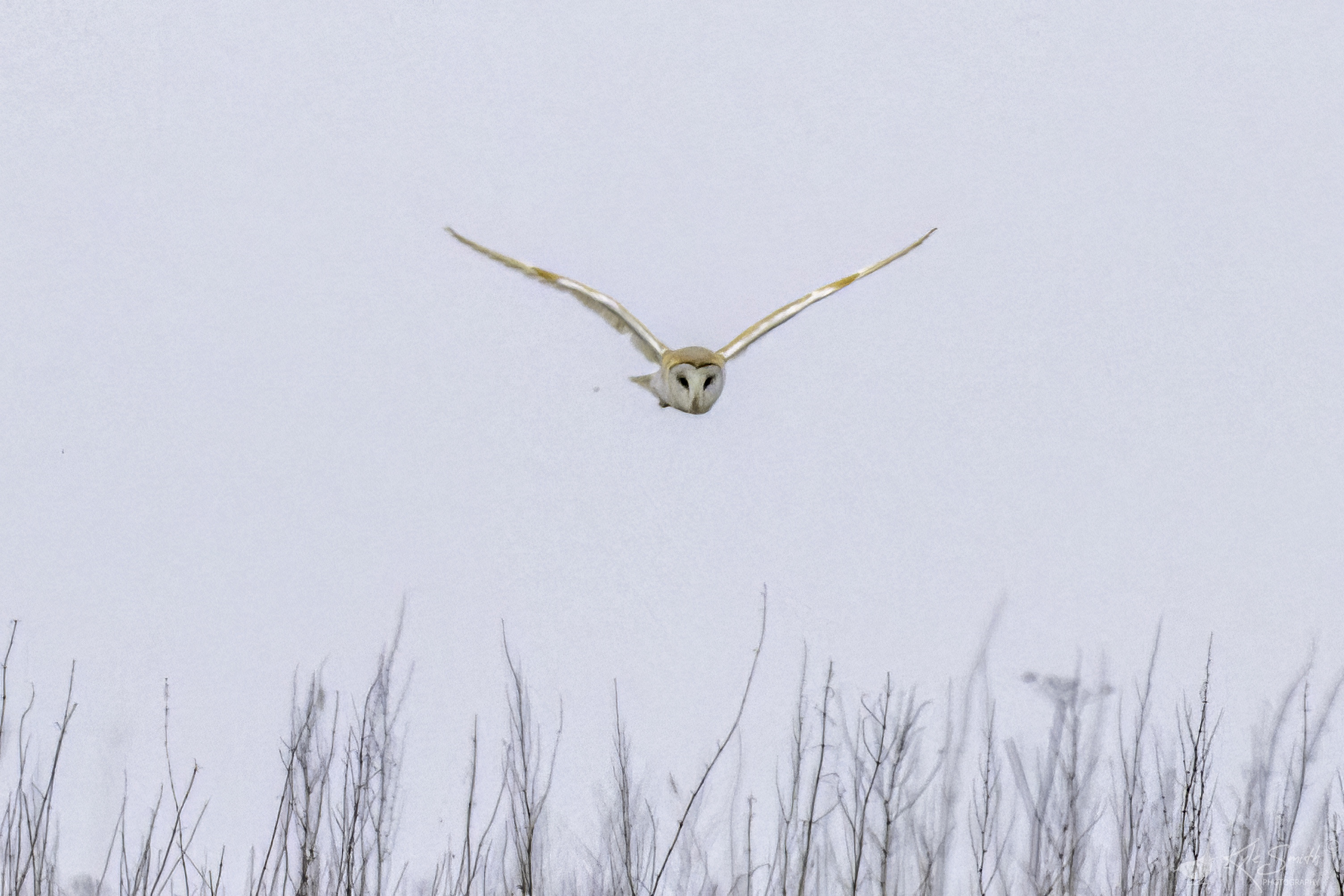
We began scanning the landscape, picking up whooper and mute swans, a couple of common cranes, flocks of greylag and Canada geese, and scattered lapwings. After around 30 minutes, a barn owl finally appeared from the left, flying across in front of us towards an area of longer grass. As it reached the broken hedge line separating the two areas, a kestrel burst from a nearby tree and gave chase, forcing the owl to dive for cover into a hole in a bush. The brief interaction was quite spectacular. The kestrel circled once before perching in a tree off to our right, while the barn owl soon re-emerged and began hunting over the scrubbier ground before being lost from view.


We continued to watch the barn owl intermittently at greater distance, passing the time chatting with some of the locals, who were very friendly. One told us that there was more than one short-eared owl in the area, though they weren’t always all visible, and sometimes not at all. He mentioned that one would occasionally drop onto a post off to the left and even showed us a video of just such an encounter. These owls clearly weren’t the only species he'd videoed. He also shared an extraordinary video of three owlets emerging from a tree hole - the sort of footage you suspect you’ll never top. While we waited, we were further entertained by several Chinese water deer feeding in the field in front of us, seemingly everywhere and, in this area at least, appearing to outnumber the muntjacs.


A short while later, the local we’d been chatting with suddenly alerted everyone to a short-eared owl that had dropped onto a post to our left. The bird sat scanning the surrounding fields, slowly rotating its head as it took in the landscape. It remained there for a couple of minutes, long enough for us to fully savour the moment - what a bird.
I rattled off a few photos and then decided to try for some video, opting to shoot handheld, unsure how long the owl might stay. Within thirty seconds it dropped from the post, flew across the fields and disappeared behind a line of trees, not to be seen again.


We waited a little longer, but with the light beginning to fade and a three-plus-hour journey ahead of us, we eventually packed up and said our goodbyes. We stopped for dinner at a pub on the way home, the same one our friends Adrian and Bryan often use when passing through Northampton - a fitting end to another cracking day out in excellent company.
Year list: 149.