Sunday, 3 September 2017

Grimsbury Reservoir :: 28 August 2017

It was a beautiful Bank Holiday Monday morning and we were due to be having a BBQ lunch with friends. It seemed to be a shame not to take advantage of such nice weather so I picked up my things and headed off to Balscote Quarry; in the back of my mind I remembered a reported sighting on the Oxon Blog a couple of days before.

As I sat down at the screen I could see that the water has dried up completely and that the feeders are not currently being filled. The site appeared to be virtually bereft of any life, until Roger Evans and a companion walked across the main body ... they appeared to have spotted something but it was not visible from my vantage point. I decided to move on to Grimsbury Reservoir instead as at least I'd have a walk.

Parked the car and the area appeared busy but I suppose this was to be expected on a Bank Holiday when the weather was good. Some people were fishing the river near the entrance and there were numbers of large dragonflies quartering the water along the reeds. I didn't stop and circled to do a clockwise rotation of the reservoir.

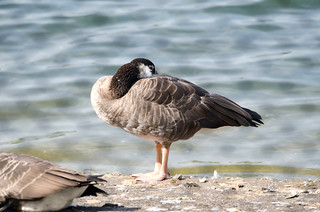
It was noticeable that there were more people than usual, in around half a dozen groups and I could see there was a very substantial number of Canada goose x greylag goose hybridcanada geese on the far bank (counted c.225). I looked along the hedgerow for the redstart seen the previous day but with no success. I stopped to talk with another birder and he hadn't seen it yet either, despite having seen it the day before and knowing where to look. He did say that he had seen a juvenile hobby in the adjacent field but I didn't see that either.

Continuing round I did find good numbers of long-tailed tits and chiffchaffs. and small flocks of linnet.

Sightings (11) included: black-headed gull, canada goose, carrion crow, chiffchaff, lesser black-backed gull, linnet, long-tailed tit, mallard, pied wagtail, woodpigeon and wren.

Saturday, 26 August 2017

Seamill and Portencross :: 23 August 2017

Visiting our Scottish family, we managed to spend a few hours between the Clyde Marina in Ardrossan, Seamill, and Portencross beaches.

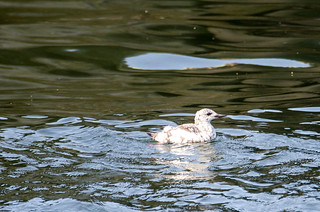
Unfortunately the brook running down the side of our hotel, the Seamill Hydro, has had wok done on the wall and this has changed the structure of the bed. No sighting of dipper this year. Black guillemotFrom the end of the garden I did get excited when I saw a black and white bird offshore but when reviewing photos I could see that is was only an eider in eclipse.

Along at the Clyde Marina we were happy to see shag and two black guillemots [154]. It is amazing that I see these in this little harbour almost every summer.

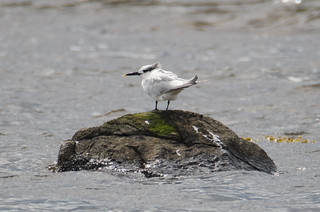
From Portencross beach we looked across a field contain a large mixed corvid flock of carrion crow, rook and jackdaw. As I scanned across I came across the welcome sight Sandwich ternof a single hooded crow [155] - I haven't seen one of these on this part of the coast before.

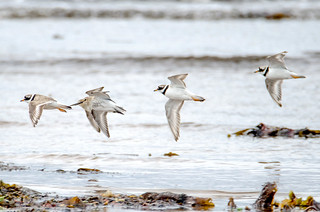
Progressing along the shoreline we didn't see anything significant until we reached the corner of the outcrop. Here we saw half a dozen sandwich terns [156] and a large mixed flock of circa 200 ringed plover [157] and dunlin, predominantly ringed plover. On closer inspection a handful of sanderling were mixing in.

Returning to the car we spotted common gull and ringed plover Ringed plover and dunlinon the shoreline, again joined by a couple of sanderling. Linnet cruised the edge of the golf course as did a small flock of house sparrows.

Sightings on the coast (30) included: black guillemot, black-headed gull, carrion crow, common gull, cormorant, dunlin, eider, gannet, goldfinch, great black-backed gull, herring gull, hooded crow, house martin, house sparrow, jackdaw, lesser black-backed gull, linnet, magpie, manx shearwater, oystercatcher, pied wagtail, ringed plover, rock dove / feral pigeon, rook, sanderling, sandwich tern, shag, starling, swallow and woodpigeon.

Saturday, 19 August 2017

RSPB Ramsey and Grassholm Islands :: 15 August 2017

We started with an early breakfast at the East Hook Farmhouse B&B where we were staying, then off to the RNLI Lifeboat Station at St Justinians, near St. Davids.

Our boat left for Ramsey (Ynys Dewi) at 10.00am and was packed. The sun was our, there wasn't much of a breeze, and the crossing was easy. Such a change from the day before (and the day after). On landing we had a brief talk from the RSPB volunteers, mainly about the key species and the options for trails. With only one toilet on the island, and everyone there carrying binoculars and cameras, everyone opted to go for a visit before setting off - a queue for the ladies as usual.

We opted for the north circuit as we could then decide on Choughprogress as to whether to loop round on the south circuit later - we had a 2.30pm boat to catch for our visit to Grassholm. Soon after we set out we had our first tick; a number of chough [151] were feeding in the fields but remained at arms length. Good numbers of wheatear showed as we walked parallel to the perimeter wall. We had considered not climbing to Cam Ysguabor but when we got there we decided to make the ascent. To the right I saw stonechat and amongst the usual butterflies, I added Wall. We started to really appreciate the views afforded from the tor.
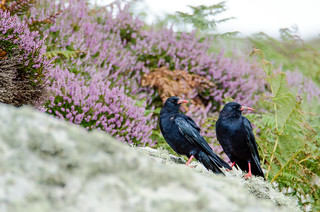
We dropped back down to Aber Mawr and from Wheatearhere watched ravens, fulmar [152], chough and herring gulls soar around the cliffs. Common seals also swam in the shallows below.
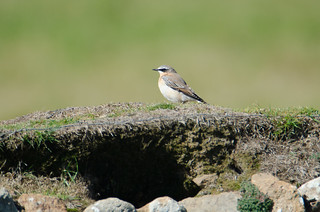
We continued along the trail and at the foot of the hill to Carn Llundain we stopped to eat our sandwich lunch. Wheatears and meadow pipit flew around us; the occasional chough soared by, usually calling loudly.

As we reached Porth Lleuog, Charlotte and Ailsa opted to take the short cut back across to the harbour for a cup of tea while Eilidh and I continued onto the south circuit; that decision was proved to be the correct one when we approached the bay across to Ynys Gwelltog - what a sight! We had more views of wheatear, mipits and chough plus an increasing number of butterflies including gatekeeper and common blue.
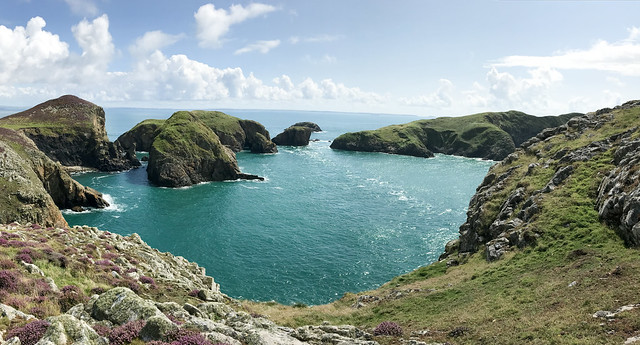
RSPB Ramsey Island

We turned for the harbour passing Foel Fawr hoping to see the harbour porpoises that are sometimes views from this stretch, but without success.

We met up with the others at the farmhouse and shop, and waited for our next ride to arrive. Just a few minutes late we climbed onto our jet boat which was due to take us out to RSPB Grassholm, some 7.5 miles offshore. Nice and steady as we started out on Manx shearwaterRamsey Sound but as we accelerated into the now stiffening breeze, we started bouncing in our seats as we hit each wave; the water often blowing directly into us as we landed - I'm not sure this was Eilidh or Ailsa's favourite bit.
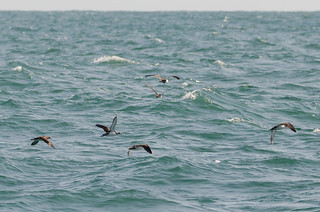
As we got further out to sea we started to see groups on manx shearwater - on occasions they flew alongside the boat and it was tempting to take a photo - not really possible due the motion of the boat. We also picked out some guillemot and common tern. As we approached Grassholm the numbers of gannets grew - we then talked with our crew and were told that around 39,000 pairs of gannet bred on the island this year and that the numbers keep growing. We also saw good numbers of kittiwake on the cliffs.

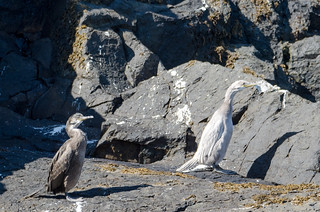
We circled the island and on the far side we came across some shag; Albino shagone of these, in amongst the juvenile group was an albino, something our crew said they hadn't seen before.
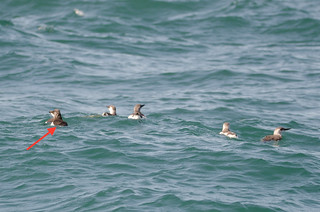
Finishing up at Grassholm we started back but soon came to a stop as we came across a group of common dolphins. They swan around the boat but as we left they unfortunately didn't follow in the bow-wave. The journey back was much smoother and it was possible to stand for some of the way. Along with the manx shearwater were increasing numbers of guillemot. I took some photos and noticed to my surprise that I'd caught some juvenile razorbill [153] too.

As we approached the halfway point I Guillemot and razorbillnoticed some fins int he water to our left and we swung round to see what it was - Risso's dolphins - a new species to me. Much less friendly that common dolphins we circled for around 10 minutes watching their various dives, presumably looking for their favourite squid meal. Infants are dorsally grey to brown and ventrally cream-colored, with a white anchor-shaped area between the pectorals and around the mouth. Linear scars mostly from social Risso's dolphininteraction eventually cover the bulk of the body. Older individuals appear mostly white.
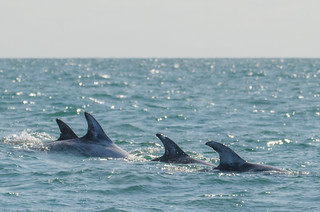
What a great end to our day!

Our sightings (24) included: carrion crow, chough, common tern, cormorant, fulmar, gannet, great black-backed gull, guillemot, herring gull, jackdaw, kestrel, kittiwake, lesser black-backed gull, linnet, manx shearwater, meadow pipit, oystercatcher, raven, razorbill, rock dove / feral pigeon, shag, stonechat, swallow and wheatear.

Sunday, 6 August 2017

RSPB Otmoor :: 05 August 2017

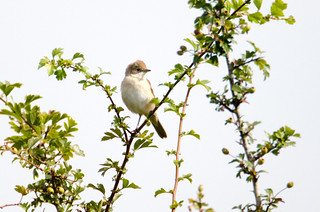
This trip to RSPB Otmoor had been postponed a couple of times lately - firstly for the green sandpipers at WkWT Brandon Marsh and then the ruddy shelduck at Farmoor Reservoir. WhitethroatHoping that this wouldn't be too late or prove difficult, I set off early to make sure I got a couple of hours before the forecast showers set in.

Leaving the car park I could hear turtle dove over the hedgerow running up the Roman Road. I stopped and considered whether to look for a view but decided to push on. As I walked up Otmoor Lane and passed the entrance to the Rifle Range, I saw what I first thought was a collared dove; on closer inspection it turned out to be a turtle dove. Unfortunately it flew up and to quite a distance, feeding along the drive, outside sensible photo territory.

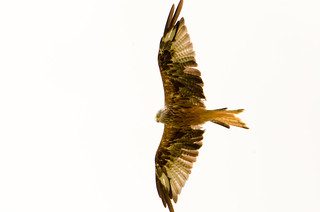
Red kiteThe entrance to Long Meadow is immediately after this gated entrance and advertised by a yellow arrow footpath sign - a very low stile gives access to the meadow proper. A good number of birds were making good use of this hedgerow, including two green woodpeckers who flew up and into the trees above.

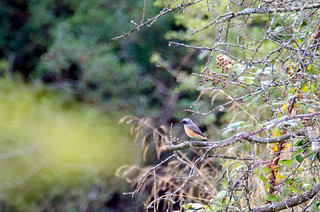
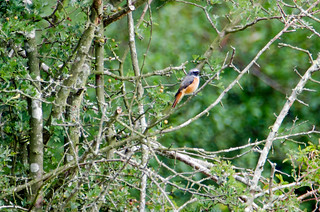
Sightings of redstart I heard were towards the far end of the meadow beyond the old brick stop-butt so I set off, keeping an eye for movement in the odd bush scattered ahead. Muntjac deer showed and moved right into the trees and to my right I could hear two tawny owls calling; nothing immediately visible to I continued on. As I came into range of the brick stop-butt I saw a bird drop into the grass from a bush then as I got my binoculars on it I was sure I saw the flash of colour indicating restart. Not close enough to be sure. I waited for a while on the far side of the stop-butt but with no success so walked on from here to a denser grouping of bushes ahead. I saw three birds fly in to the bushes to my left and quartered around to see if I could get a view. Yes, male redstart [#145]. RedstartRedstartQuite distant for a photo but a tick. A couple of minutes later it showed again but then everything went quiet - I did find a big group of goldfinch feeding on the seeds of wild flowers on the field fringes.

I doubled back the the stop-butt but nothing immediately evident. As I turned to go (the skies beginning to darken) I caught a glimpse of the tell-tale colouring rising from the grass again. I stepped back and then heard a male call and although at distance, managed a couple of photos. Difficult to get close to these birds and they seemed to be on the move or hidden.

Red kite over as the rain started to fall and I hastely returned to the car. As I got to the car park a group of birders who had been out on the wetlands seemed to have the same idea as me and were all back to get out of the showers.

Sightings in Long Meadow (17) included: blackbird, blue tit, bullfinch, carrion crow, chaffinch, dunnock, goldfinch, great tit, green woodpecker, long-tailed tit, magpie, red kite, redstart, turtle dove, whitethroat, woodpigeon and wren.

Saturday, 29 July 2017

Farmoor Reservoir :: 29 July 2017

Decided to visit Farmoor Reservoir and see if I could catch up with the ruddy shelduck. A bacon butty set me up for the morning - Charlotte and I were on site by 9.20am. By the cafe we started with two Egyptian geese, coot and mallard. Which way to go? We couldn't see any birders around so opted to take the causeway first and hope to bump into someone.

Common term were fishing left to F2 and no long after we set off, a hooter sounded and around a dozen boats carrying two fishermen each steamed out. That might make some of the birds mobile.

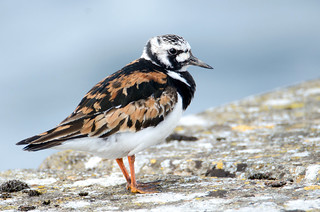
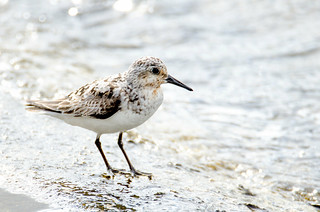
Soon a turnstone could be seen on the left wall - Turnstonegot a couple of photos before it hopped down onto the waters edge. As it did so, I saw another bird run ahead of it; it turned out to be a sanderling [#143]. I spent a bit of time following the sanderling up the causeway while Charlotte checked out the hide. Eventually the sanderling flew back passed me, and I doubled back. I then had sanderling, turnstone, common sandpiper and dunlin.

Just as we approached the end of the causeway we chatted to an birder who had caught us up and when I asked about the shelduck he suggested it might not be there as it hadn't appeared in the early morning reports; if it was there he suggested it would be on F1. We then had common tern land on a buoy right.

We dropped down to the Pinkhill Reserve only to find that, Sanderlingdue to antisocial behaviour, the hide was locked. Bugger. We did enjoy the walk and sight of large quantise of quince fallen on the paths. We returned back onto the perimeter path and quickly checked round F1 - no obvious sighting of the shelduck and so opted to complete the circuit round F2.

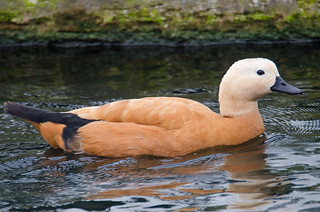
Passed a couple of (juvenile?) female red-crested pochard and stopped to watch a fisherman land a sizeable rainbow trout. As it was netted we talked with a birding couple passing in the opposite direction - the shelduck was indeed on F2 and not far ahead. Close views of the ruddy shelduck [#144] allowed some decent photo opportunities.

Not far left we had a hobby high right then some Ruddy shelduckjuvenile willow warbler in the trees. Another, or one of the previous Egyptian geese was feeding on the grass with a group of greylag geese.

We then decided to have a coffee in the cafe before heading home.

Today's sightings (35) included: black-headed gull, blackbird, blue tit, buzzard, carrion crow, common sandpiper, common tern, coot, cormorant, dunlin, Egyptian goose, great black-backed gull, great crested grebe, great tit, greylag goose, hobby, house martin, long-tailed tit, magpie, mallard, mute swan, pied wagtail, red-crested pochard, robin, ruddy shelduck, sand martin, sanderling, starling, swallow, swift, tufted duck, turnstone, willow warbler, woodpigeon and yellow-legged gull.

Sunday, 23 July 2017

BOS Bicester Wetland Reserve :: 23 July 2017

Got in touch with the BOS Warden for the Bicester Wetland Reserve and he offered to show me round this morning. A good result, other than meeting at 8.30am - this week's lie in gone :-)

Disturbance to the reserve is kept to a minimum by viewing from hide or screen. Bicester Wetland Reserve is managed by the BOS on behalf of Thames Water. This is a member-only site due to the hazardous nature of the site, heavy moving equipment and hazardous areas. Created in 1999, Bicester Wetland Reserve was the result of an agreement between the BOS and Thames Water. The 7ha site was previously used for the disposal of sewage sludge from the nearby sewage treatment works. Channels and scrapes were excavated with supporting bunds and water control mechanisms.

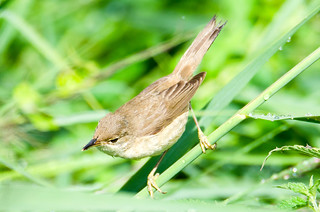
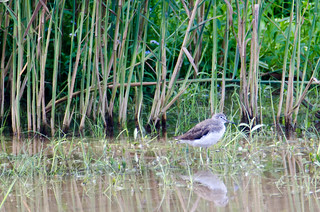
Arrived on the dot and met Alan Peters at the foot of the Tower Hide. Reed warblerWe climbed the steps and he explained how the key system worked. We watched as 7 green sandpiper fed at a distance. We had a fly-by from a kingfisher and then Alan spotted a snipe wading from an island to the bank.

Alan then took me across a stile and onto the rest of the reserve. We passed a swallow nesting tower which has, as yet, not been used. A number of goldfinch, dunnock and whitethroat flew ahead of us and onto the left fencing as we went.

We reached a field with a kestrel nest box on the left and crossed to a new gate and fence, running alongside the train tracks. Alan explained that they are going to plant a large number of whips along this boundary to replace hedging removed when the train line improvements were done - this should provide a screened access to the new hide at the end of the field.

A pheasant briefly caused some excitement. Green sandpiperThe farmer, who grazes 8 cattle in the field for management purposes, joined us in the hide for 5 minutes or so and chatted about the little owls seen along the far hedge. Alan was running a tight schedule so we left and returned to the cars. We drove to the gate where I was instructed on the padlock system used. Alan then left and I returned to the Tower Hide for half an hour. Had good sights of wren, reed warbler, blue and great tits plus a noisy arrival from a dozen canada geese.

A pleasant first visit and now that I have a key, I'll be back.

Sightings (22) were: blackbird, blue tit, carrion crow, dunnock, goldfinch, great tit, green sandpiper, grey heron, house martin, kingfisher, little egret, magpie, mallard, moorhen, pheasant, reed warbler, robin, snipe, tufted duck, whitethroat, woodpigeon and wren.

WkWT Brandon Marsh :: 22 July 2017

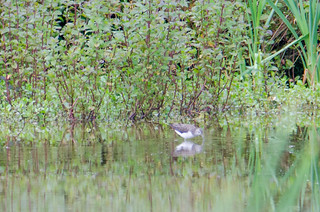
Dropped into WkWT Brandon Marsh again to see if I could get a longer and better view of the green sandpiper. Not starting so early this week and so Charlotte came along too. Arrived before the Visitor Centre opened and so walk round the back and off round Grebe Pool. Suspected I saw a pair of garden warblers playing in the bushes but through substantial foliage - later confirmed from my photos. As we got into New Hares Covert we stopped and individually saw treecreeper and buzzard. As we exited onto Swallow Pool we were entertained by a whitethroat. At this point Charlotte had something in her boot and so we pushed on to the Wright Hide. From here we could see a couple of sand martins being fed by parents in the nest wall. Many more lapwing to be seen too.

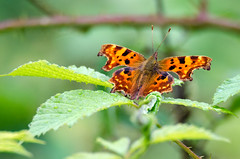
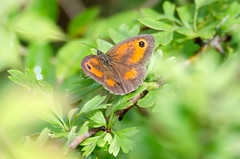
Considering the time of day, the butterflies were out in number. There has been a noticeable emergence of gatekeeper. Also enjoyed the meadow brown, small tortoiseshell, red admiral, comma and various whites plus a male banded demoiselle.

Comma butterflyGatekeeper butterfly

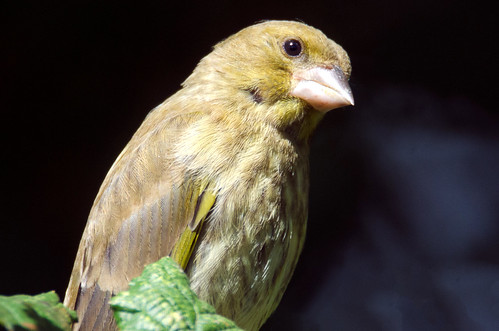
Greenfinch

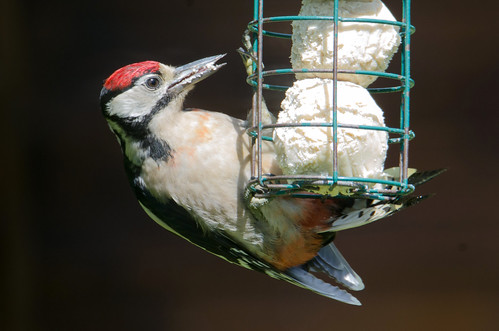
We decided to turn back to the Visitor Centre for a coffee and while there had good views of many fledgling blue and great tits. We also had greenfinch and great spotted woodpecker.

Great spotted woodpecker

Knowing that the rain would come at sometime before lunch we pushed on and stopped in the Teal Hide; from here we could see three green sandpipers. Mission accomplished. Charlotte then spotted a hobby hunting for dragonflies over the seedbed in the distance.

Nothing additional to be seen in the Green sandpiperEast Marsh Hide we stopped to look in the Carlton Hide - nothing at all ... to reward our patience a reed warbler showed briefly. Finally into the Ted Jury Hide but again pretty devoid of any views. Shame ... I think I'll wait for a new arrival before visiting again.

Sightings (39) included: blackbird, blue tit, bullfinch, buzzard, canada goose, carrion crow, chaffinch, common tern, coot, dunnock, garden warbler, goldfinch, great spotted woodpecker, great tit, green sandpiper, green woodpecker, greenfinch, hobby, jackdaw, lapwing, long-tailed tit, magpie, mallard, moorhen, mute swan, oystercatcher, pied wagtail, reed bunting, reed warbler, robin, rock dove / feral pigeon, sand martin, sedge warbler, song thrush, swallow, treecreeper, whitethroat, woodpigeon and wren.