Wednesday, 24 January 2024

Long Itchington & Farmoor Reservoir :: 17/18 January 2024

I was sitting watching BBC Winterwatch when I got a message from one of my work colleagues - he said his wife had asked if I had seen any waxwings this year - on the programme they had been discussing that this was a 'Waxwing Winter'.

When large numbers of waxwings migrate to Britain, sometimes in flocks of hundreds, from their summer breeding grounds in Scandinavia and Russia, the birds are often easily spotted in carparks around our towns and cities where ornamental rowan trees bear their favoured berries. It isn’t every year that we see these birds in large enough and widespread numbers to constitute what is known as a ‘Waxwing Winter’ but this year has been one of those years.

The large arrivals of Waxwings seen in mid-winter are thought to belong to the Fennoscandian breeding population. Their breeding season is relatively late with egg laying beginning in May. Their predominant diet in summer is insects, switching to fruit and seeds in the winter and it is this reliance on fleshy fruits that drives them to range away from their breeding grounds.

I'd previously visited Brandon Marsh on reports of up to twelve waxwings at the entrance, but they had departed before I arrived. I had also visited Long Itchington but with limited time hadn't connected with the birds. So, with a couple of days off to attend a friends birthday celebrations I found myself with a few hours where I could make a better go of it - they are worth making the effort for.

I awoke at my usual time for work and jumped into my clothes and left without breakfast and made my way past the office and to Long Itchington. I parked up and found that I was the only birder there - reports have dropped off as the locals have all seen the birds - in flocks of three to fifteen. I started my search up and down the main road, and down to the canal where I'd heard of reports before - nothing. There had also been reports of the bird down past a layby and near some pools and so I extended my search area but found only winter thrushes.

I searched for an hour and a half, deciding to try again closer to where I'd parked the car - on the way back up the slope I found c.14 waxwings hanging out in a large tree on the opposite side of the road feeding on some berries in the base, occasionally flying off and returning - always leaving a few individuals behind. Lovely to see.

Waxwing
Waxwing
Waxwing
Waxwing

Success and great views of these special birds - ideally, I'd have waited for better light as the day and sun got into full swing but I was on the clock. I decided that I was close to Draycote Water and so on the way home dropped in to see the black-throated and great-northern divers (both at extreme distance) and bonus goosanders. I couldn't spot the common scoter that had been reported but I had seen rafts of these off Stevenston Point a couple of weeks ago and so while it would be nice to see an inland bird, it wasn't critical.

As I watched one male goosander it dived, returning to the surface with a perch. It began to shuffle the fish round so that it could eat it headfirst, avoiding issues with the spiny and sharp dorsal fin; located in the middle of the back, it is divided into two sections; the front section is spiny and the rear section is soft rayed. Bizarrely, great-crested grebes were also new for the year.

Goosander
Goosander
Great-northern diver

Having returned from our party and overnight stay at late lunchtime, Charlotte said she was going to watch tennis from the Australian Open and so I slipped out to connect with the scaup and great-northern diver at Farmoor Reservoir. The sun would be dropping when I was there, but these birds usually give good opportunities for photographs. There was also the possibility for knot that had been reported over recent days.

I made my way across the causeway between F1 and F2, stopping to chat with a birder coming the other way - he confirmed that the scaup was in its favoured place and that the great-northern diver was out in the middle of F2 and travelling great distances on each diver and so could end up anywhere. I reached the scaup and it gave immense views, as always. No sign of a knot but a year tick for a common sandpiper - I do have a photo but rather frustratingly I took the photo with a very odd aperture setting - must have spun a dial inadvertently.

Scaup

I set about scanning for the great-northern diver and located it back down the causeway, but some way off. I made my way down to find it had travelled towards the western end and back round the corner to where I had been standing. I returned and managed to get several photos, some in the shade and others in the low sun. Such a lovely bird.

Great-northern diver

I saw the common sandpiper again, but it was very flighty, and I couldn't get an angle to take a front or side on photo so didn't bother - I already had a record shot. A short but productive visit and in the end both birds showing well.

Sunday, 21 January 2024

Heybridge & Bradwell-on-Sea :: 13 January 2024

Having returned from a short holiday in Scotland almost a week before, I was relieved to see that the Northern waterthrush had stayed at Heybridge, Maldon in Essex. It had been a very popular bird, primarily due to it being the eighth recorded in Britain - seven previous records between 1958 and 2019. This is a first for Essex, only the third mainland record, and the first British record since 2011.

It breeds in the northern part of North America, in Canada, and the northern United States. It is migratory, wintering in Central America, the West Indies and Florida. It is a very rare vagrant to other South American countries or to western Europe. It likes "swampy or wet woods" as habitats but is more commonly seen in tropical climates during the winter and actually resembles a large pipit rather than a "thrush" - maybe a dwarf redwing … without the red. Typically it feeds on insects and other small invertebrates on streams or pond edges.

Kev @kev07713 and I knew that visiting on a Saturday we'd encounter more people but there had been opportunities the previous weekend and over the sunsequent five weekdays - we left early to ensure that even after a stop for breakfast we'd be there by 7.00am, with sunrise scheduled for 07.59am. Kev had visited more than a week before while I was away but understood this was a bird I'd like to see - hopefully we'd be able to make later plans based on what else was reported in the area that morning.

We arrived to find hordes of people already in place - around 200 at a quick estimate, with more trying to view from the other end of the creek - mayhem. We joined on the lefthand edge only to discover that you couldn't see the creek at all from here and so pushed through and knelt in the mud in front of the line of scopes, and behind people sitting on the grass. I put down my gloves to try and limit the damage to my trousers - this turned out to be a futile exercise and simply resulted in more items to wash when I returned home. At least we had a view from here.

At 07.26am the crowd's attention was raised when the bird was spotted halfway down the creek - it took me a while to latch on but then I had my second life tick of the year. I used my camera to follow the bird as it was much brighter than the current conditions - I tried to take a few photos but my settings meant that the shutter speed was too slow. The bird fed up and down the channel eventually venturing right up to the sluice - the closest position it could be to us. Now I encountered a new issue - I had the camera set for crop instead of full frame and it was increasingly difficult to follow the bird as it walked, hopped and flew across the water and from perch to perch. I switched out and managed to fire off a few shots before the bird flew back along the creek and out of range. Shortly after it flew right out of the creek and into the reeds beyond. It was now 08.15am and we'd had good views so decided to move out to give those that had been less fortunate than ourselves a chance to view - a dozen or more people around us did the same.

Northern waterthrush

As we left, we bumped into Penny @FegWitch and Ann, stopping briefly for a chat with them and two of their friends. They were going to Abberton Reservoir with hope of the canvasback (not been reported for a couple of days), the smews and a possible Slavonian grebe. We now looked on our phones and opted instead for a trip over to Bradwell-on-Sea to try for the red-breasted goose (another species I hadn't seen in 2023). We said our goodbyes and made the journey of just over half an hour.

We arrived, and Kev said that he'd been told that the bird was likely to be a 2-mile walk out to where the main brent geese flock were feeding. Our target was a first-winter bird but worth the visit. The red-breasted goose is native to Eurasia and is a relative of the brent goose, despite its appearance. It is threatened by habitat loss and has been in decline over the last few decades to the point it is classed as endangered. They breed in Arctic Siberia and usually spend their winters along the shores of the Black, Caspian, and Arial seas. They are typically found on riverbanks, flooded fields, wooded tundra, lakes, and marshes.

We set off down the track and saw a couple of birders down on the edge of the Saltmarsh - we'd likely be following them along - to our left was a flock of brent geese but it didn't contain our bird. With them were a handful of lapwings. When we got closer to the church (the Chapel of St Peter-on-the-Wall), we met the birders coming back up the track - apparently the walk had put them off and they were going to give it a miss (they'd heard it was 3½ miles to the bird while my maps suggested 2½) - Kev said he hoped it would be the latter. Looking out over the bay from the church we could see more brent geese, knot, dunlin, curlews and more. Kev piped up and said there was a short-eared owl perched on a post and when I got my bins on it, it was a gnome - oh he thinks he is very funny.

Gnome

Walking along the path Kev called a harrier and as it was flying away from us, we couldn't be absolutely sure of the species - with the grey it may have been a male hen harrier - we will never know. We joined up with a few other birders that had been catching us up - one had just seen a male hen harrier ... we added views of both male and female marsh harriers. After around 1½ miles we came to a bend in the path and out in front of us was the main brent flock, feeding and swaying back and forth from left to right. It was quite difficult to pick out the red-breasted goose from the others, but easier on the scope. I considered taking a photo but away from the scope I always lost the bird. After a few minutes our bird made it to the front and I had much better views on the scope - this was my chance - I got a line and raised my camera as the flock took off, whirled around a couple of times, and landed a couple of fields away. Fortunately, Kev got some video and below is a screen grab from one of those.

Red-breasted goose
Copyright and courtesy of Kevin Heath

There was a cold breeze and we realised we'd need to move on to stay warm. We started back and a couple of birders strode out, leaving us behind while we followed another and out into the Saltmarsh - much closer to the shore. Once at the closest point we could pick out many more of the species on the water and shore: dunlin, knot, bar-tailed godwits, oystercatchers, grey plovers, pintails, red-breasted mergansers, turnstones, and more. Quite a few year ticks amongst us.

Our companion said goodbye and made his way along the track at a fair pace while we took it steadier. We were watching the passing waders when a ringtail/female hen harrier came into view along the edge of the Saltmarsh and where it meets the shore. We watched it quarter the area but purposefully making progress from our left to right. We had excellent views and were warmed by the experience - the cold couldn't touch us now.

Hen harrier
Hen harrier
Hen harrier

We joked that we would find a merlin on one of the posts dotted across the marsh but never did, although we had more views of marsh harriers. Eventually we made it back onto the main path and started back towards the church.

In the distance flocks of waders sparkled in the sky, as they often do in sunlight and when numbers are in the thousands. Movement at the edge of my field of view caught my attention and as I scanned there was a merlin acrobatically attempting to capture a small bird. Thankfully I managed to get Kev on it to see the action - wow, that was special. All distant but a feast for the eyes through our bins. We continued on and spotted the merlin perched in various bushes and scrub - at one point it took to the wing, flew along the shore and then up high, only to be lost right. With distance and the sun, it was hard to get any sort of record shot.

Merlin

We continued and noted the flocks of knot and dunlin on the shore - part of the flock that we'd seen earlier no doubt. In the field to our right, we saw a dozen or so golden plover, and a pair of stonechats.

Knot and dunlin
Golden plover
Stonechat

We stopped and visited the church to find out about its history. The Chapel is open during the day to visitors and in the summer, they hold a 09.00am Communion service on the last Thursday in the month and every Thursday during July and August. During the winter months services are less regular - the website provides details.

In AD 653 St. Cedd had sailed down the east coast of England from Lindisfarne and landed at Bradwell, finding the ruins of an old deserted Roman fort. The Chapel is said to be that of "Ythanceaster" (Bede, Historia Ecclesiastica), originally constructed as an Anglo-Celtic Church for the East Saxons in AD 654, astride the ruins of the abandoned Roman fort of Othona.

In June 1916 the Parker family who owned the chapel gave it to Chelmsford Cathedral. In 1920 it was restored and re-consecrated. Soon after this the annual pilgrimage started at the beginning of July each year. The day-to-day maintenance and care for the chapel has always been carried out by the parish church, whose Rector was Chaplain until 2010. In 1959 it gained the Grade I listed status.

The first altar was made from oak beams from Chelmsford Cathedral that was being restored at this time. This was replaced in the 1980s when a new stone altar was installed with stones from Iona, Lindisfarne and Lastingham.

On the track back up to the car we were stopped watching lapwings in the field, with pied wagtails over, when we heard a strange call - corn buntings. It took only seconds to locate two sitting atop some trees back down the path - one continued to call but all too soon they were gone. Kev insisted that I should have jumped on the scope for a better look - I had photos ...

Corn bunting
Corn bunting

Tuesday, 16 January 2024

A New Year :: 01 - 07 January 2023

Happy New Year to you and yours! It is the start of a new year and New Year's Day found Kev @kev07713 and I meeting up at RSPB Otmoor for a wander round early doors. I had to be back by lunchtime for my daughter finishing her shift at work, while Kev could stay later and so we travelled separately. Once on the reserve we saw many of the usual species and kicked off our year lists with 51 species, Kev adding a couple more along the bridleway and Roman Road. Nothing of particular note and no outstanding photos

The following day Alan Boddington reported seven waxwings at the main entrance gate to Brandon Marsh near Coventry. They were reported at 9.51am and I was on the road about an hour later. On the way the roads were wet but as I turned down Brandon Lane the road was completely under water - a car was at the other end of the ‘puddle’ wondering what to do. In fact it was easily passable for now and so I drove through carefully and turned down for the reserve, stopping to see if I could locate the waxwings in the rain. None.

I checked WhatsApp to find a message "Final Waxwing total before they flew was 12". Damn. I made for the Visitor's Centre to see if there was any news - no one else around. They were closing the Centre before the roads became impassable - on my way out I added jay to my year list as two flew over. My first dip of the year - I'm sure there will be more. On the way home, just outside Marton, two puddles had almost met in the centre of the road but now on the way back they had joined, and the water was now almost 9 or 10 inches deep - fed from water coming down the slope on the right. In many ways going home now might be the best thing that could have happened – it is possible the road could be closed.

Wednesday saw us driving to Scotland to see my mum and brothers - an extra week off work. With reports of white-tailed eagle on Hunterston Sands on Boxing Day I'd asked my mum to keep it there until I arrived - hopefully I'd find something in the area. When we arrived, I looked on Birdguides to see what had been reported and over a late lunch up popped a glaucous gull on the pool by Auchenharvie Golf Course and then on the roof at Dunbia Highland Meats. The light was dropping as we checked into our hotel and so there was no point going now.

The following morning sunrise would be almost 08.50am and so it was after breakfast before we set off, arriving at Stevenston Point. With guillemots, razorbill, a raft of very distant common scoters, a red-throated diver and more on the water there were a few good birds but all very distant. As I scanned on my scope another birder arrived, and I asked if he'd been to Saltcoats - the glaucous gull had been reported not long before. He confirmed that it was he that had posted the sighting and confirmed the bird was back on the roof of the factory. Charlotte and I packed up and made for Saltcoats - a glaucous gull would be a lifer.

We parked at Auchenharvie Golf Course and while Charlotte stayed in the car, I walked down the path to the meat factory and met another birder scanning the pond and then the roof of the factory. I joined in and we worked along the roof but couldn't locate our bird - the other chap said that he was going down to Ardrossan harbour to tick purple sandpipers for his year list but would return and perhaps the bird would be back.

I walked further along the path to find there were more roofs and within a couple of minutes had spotted the glaucous gull. I excitedly dropped my scope on the tarmac of the factory car park and was quickly approached by a security guard that asked me to return to the perimeter of the site - only reasonable. As I repositioned the gull dropped onto the ground and it was then I could see quite how big it was! - a very large (the second biggest gull in the world), pale gull - up to 77 cm in length and can span 170 - 182 cm across the wings.

Adults are mostly white with a very pale grey back; pure white wingtips. Juveniles (as this one) are white or pale tan with light brown markings and again no black on the wingtips. It breeds in the High Arctic, winters farther south in a variety of habitats - rarely far from a large body of water - and often seen mixed with flocks of other large gulls. They eat virtually anything, from small rodents to seabirds to starfish, as well as fruit, insects, carrion, and rubbish - here it was hanging around the abattoir/processing facility looking for scraps - to be fair, there were a significant number of gulls doing the same.

The glaucous gull returned to the roof and occasionally flew a circuit around the facility. It was interesting to see the bird against the other species (often thought to be large themselves).

Glaucous gull
Glaucous gull
Glaucous gull
Glaucous gull
Glaucous gull
Glaucous gull
Glaucous gull
Glaucous gull

Another birder turned up to take photos and we had a nice chat as we watched - he mentioned that there was a reliable spot in Saltcoats for purple sandpipers, one of my target birds along this stretch of the coastline. Once we'd had our fill I headed back to the car and announced to Charlotte that I wanted to make one more stop - we made our way along to the area suggested but in the short time I had I didn't locate any sandpipers. I did have great views of a seal basking on the water's edge. Ringing records show that purple sandpipers are remarkably faithful to wintering sites, with individuals returning to the exact same stretch of coast year after year; they'd likely be here somewhere.

Seal

Back at my mum's house rather a lovely mistle thrush rested in top of one of the fence posts, with song thrushes keeping it company.

Mistle thrush

The next morning we had breakfast and I asked we return to Saltcoats - I'd had some conversations with some locals on social media and they'd clarified where I should be for the sandpipers. On arrival a turnstone fed on the grass between the beach and the children’s play area, but I wasn't stopping here - my quarry lay elsewhere. I walked to the pools I'd been directed to and immediately saw the sandpipers I was looking for, feeding with redshank and turnstones. The common name refers to a seldom-seen purple sheen on some of the wing feathers. I started taking some photos as they worked up and down the channels and water's edge getting what I hoped were nice shots. The six birds nimbly explored seaweed-covered rocks as they search for mussels, crustaceans, and flies, flashing bright orange on the legs and bill.

Suddenly one of the birds hopped onto a wall, ran directly at me, and jumped down in the closest pool almost as if it was posing - what a great experience. As quickly as it had chosen to entertain, it turned and flew away to the remaining flock.

Purple sandpiper
Purple sandpiper
Purple sandpiper
Purple sandpiper
Purple sandpiper
Purple sandpiper
Purple sandpiper
Purple sandpiper
Purple sandpiper

I returned to the car and Charlotte and made for Stevenston Point to see what might be there. Another (different) seal watched on.

Seal

I set up my scope and scanned, standing nearby another birder. Out on the water there was a red-throated diver, several pairs of red-breasted mergansers and distant sanderling feeding along the water's edge. Ringed plover, dunlin, turnstone, and a handful of purple sandpipers fed on top of the pier structure out into the water. A single razorbill and a couple of black guillemots caught my attention - the common scoters were absent.

Red-throated diver
Red-throated diver
Turnstone

We were approached by another birder that had been viewing further back along the Point and had seen a single Mediterranean gull, and a dozen or so knot - both had since vanished. He did say that locals had just reported that the white-tailed eagle had just been seen along at Hunterston Sands. This was an opportunity not to be missed - we said our goodbyes and set off.

The white-tailed eagle is an international conservation success story. These superb birds became extinct in Britain in the early 1900s but are now living here again after a re-introduction programme that brought chicks over from Norway to the island of Rum, one of Scotland’s wildest places. Since then, they’ve established other colonies, and have even started nesting in the Lowlands on Loch Leven in Fife. In Norway, white tailed and golden eagles will share the same territory, but in Scotland the two species establish separate ranges. Schedule 1 protection means it is illegal to disturb this species.

They eat largely fish, but also take various birds, rabbits, and hares. Carrion is an important part of their diet, especially during the winter months. Most lambs are taken as carrion. When fishing, they fly low over water, stop to hover for a moment and drop to snatch fish from the surface. During the breeding season while they are rearing young, they require 500-600 grams of food per day, but this drops to 200-300g per day during the winter months when the birds are less active.

When we arrived, we found the eagle on the rocks and just as far away as it could be. Not needing much food it seemed content and in no rush to move. Several birders were already there and had been for some time - discussions centred around whether the rising tide might push the eagle skywards. As we waited, a couple of dog walkers appeared on the righthand edge of the sandbar and walked left with their golden labrador. It took a while for them to approach the eagle as they stopped frequently to take landscape photos of the bay - we wondered if this might provoke the bird to depart its resting place. Slowly slowly the couple and their dog approached and damn me, the bird gave them a cursory look and stayed put - more amazingly the couple just walked by as if they hadn't seen it. The dog didn't stop, and the eagle didn't appear to feel threatened.

White-tailed eagle

Once the walkers had passed, I looked at the time and decided I'd need to get back to meet with mum and my brother - no flight shots today.

We'd tried for the dipper in our usual spot on Seamill beach without success and this lack of success continued through our final morning. Charlotte and I ventured down on the beach and south towards Ardrossan, seeing a kingfisher resting in the rocks, and then both rock and meadow pipits. There was a lot of early fog and we were surprised to see people out in kayaks. Eventually this cleared leaving a 40m bank of fog on the sea to the north.

Kingfisher
Rock pipit
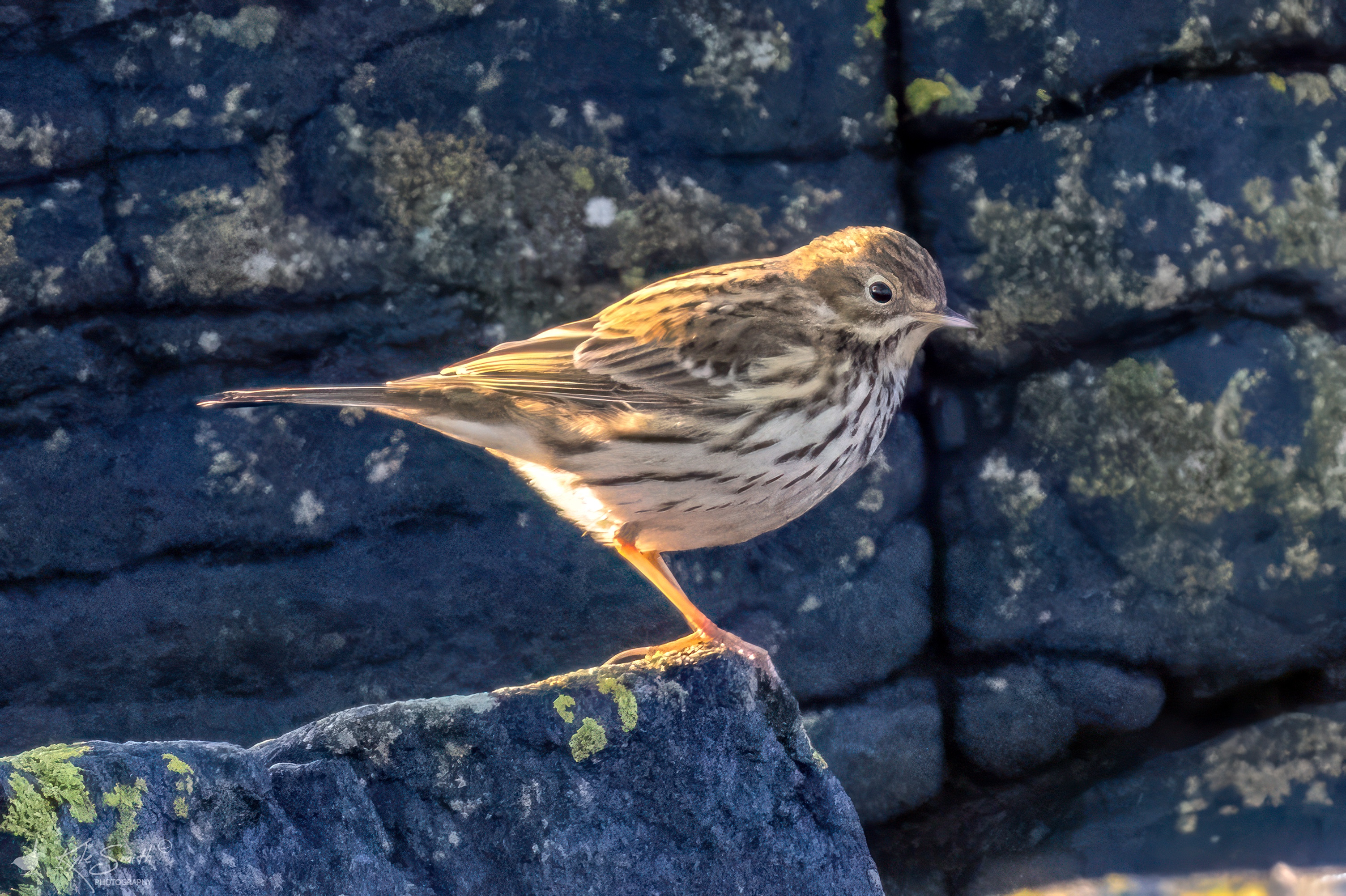
Meadow pipit
Kayaks
Kayaks

We turned to return to the car and on to my mum's and spotted ringed plovers on the rocks, razorbill and eider on the water, and then two purple sandpipers on the water's edge. A terrific morning despite connecting with our dipper.

Ringed plover
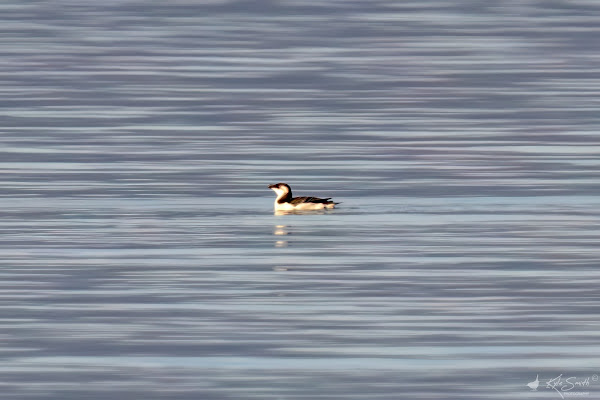
< div class="separator" style="clear: both;">Razorbill
Eider
Purple sandpiper

Although not the reason for my visit to Scotland, my mornings had delivered great birding and the weather had also held out. Most enjoyable.

2024 year list: 85.