Monday, 13 November 2023

Linford Lakes NR :: 09 November 2023

On Tuesday / Wednesday Kev @kev07713, his wife Karen @karenheath62 , and our mutual friend Nick Truby @old_caley ,had all made a pilgrimage to see the little crake reported at Linford Lakes NR first on Monday evening. Unfortunately, I had several work appointments and couldn't join them. For most people I know this would be a lifer and it was true for all of my friends.

However, on Thursday morning I had a small window of opportunity with my first meeting of the day scheduled for 10.30am - one slight issue was that, unlike the two previous days, non-permit holders were not being catered for - issues with health and safety and controlled numbers/access. The issue was easy to overcome as it was possible to buy an annual permit which would allow access immediately, and for the rest of the year - a no brainer.

Typically breeding in eastern Europe and in reed beds, little crakes are vagrants to the UK with only one or a very few records per decade; they are migratory and winter in Africa. Little crakes are very secretive in the breeding season, are mostly heard rather than seen, but can be easier to see on migration.

They are slightly smaller than spotted crakes, from which they are readily distinguished by the lack of dark barring and white spots on the flanks - Kev and I had seen a spotted crake in late August 2022 and so this was something to go on. They mainly eat insects and aquatic animals and from photos posted on X (formerly Twitter) this week, it had showed well on occasions as it worked along the edge of the reeds.

I arrived and found myself first there at about 6.30am and unlocked the padlock with the code supplied by the Parkland Trust. As I was closing the gate, two more members arrived and so I left that honour to them, my car already on the inside. I parked at the far end of the car park and joined the now handful of birders that had arrived as I put on my walking boots.

At the Otter Hide I took a place on the benches looking out over the water and settled in, hoping I'd get a view in the couple of hours I had. After about 25 minutes I could hear someone unlocking the door with the code and as they came in I could see it was Keviin Heath's sister Karen @hobbylovinglife and her partner Dean @worlebirder. We said our 'hellos' and settled down. On Dean's second sweep of the water, he called our bird as it was flushed by something in the reeds, landing on the front edge of the bund. It fed in and out of the reeds, working left until it was lost for about 20 minutes. We had our fingers crossed that it might hop across the channel and work round in front of the hide - a good opportunity to catch up with Karen and Dean.

Little crake
Little crake

With only about 10 minutes before I'd need to leave for work the bird appeared on our far left and continued to work right - come on! It wasn't long before we had great views but often interrupted by the reed stems. I did get a couple of photos as it moved through some more open areas but as it was about to reach the sparser area of vegetation it turned and worked back left and eventually out of view. No doubt it would show again but happy with my views I shot off and made it to work before the compulsory core hours began.

Little crake
Little crake
Little crake

Wednesday, 8 November 2023

Stodmarsh NNR :: 04 November 2023

Friday's views and photos of the solitary sandpiper at Stodmarsh NNRwere unbelievable and despite the forecast of heavy rain, Kev @kev07713 and I decided this was an opportunity not to be missed - hey, we'd be in a hide.

Stodmarsh National Nature Reserve (NNR) is owned by Natural England, located just outside Canterbury, and managed for wildlife and visitors. It is an area of wetland with marshes, reedbeds, lakes and woodland with over 6 kilometres of footpaths, including a circular walk around the whole site. We were here to find the Reedbed Hide as it was the best viewpoint from Friday's posts.

The solitary sandpiper breeds in woodlands across Alaska and Canada and is a migratory bird, wintering in Central & South America, especially in the Amazon River basin and the Caribbean. It is a very rare vagrant to the UK and western Europe, usually being found in the summer–autumn period.

Almost all sandpipers migrate in flocks and nest on the ground, but the solitary sandpiper breaks both rules. In migration, as its name implies, it is usually encountered alone. In summer in northern spruce bogs, rather than nesting on the wet ground, the solitary sandpiper lays its eggs in old songbird nests high in trees. It mostly forages in shallow water, moving about actively, picking items from surface and probes in water and mud. Quite a similar behaviour to our closely allied green sandpiper. In the field you have to really pay attention to separate the species. A cracking post by Gaz Foreman @GadgetGazPhoto on X (formerly Twitter) shows some great photos but also has one that allows a detailed comparison between the green and solitary sandpipers to be made. Kev and I studied this in preparation.

We arrived at the Reedbed Hide to find that there was still space on the benches - it was just after sunrise and this bird was popular - getting one a year in the UK is not always the case. Kev set up his scope and we settled in hoping for success. While there had only been a slight drizzle so far, and dry from the car to the hide, the heavens now opened. After just over an hour a sandpiper dropped in along the water's edge - everyone jumped to attention and started checking out the bird - a green sandpiper ... not our quarry but it was a start!

Green sandpiper

Gradually the bird worked along the water's edge, getting closer and closer. Our hopes were high now that a sandpiper had appeared - perhaps the solitary species would appear to join this bird - it had been associating with a green sandpiper in recent days ...

Green sandpiper

Before long the green sandpiper was up and away, flying past the hide and out of sight. Marsh harriers, teal and mute swans dominated our sighting now and while we had little else to do, I repeatedly counted to get a peak for each of the species on the water: teal 162, and mute swans 29. At one point a number of teal to our left took to the air and as we waited, we had a fabulous pass from a female sparrowhawk.

A chap we'd met at the magnolia warbler, and then at RSPB Frampton for the buff-breasted sandpiper left the hide to. see if he could locate the bird elsewhere on the reserve in spots where sightings had been made previously - he came back soaked and joined us at the window and we chatted - he runs a YouTube channel S2SBirda - Summit to Seashore Birding Adventures and is well worth a watch if you get time. On his channel he shares birding adventures, trip reports, day twitches for rare birds and tutorials.

By around 11.00am a green sandpiper arrived, this time spinning around to land facing away from us, showing a great flash of its white tail/rump. Even before it landed, we knew we were not on our target bird and on investigation it was confirmed. Sadly, no solitary sandpiper joined it before in just a couple of minutes (and after a preen) it was off again, leaving as before.

The sun came out for an hour, and we hoped this might result in a change in our fortunes - unfortunately not as far at sandpipers went. While scanning though I picked up a bittern flying along the reeds at a distance of 225m+, raising the attention of others in the hide I snapped a few records shots hoping that at least I'd have something to show for the day. Directly in front of the hide was a stick, there to entice a kingfisher. However, a lovely grey wagtail dropped onto the stick and posed for photos - normally this wouldn't have resulted in a bunch of photographers snapping away but there had been limited action and so most joined in.

Bittern
Bittern
Grey wagtail

Time passed, and we watched as marsh harriers quartered the reed beds, both males and females - the green sandpiper visited a couple more times but for shorter periods. The teal and swans moved around the site but other than kestrels and crows mobbing sparrowhawks there was little more to add - as we left the grey wagtail repeated the pose on the stick planted near the water's edge. It was a frustrating day with 8 hrs in the hide and a long drive home for Kev.

Marsh harrier
Grey wagtail

Tuesday, 31 October 2023

RSPB Titchwell :: 28 October 2023

Kev @kev07713 would probably have liked to head up to Spurn and Flamborough given the fall of birds this week, but I had to be in Banbury by about 5.30pm as I was going out with friends for a Bonfire and Fireworks display. We saved a couple of hours by visiting RSPB Titchwell, Norfolk and hoped to be able to see something on the sea (little auk spotted along the coast on Friday) and/or Pallas's & yellow-browed warbler both reported on Friday too.

On arrival we went straight out to the beach and found it wasn't windy, or particularly cold. There were numbers of waders on the beach including two bar-tailed godwits, lots of sandering, oystercatchers, black-tailed godwits, a few dunlins, and a handful of turnstones. However we were more interested to find what was on the water.

Bar-tailed godwit
Bar-tailed godwit

Immediately we could see two red-throated divers and a large flock of common scoters, the scoters being too far offshore for a photograph. A dark diver was followed by Kev but he was unable to get a good enough view for a positive ID which he was disappointed with as a black-throated diver had been reported earlier in the morning but had drifted off left. Great crested grebe and razorbill appeared in singles.

We bumped into a couple who had been fortunate the day before to see a little auk splashing about in the shallows just along the coast – we wouldn’t be so lucky.

Red-throated diver
Red-throated diver
Red-throated diver

Brent geese added to the flocks of wigeon moving along and in from the sea. We were keeping an eye on reports and saw that the yellow-browed warbler had been reported by Fen Hide - the weather was drawing in with mist rolling in off the sea – looking very grey. A call went up and we watched as a merlin cut through sending waders into the sky as it passed.

Brent goose
Brent goose

We made our way back to the Visitor Centre passing grey plover, curlews, and stonechats on the way. Avocets and black-tailed godwits took to the air but there was no sign of any adversary – the merlin?

Grey. plover
Curlew
Stonechat

We came across a group of people searching for a warbler and I joined them. Kev wandered off and in a few minutes I got a call to say that a women he'd come across had called a hawfinch on the ground, near the car park and toilets. By the time I got there the bird had come off the ground and disappeared into the bushes but a few minutes later Kev scanned further down the path with his scope and found the bird feeding by a gate. This wasn't a bird we were expecting to see today. As news broke dozens of people rocked up and we decided to depart.

Hawfinch
Hawfinch
Hawfinch

We searched for a while around the picnic area and in the general vicinity of the Centre and, despite seeing a bird foraging in the ivy which didn't appear to be a goldcrest, we were unable to make a positive ID before it was lost. We decided to stop for lunch and managed to get a spot at the last remaining outdoor table, drying off the seats.

We returned to the task of searching for a warbler and stalked along the boardwalk to the Fen Hide and beyond. Unfortunately, there wasn't a sniff of our bird but we had encounters with flocks of goldfinches, tits and treecreeper. A noisy jay landed in a nearby tree and strutted his stuff before also flying off in search of food.

Treecreeper
Jay
Jay

To be honest, the number of small bird species was fewer here than back around the Visitor's Centre, but we persisted for a while before heading back to the picnic area and on the other side of the hedge from the Fen Hide, and around the overflow car park. Another unknown species flew about 15ft off the ground at the rear of the Centre but didn't stop to allow a view. Time was getting on and aware that we'd need to be leaving before mid-afternoon we decided to make our way back along the main trail towards the sea. We stopped to look down a channel and picked out a handful of bearded tits cutting across, back and forth; they were never close enough or predictable enough to even try for a photo. Behind us flew a kingfisher and behind that, perched on a tall post was a kestrel, now bathed in sunshine. Overhead flew flocks of mainly barnacle geese but also a few pink-footed geese.

Pink-footed goose
Pink-footed goose

There were handfuls of redshanks feeding on the marsh and they took flight with many other waders when a marsh harrier flew through. A flock of hundreds if not thousands of golden plovers joined those circling in the sky.

Eventually it was time to make tracks and despite finding a chiffchaff (raised our hopes briefly), more goldcrests and treecreepers we just couldn't locate a yellow-browed warbler - but talking to others, neither could they. After we’d left a yellow-browed warbler was reported around the Visitor’s Centre and the day after that there were two. Elusive. Hopefully I will get to see one before the autumn is out.

Chiffchaff
Chiffchaff

By the time I left home for the night's Bonfire and Fireworks display the heavens had opened and the roads became waterways. Despite arriving on time, we decided to give standing in the pouring rain a miss and enjoyed the fireworks, at least the sound, from our friend's house.

Sunday, 29 October 2023

Lymington Normandy Marshes :: 25 October 2023

My car was due in the garage and was to be left there for the day. Charlotte followed me down and we drove from there to visit Lymington and onto the Normandy Marshes. It has been very wet over recent days and there was flooding on the roads, but no problem accessing our usual parking space. The forecast was for the sky to clear and perhaps some sun to appear. Although dry, the sun had yet to make an appearance.

On the water were teal, wigeon, shoveler and mallard but that was no the initial interest; a pair of stonechats were hopping across the top of some bushes and as I watched out popped a Dartford warbler. No sooner than I was on it than it dropped down and into some gorse. We waited until it showed again, and did it show - a couple of minutes of heaven. It fed through the gorse popping out occasionally and finished with a flourish, landing on top of a stalk and looking around for the next meal. And gone.

Dartford warbler
Dartford warbler
Dartford warbler
Dartford warbler
Dartford warbler

We walked around Normandy Lagoon and now could see ever larger numbers of dunlin, ringed plover and a few turnstones. A. single grey plover snoozed on the water's edge and as I put Charlotte on the bird a little egret flushed all the birds around that area and the grey plover was lost from view. A single bar-tailed godwit was asleep in amongst the lapwings while a dozen or so black-tailed godwits fed frenetically in the shallows.

Black-tailed godwit

On one of the remaining islands stood a bar-headed goose, initially asleep but then preening, hardly pausing for breath. The waders and lapwings suddenly arose but no raptor could be seen to explain the massive departure. The flock then spun around the lagoon and out over the sea, returning in smaller flocks of about 50 all around us - magical. We continued on around the corner adding a handful of snipe to the day count but found nothing else of particular note.

Bar-headed goose
Bar-headed goose
Redshank

We made our way back and around towards Keyhaven but about halfway ran into an increasingly heavy rain shower - this wasn't the plan. Families stopped to put. on stronger rainproof clothing and our trousers started to get wetter. After a few minutes it became clear that we'd need to head back to the car or be soaked for lunchtime.

We'd booked a table for lunch at The Mayflower pub and made for there, half an hour ahead of when we were scheduled - there was no need to wait for our slot and were soon warming up with lunch. I looked at my phone to find that a short-eared owl had been reported not far from where we'd turned back due to the rain and about the time we'd have been in place - damn.

After a nice lunch we jumped into the car and went down to the other end of the Keyhaven Marshes and had a nice walk but there were no added opportunities for photos or additional species, but the sun had come out – a better day than having to be at work.

Friday, 27 October 2023

Wildlife BCN Summer Leys & Eyebrook Reservoir :: 21 October 2023

Kev @kev07713 and I had failed to connect with a jack snipe last winter / spring and, despite keeping our eyes open, hadn't yet found one yet this autumn. This well-camouflaged wader is a winter visitor to the UK, where it can be seen feeding on wetlands and is distinctive due to its bobbing motion. They are secretive birds, often hidden in thick vegetation on marshes, wet grassland and in reedbeds. They use their long bill to probe the mud for insects, worms and even plant material, moving in a slight crouch and constantly bouncing up and down as if their legs were made of springs.

Wildlife Trust BCN Summer Leys is a good spot and we've seen them previously there from the double-decker hide. Despite Kev having tried there recently, we thought we'd give it another go - the weather was forecast to become wet as the day went on and so going somewhere with cover (hides) was a good idea in any case. We stopped for breakfast on the way and then on arrival dropped into the Pioneer Hide to find Ricky Sinfield @Rickysinfield1 and Martin Swannell @alanthetortoise (amongst others) already in place.

I took a seat on the bench between Ricky and Martin while Kev set up his scope and scanned between the line of photographers at the window. Most had presumably come for the bittern that has been showing insanely well over previous days, but as the water level had risen by around 0.6m there might be a change in position or behaviour. There was lots of chat as nothing much was happening outside, mostly between Martin and Ricky. Ricky then picked up a marsh harrier coming into view. It quartered a specific area for a good few minutes obviously having spotted something of interest but eventually it broke away and left. A beautiful bird - none of us appeared to be ready, but we tried for photos regardless with limited success.

Marsh harrier
Marsh harrier

On the scrape we could see two dunlin and as we watched them, a couple of snipe dropped in. Through the scope Kev then updated that the number of snipe was increasing and in the end he counted at least 25. Three little grebes buzzed around the front of the hide, busily diving. I still needed to sort out my settings ...

Little grebe
Great white egret
Great white egret

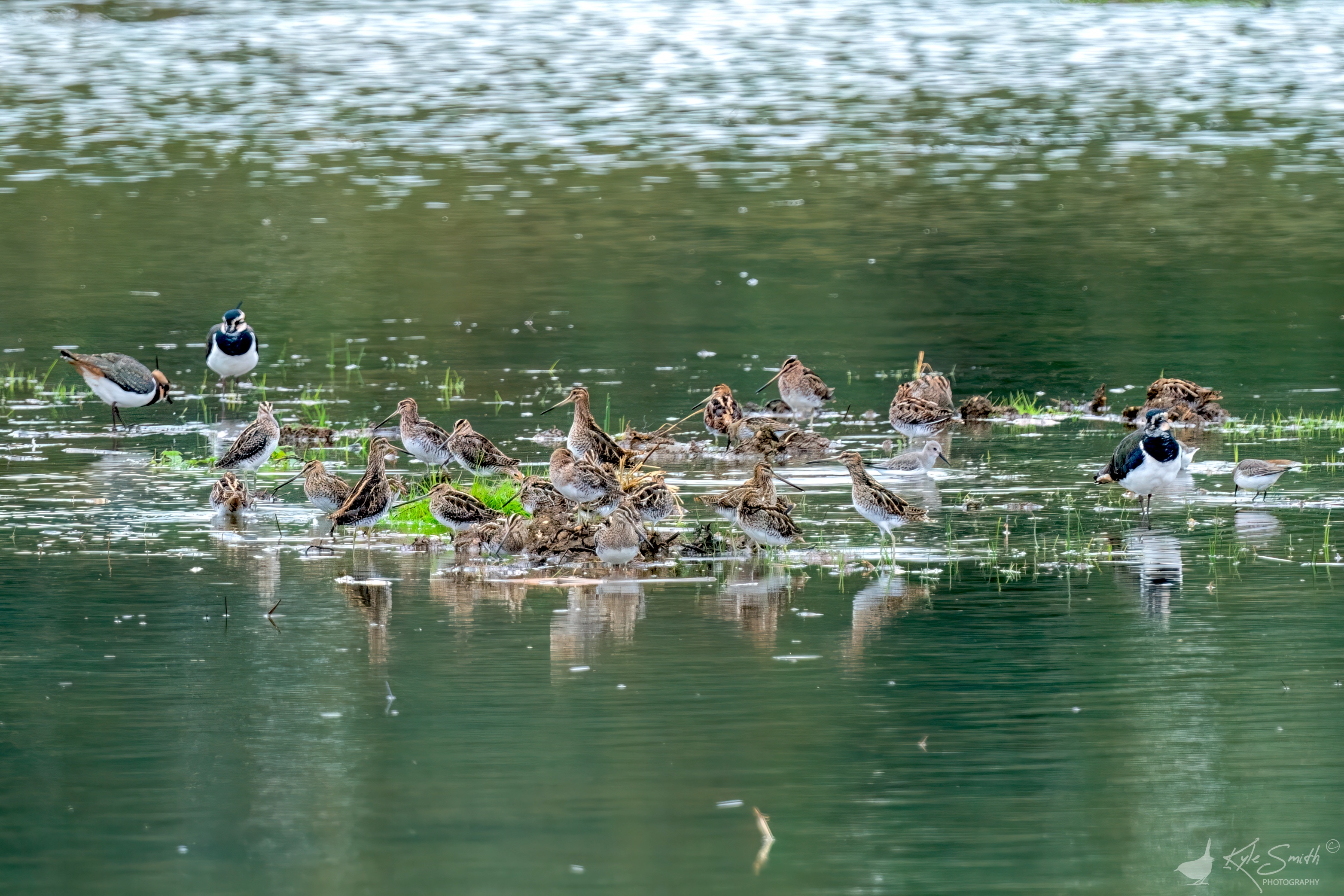
While it was all very pleasant, we weren't likely to see a jack snipe from here and so relocated to the double decker hide spotting good numbers of tits and finches on the way. We arrived to find we were the only people in the hide, at least on the upper deck. We set about scanning the area, particularly on the water's edge and on the small muddy patches still above the water line. The number of common snipe grew and grew until we counted almost 50 across the viewable margins and islands.

Common snipe
Common snipe

In amongst the snipe fed five dunlin and a single ruff. Still no sign of our quarry.

Ruff

On the rightmost island was what appeared to be a heap of mud but there dis seem to be some form to it - I kept scanning to it as we investigated over the next hour or so. Eventually many of the snipe took to the wing with a number landing on the rightmost island. Kev was scanning through them when the lump of mud started to move ... and bob - jack snipe. Result!

Common snipe

We then enjoyed the jack snipe as one became three and shared the news on Birdguides and WhatsApp - others came to join us and ask where to view. The three jack snipe scurried around, often being flushed by the common snipe - photos show the considerable size difference, although it is sometimes harder to see in the field.

Jack snipe
Jack snipe
Jack snipe
Jack snipe
Jack snipe
Jack snipe
Jack snipe
Jack snipe
Jack snipe
Jack snipe
Jack snipe

While enjoying the snipe we were also chatting to Adrian Sparrowhawk who said that he, Bryan Manston and a couple of others were at Eyebrook Reservoir to see the red- and black-throated divers, common scoters and greater white-fronted geese. The scoters and geese had departed but I needed a black-throated diver for my year list, and it would be nice to catch up with the others - we packed up and set off.

We arrived at the spot Adrian had pin dropped as the location we could view the black-throated diver from and found Alan Boddington @alanbodd standing by his scope. He had seen the diver previously but had come back for seconds - the bird had different ideas and wasn't visible - we hoped this wasn't bad news. We continued to scan, hoping that the bird was just diving, and that we just hadn't picked it up on each pass; after five minutes we still hadn’t located it. I moved my scope to look back along the water and in just a couple of minutes picked up the bird. I pointed to Kev and Alan where to look to make sure I wasn't seeing things - my scope is functional but not great at very large distance. I needn't have worried, it was correct. The bird stayed distant and eventually flapped its wings a couple of times, before then taking off and flying strongly across the water, rising high, and then away towards Rockingham. Our timing couldn't have been any better, just-in-time.

Black-throated diver

We had a call with Adrian who said they were on the other side of the reservoir and were on the red-throated diver - we jumped in the car and joined the crew on the other bank. In many ways we would have been better on the side we were as the bird was locked near the far side, eventually disappearing off to our left. Adrian, Bryan and the crew decided to try for the jack snipe at Summer Leys and if successful would then travel on to see a hoopoe at Harlestone. We stayed for a while more but didn't add anything of note although did see a rather late common tern.

Red-throated diver