Showing posts with label blackcap. Show all posts

Monday, 13 October 2025

Dunwich Heath & Aldeburgh :: 11 October 2025

The Turkestan shrike (also referred to as red-tailed shrike) is a small passerine bird known for its striking plumage and characteristic predatory behaviour. Its breeding range is central Asia, mainly from southern Kazakhstan, Uzbekistan, Turkmenistan, and northern Iran eastward into western China. It then winters by migrating south to the Arabian Peninsula, Pakistan, and northwestern India and prefers open scrubland, semi-desert, farmland edges, and thorny bush areas. It was once considered a subspecies of the red-backed shrike or Isabelline shrike, but is now generally treated as a distinct species, though classification can vary between authorities.

According to the British Trust for Ornithology, there had been 12 records of Turkestan shrike in the UK. However, a 13th turned up last weekend at Dunwich Heath National Trust in Suffolk and while I was away work abroad during the week, Kev @kev07713 did the sensible thing and went with his wife Karen to see it - he had seen one at RSPB Bempton Cliffs back in July 2022, but his wife hadn't seen it then.

The bird has been very visible, offering birders superb viewing opportunities. It has been observed actively hunting, catching prey like dragonflies and bees, and displaying classic shrike behaviour by impaling food on gorse for later. Perched prominently on bushes, it has allowed for clear and prolonged observation - there have been some cracking photos.

Kev and I discussed our options for Saturday: the Turkestan shrike, which would be a lifer for me; the Baird’s sandpiper at Rutland Water; or the greater short-toed lark, also a lifer for me, at the Snettisham Coastal Path. Since we had both seen Baird’s sandpipers before, the real decision came down to the other two. Both were species Kev had already seen, but I leaned toward the shrike because of the potential for perching and flight photos. Kev was happy with that plan, and I offered to drive since he had already made the journey a few days earlier.

On the way, we stayed in touch with our friends Adrian Sparrowhawk, Bryan Manson, and Mark, who were also heading to the site and apparently only about ten minutes behind us. We stopped at Greggs for a breakfast roll and coffee, waiting for them to catch up. The venue itself was a bit rough, but that didn’t concern us; soon we were back in the cars, with Adrian following me.

We were only 30 minutes from the site and arrived perfectly as the car park was being opened - a man was unlocking the gate that normally prevented access. Interestingly, the car park wasn’t scheduled to open until 9.00am., but it was only 8.30am. when we got there - some people had parked up along the road and had walked in. We drove to the car park by the Visitor Centre, and Kev paid for parking - Bryan, being a National Trust member, received a whole £1 discount.

As we passed other birders, they confirmed that the Turkestan shrike had not yet been seen. We joined the group near its last reported location, looking back to where two birders were staking out the spot Kev had seen it earlier in the week. Like many shrike species, Turkestan shrikes are diurnal hunters: they often start perching and scanning for prey at dawn but typically wait until insects and other prey become active before hunting in earnest. Overnight temperatures had been cold, and it was still quite cool, so hopefully the bird was still roosting.

There were more than a dozen people scanning for the shrike, and after taking a look ourselves, we left Adrian, Bryan, and Mark to continue watching. It seemed possible the bird had moved on, but with so many eyes on it, any reappearance would be quickly reported - and we would be less than ten minutes away. Meanwhile, a yellow-browed warbler had been reported closer to the entry gate the day before, so we made our way down, spotting various warblers and pipits along the route. Scanning over the sea revealed only seals and herring gulls.

We stopped at a clearing where there was plenty of movement among tits and finches and set about working through the flock. Blue, great, and long-tailed tits were joined by chaffinches, blackcaps, and goldfinches. Ten siskins flew over, and a striking male continental blackbird made an appearance before chiffchaffs and goldcrests then showed up.

At one point, we heard a call we didn’t recognise and tried the Merlin app, which suggested a blackpoll warbler - three times. We did see a warbler pass through that we couldn’t identify, but it’s likely a mis-ID - the app can be prone to errors with some species. That said, there have been a few blackpoll warbler sightings in the UK this autumn. These rare North American migrants would be a thrill to spot, and Dulwich Heath could have been another stop on their incredible journey though, in this case, the mystery remains.

Treecreeper
Blackcap

We’d heard woodlarks and great spotted woodpeckers calling, with one woodpecker dropping into a tree right in front of us as a few more siskins passed overhead. Adrian rang to say they were heading off to try for the greater short-toed lark at Snettisham, and we wished them luck. We made our way slowly back to where the shrike had been, finding the area quiet - most of the birders had already moved on.

We looked on Birdguides and noted that a yellow-browed warbler had been reported along the coast at St Peter & St Paul's Church, Aldeburgh - the churchyard seems to be a regular spot for these yellow-browed warblers with records now in 2025, 2024, 2022, 2020, 2019, 2018, 2014, and 2012. We'd not found the one here at Dunwich Heath and decided to try Aldeburgh for our first of the autumn.

The yellow-browed warbler is a tiny, energetic leaf warbler from Siberia that has become a much-loved autumn visitor to the UK. It is very small and similar to a goldcrest with plumage that has bright greenish upperparts, pale underparts and distinct yellowish supercilium (“eyebrow”), dark eyestripe, and two whitish wing bars. It breeds across northern Asia, from the Ural Mountains through Siberia to far eastern Russia and winters mainly in South and Southeast Asia. In Europe it is a classic autumn vagrant, appearing in the UK from late September to November in increasing numbers. Once a rare vagrant, the yellow-browed warbler has become a regular autumn migrant, with hundreds recorded annually, particularly along the east coast.

We arrived at the church and made our way from the car park to the spot where the yellow-browed warbler had last been reported. Within five minutes, we heard a sharp, rising “tswee-eet”, often the best clue to the presence of this tiny migrant. The bird perched briefly at the top of a tree directly behind us, staying for only ten seconds before flitting across our heads to a tree further along the path.

We followed it as it moved, soon joined by another birder, whom we helped onto the bird. It remained quite vocal, calling persistently before relocating again and again. The warbler darted through the dense trees with astonishing energy, barely pausing as it threaded among branches and foliage. Its small, bright body was glimpsed only fleetingly, the pale underparts and greenish upperparts catching occasional flashes of light as it twisted, hopped, and foraged.

Watching it demanded patience, as we scanned the tangled branches and shadowy gaps, tracking this restless bird as it wove through the canopy. Even following it was a challenge and photographing it proved even trickier - the bird was often partly obscured by twigs, branches, and leaves, making each clear view feel like a small victory.

Yellow-browed warbler

We spent the next couple of hours watching and photographing the warbler, chatting with a steady stream of fellow birders - at times there were up to ten birders around. Capturing a good photo proved no easier than tracking the bird itself, and many were just as frustrated as Kev and I. I did manage a few shots I was pleased with, though. It was also excellent practice for Kev with his new camera - his first real birding challenge with a bird staying with the trees - and given how elusive the warbler was, it tested his patience almost to the limit.

Yellow-browed warbler

The bird moved frequently, and as it shifted through different lighting, its colours revealed themselves in fleeting glimpses.

Yellow-browed warbler

The bird showed almost continuously, though many of the photos were partly obscured by foliage - but in a way, I didn’t mind; it reflected the reality of the views we were getting. We considered leaving a couple of times, yet each time the chance of another good look persuaded us to stay a little longer. There was still just enough time to get back before my evening visitors arrived. Eventually, the bird melted into an even denser patch of trees, and sightings became increasingly difficult. When it finally reappeared, we had one last go at some photos, though I doubt we improved on what we’d already managed.

Yellow-browed warbler

Although I was disappointed not to see the Turkestan shrike (and Kev was on my behalf), the excellent views of the yellow-browed warbler helped make up for it on another fine day out.

Year list: 240.

Friday, 11 April 2025

Draycote Water & RSPB Ham Wall :: 04/05 April 2025

On Friday afternoon at work, I kept seeing repeated WhatsApp updates about a passage little gulls at Draycote Water. By mid-afternoon, the count had risen to 31 individuals. Deciding I'd clocked enough hours for the week, I left a bit early, swung by home to grab my camera and scope, and headed to the site hoping some would still be around. On arrival, I discovered the parking system had changed since my last visit - payment was now based on arrival times recorded by camera monitoring, with fees charged at the end of the stay.

I made my way up to the path beside the Visitor Centre and set up the scope to scan the water. At first, there didn’t appear to be any gulls in sight, but through the scope I spotted some movement between Biggin and Toft Bays. Watching carefully, I managed to pick out a gull that was unmistakably a little gull.

The little gull is the world's smallest gull species - adults in summer plumage are characterised by a black head, pale grey back, and dark underwings. Just like black-headed gulls, non-breeding adults display a black cap and ear spot. They are primarily observed during migration, in spring from mid-March to mid-May, especially during east or southeast winds and increasingly with winds accompanied by rain. Autumn sightings are less frequent.

The UK typically hosts between 200 and 800 individuals - notably, little gulls were recorded to successfully breed in the UK for the first time at the Loch of Strathbeg Reserve in 2016. Well worth the money to view them. Their feeding flight is often described as buoyant and fluttery - quick wingbeats, fluttering just above the water's surface picking up insects or small prey off the surface without fully landing. Here at Draycote they were likely taking advantage of hatches of (aquatic?) insects.

I walked along Farborough Dam to the point, where at lower water levels a sandy spit appears. I set up the scope again and watched little gulls work into the wind, feeding in their distinctive way amongst handfuls of herring and lesser black-backed gulls. The gulls were a good 450-500m away and although good to watch on the scope, it would be a more difficult to get a photo - I had a go.

Little gull
Little gull
Little gull

Wing surfing - also called wing foiling - is a watersport that blends elements of windsurfing, kitesurfing, and foiling. Out in the water were a couple of people doing just that. As can be seen in the photo below you use a handheld inflatable wing (not attached to the board or rider) and a board, usually with a hydrofoil - a long fin with wings that lifts the board above the water. Amazing to see out and in the air!

Wing surfer

I only had a short window to stay, as I was due back home in time for dinner. But before heading off, I caught sight of three common terns fishing just beyond the little gulls but practically as far away as they could be. Two year ticks for the price of one. I packed up, paid my dues, and made for home.

Common tern

Kev @kev07713 and I discussed a few options for our Saturday birding trip and settled on RSPB Ham Wall, with glossy ibis and garganey both viewable from VP1 in recent days. Karen @hobbylovinglife and Dean @worlebirder were also going to be on site, from early as they were assisting in a breeding survey - perhaps we'd bump into them later.

Cattle egrets are a familiar sight around the Glastonbury area, with winter roosts sometimes exceeding 700 birds. They’re not often seen on the main reserve, but as I’d yet to tick one off my year list, I was quietly hopeful of spotting one somewhere nearby.

The drive to breakfast was already proving rewarding: we saw two Barn Owls—one quartering a field alongside the road, and another flushed unexpectedly from the roadside verge. Then, in a field next to the M5, two cattle egrets stood among grazing sheep - frustratingly, there would no safe spot to stop! As we left the motorway at the Dunball/Bridgwater exit, another flock of over 50 cattle egrets caught our eye in a field of sheep. We planned to check again on the way out, but by then, they’d moved on.

From the breakfast car park, things kept ticking along - literally. Two oystercatchers were perched on the roof of an industrial building, with sand martins and swallows swooping in the distance. In the reeds beyond, we heard a Cetti’s warbler calling, spotted a reed bunting, and picked out a willow warbler. Who would've thought breakfast could bring two year ticks?

Arriving at the reserve, I waited in the car park while Kev checked out the facilities. A flash of colour caught my eye as a Kingfisher zipped across the car park, heading for the main reserve. A large bird then swooped in from the right, disappearing behind the trees - I tried my best to turn it into a bittern, but it was a grey heron.

We walked on to the bridge and paused before reaching the main track, where we heard a sedge warbler singing, though we couldn't quite locate it. No doubt we’ll tick one soon for the year list - the place was alive with blackcaps in full song.

A little further along, by a narrow drain, we stopped to watch a barn owl being mobbed by a couple of crows before it ducked into cover. At the end of the channel, we spotted Karen and Dean also watching the scene unfold. As I waited, hoping the owl might reappear, a Kingfisher darted low along the reed tops - unseen by Karen and Dean, though they later said they’d heard its call. I pointed out where it had landed, and within moments Kev had it in view.

As we continued toward VP1, the soundtrack of blackcaps and chiffchaffs surrounded us. When we arrived at the viewing platform, a chiffchaff fed just a few feet away, completely unbothered by us or the handful of birders nearby.

Chiffchaff

From the platform we were able to see three ruff out in the water. Numbers peak during April, as birds move north from wintering grounds (mainly Africa) to their Arctic and sub-Arctic breeding areas. They are most often seen at wetlands, scrapes, flooded meadows, and RSPB reserves with shallow pools such as here. We usually see good numbers of them on the East coast reserves, such as Titchwell, Frampton Marsh, and Cley. We always keep an eye out for white-headed or black-faced males - their breeding plumage is stunningly diverse but none of these individuals were yet in their best plumage.

In the same vicinity we saw a spotted redshank, transitioning to its breeding plumage. March to May is their northbound migration period but peak passage tends to be in April, sometimes lingering into early May. By late spring, most have moved on to their Arctic breeding grounds in Scandinavia and northern Russia. In mid-spring to summer, they sport jet black plumage with subtle white spotting - really striking. It would work around ahead of us, always at distance. A few common redshanks fed close by. Also at distance were a handful of remaining pintails.

Ruff
Spotted redshank
Pintail

As we scanned the area, we spotted several common snipe probing the exposed mud in search of food. Suddenly, a bird darted across the water, possibly a sparrowhawk, sending most of the waders and some ducks into the air. We had actually been hoping for a bit of a shake-up like this, especially with the garganey nowhere in sight and still no sign of the glossy ibis.

I was especially taken with a group of around 30 snipe that took to the air together, circling the pool in front of us before sweeping overhead. After another pass, they settled again, scattering across the pool at distance.

Common snipe are both resident and winter visitors in the UK, but many of the wintering birds head back to northern Europe in spring. Breeding birds do stay, particularly in wetland habitats, and from March to May, they begin their courtship displays. One of the most evocative sounds of the season is the male’s “drumming” flight display - soaring high in circles before diving rapidly, the wind rushing over their outspread tail feathers to create that distinctive, "drumming" sound.

Bitterns continued to call in the distance, though we never quite managed to catch sight of one. A common crane lifted into the air and disappeared far off - probably the same bird Kev had spotted earlier in the morning, though he’d been the only one lucky enough to see it.

Snipe

Hoping the glossy ibis was simply feeding out of sight, tucked just over the brow between us and the water, I followed the track, crossed a bridge, and continued along another path. This route gave me a view of the area hidden from the platform, but no luck - the ibis wasn’t there.

While scanning the scene, a green sandpiper suddenly took flight and passed by quite close. I was so focused on tracking it through my binoculars that I completely forgot to take a photo! Kev and a few other birders saw it too and confirmed the ID - a year tick.

On the walk back, I heard a Cetti’s warbler calling nearby - close but hidden as ever - and then came across a blackcap singing its heart out in a tree. I couldn’t resist stopping to enjoy the song.

Blackcap
Blackcap
Blackcap

After another twenty minutes or so, one of the other birders on the platform called out ... the glossy ibis was coming in. It landed a little off to the left, only really visible if you stood up on the benches. I took a few photos, but it wasn’t ideal, so I decided to loop back around in the hope of getting a clearer view from the other track.

That decision paid off. I ended up taking quite a few shots, and eventually got some I was happy with, as the ibis emerged from the denser cover and moved into better light.

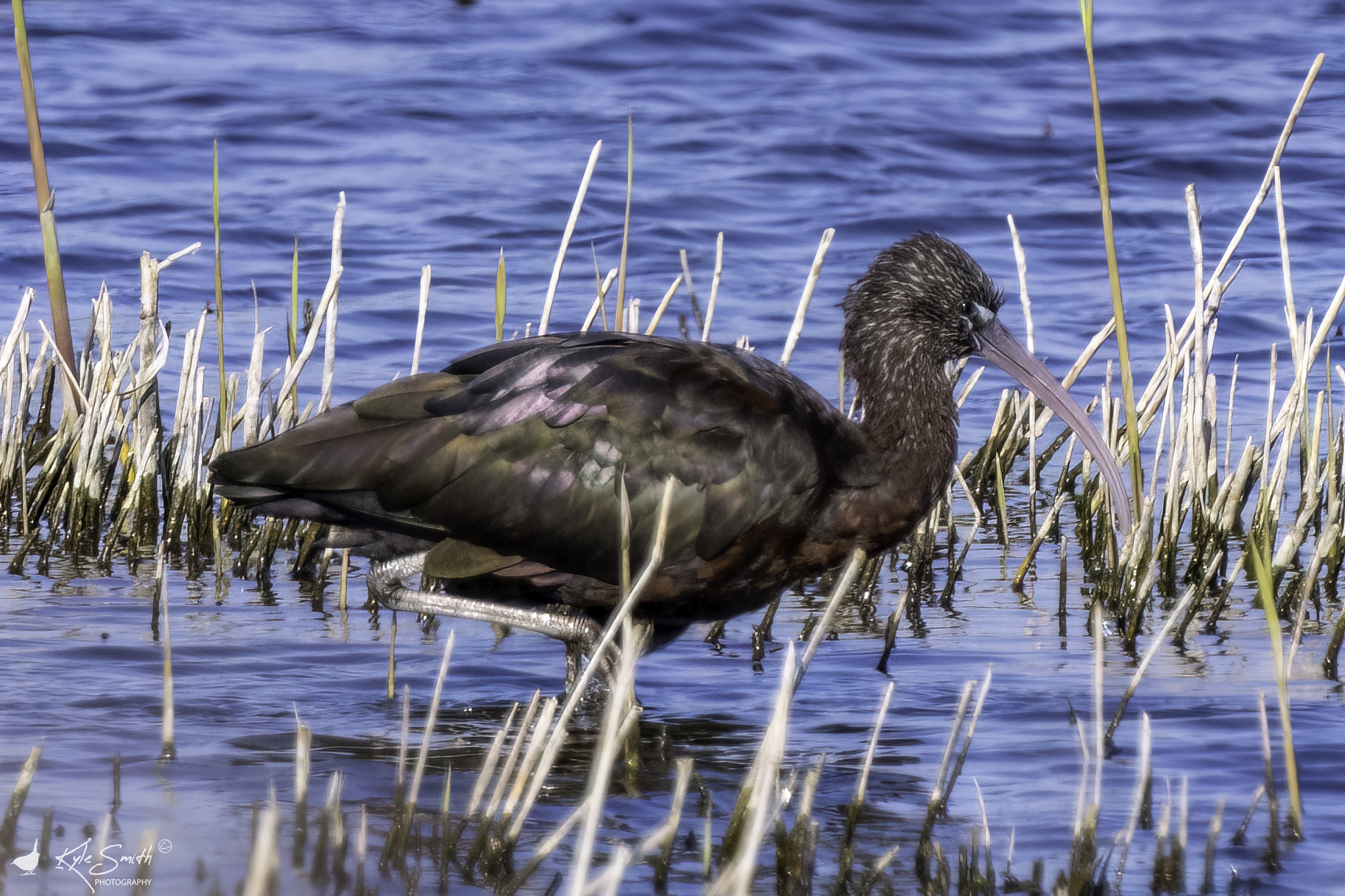
Once a mega rarity in the UK, the glossy ibis has become increasingly regular over the past two decades, with sightings now annual and sometimes long-staying. Though still scarce, their numbers are definitely growing. Kev had already seen one at Summer Leys in Northamptonshire, where a bird has been present since November 2024 - five months and counting.

This bird gave excellent views. Glossy ibises are surprisingly confiding when feeding, and I had the chance to properly take in the stunning iridescence, the glossy greens, bronzes, and purples catching the light.

Glossy ibis
Glossy ibis
Glossy ibis
Glossy ibis
Glossy ibis
Glossy ibis
Glossy ibis
Glossy ibis
Glossy ibis
Glossy ibis
Glossy ibis
Glossy ibis
Glossy ibis
Glossy ibis

I returned to VP1 and rejoined Kev - he was getting a bit restless, as I’d been gone a while. We decided to head down to VP2 after Karen called to say an osprey had passed overhead in that direction. She’d even sent a photo. We figured it might have been hard to spot from VP1, and if it was still around, VP2 could offer a better view.

As we wandered along the track, blackcap and chiffchaff called from the hedgerows, and a sparrowhawk zipped through. I was trailing slightly behind Kev and missed a peregrine he caught sight of. But I did get a great view of a great white egret just off to our left in the drain - it was surprisingly close and didn’t seem at all bothered by people watching it.

I always tend to associate great white egrets with yellowish-orange bills, as some of the birds here were showing. This one, however, had a black bill and is likely an adult in breeding plumage. The colour change typically occurs between March and May as they prepare to court and nest. Its sheer size also gave it away.

Great white egrets have become regular breeders in the UK, particularly in southern England. By 2021, the British population had grown to around 50 breeding pairs, which fledged 73 young that year. In 2023, a record 88 chicks fledged from 53 nests in the here in the Avalon Marshes area of Somerset. Judging by the activity around the reserve, it looks like this success might well be repeated this year.

When we reached VP2, we noticed several birds dropping into the reeds, possibly suggesting breeding behaviour. Karen and Dean were nearby, keeping tabs on this and other signs of nesting activity. We agreed to catch up with them later for a chat. There were birds out on the water, but still no sign or sound of bitterns.

A reed warbler called further down the track, and when Karen and Dean arrived, I thought I glimpsed it relocate, but not clearly enough to tick it for the year list. It won’t be long, though. Overhead, we saw a scattering of marsh harriers, a few red kites, several buzzards, and another sparrowhawk cruising the sky.

Great white egret
Great white egret
Karen & Dean
Karen & Dean
Karen & Dean
Marsh harrier

We made our way back down to VP1 for one last check, hoping the garganey might finally be showing, but no such luck. The same mix of birds was still present, though we were briefly entertained by two unusually bold chaffinches hopping around Karen and Dean’s feet.

Eventually, we decided to pull stumps and head to the car park. Karen and Dean had shared a tip about a nearby site with a known little owl tree, not too far from the reserve, so we figured it was worth a try.

On the way back, we paused at the stone bridge to watch a few grass snakes basking in the sun, curled up along the warm stonework. We stood for a while, before meeting Karen and Dean at the reserve café for a quick drink and a snack. Then, we set off for our final target of the day.

Grass snake

We arrived at the spot and parked our cars safely further up the lane, out of the way of any passing traffic. Then we walked back down, scanning the trees for any sign of our target. It only took a few minutes before I spotted a pair of eyes staring right back at me - I called the others over.

Spring is a great time to watch little owls, as they become more active and easier to spot. They nest in tree cavities, old buildings, and occasionally barns, laying their eggs around April and May. With their distinctive features and quirky behaviour, they’re always a delight to watch - full of character.

As usual, I took far too many photos.

A chap stopped for a chat and mentioned there were footpaths running through the nearby field, though they wouldn't offer a better angle on the branch the owl had chosen and might risk disturbing it. So, we kept our distance and simply enjoyed the view.

Little owl
Little owl
Little owl

All too soon we were back at the car and saying our goodbyes. Another cracking day birding in the southwest - Karen and I joked about seeing each other next weekend as we have met up on each of the last three. I wonder what we'll do and where we'll be next weekend ...

Year list: 161.