Showing posts with label nightingale. Show all posts

Saturday, 31 May 2025

RSPB Pulborough Brooks & Woolbeding :: 24 May 2025

Over the past few years, Kev @kev07713 and I have made several attempts to catch sight of honey buzzards though, truth be told, largely with limited success. Recently, we heard about some sightings near Woolbeding in Sussex, so we decided to give it another go. The area also offers a chance to hear nightingales, a species we’d yet to tick off our for this year's list. Kev did the research (someone has to!) and found that the best chances of seeing honey buzzards seemed to be between 10.30am and 1.30pm. So, we planned to start the day at RSPB Pulborough Brooks for the nightingales, then head over to try our luck with the buzzards.

Nightingales are one of the great signs of spring in the UK, famous for their rich, melodic songs that brighten the woodlands in April and May. These long-distance migrants travel from West Africa to breed in southern and eastern England. In Sussex, climate change appears to be shifting their arrival earlier, from mid-April in the 1960s to as early as the first week of April more recently. They stick around through the summer before heading back to Africa between July and September.

Male nightingales are best known for their powerful and complex songs, used to attract a mate. Unpaired males often sing through the night, hence the name, while paired ones tend to sing at dawn and dusk. Their unmistakable song, a rich mix of whistles, trills, and gurgles, is one of the most celebrated in the bird world. And since they prefer to stay hidden in dense hedgerows and scrub, it’s often the song that gives them away.

We arrived at the car park before the Visitor Centre had opened and were quickly approached by a woman asking if we knew the site or where to go. It was our first time there too, but she decided to tag along as we made our way along the tracks and onto the reserve. From our vantage point overlooking the pools, we picked out little ringed plovers, dunlin, lapwings, and a few avocets. A garganey had been reported recently, but no matter how hard we looked, we couldn’t track it down.

We followed the track downhill and eventually lost our unexpected companion. A few hundred metres on, we heard the familiar call of a song thrush and then, unmistakably, a nightingale - almost exactly where our friend Adrian Sparrowhawk had reported one recently. Despite our efforts, we couldn't get eyes on it. Some goldcrests and long-tailed tits fluttered around the area.

We continued further along the track and soon came across a birder scanning the trees. We’d just heard another nightingale calling, but before we could catch up to her, she was off. Fortunately, Kev’s sharp ear picked up the song again, and before long, he managed to spot the bird through a small gap in the foliage, having seen it relocate. With a bit of manoeuvring, we get into a good position for a reasonably clear view, and even managed to get a few decent photos.

Nightingale
Nightingale
Nightingale

We eventually decided to loop back and try our luck again with the earlier nightingale, but once more came up empty-handed. With news of honey buzzards being spotted at Woolbeding already, we started heading back toward the Visitor Centre. On the way, we paused again to scan for the elusive garganey, but still no joy - though we did spot another jay, bringing our tally for the day to eleven. Right on cue, a male bullfinch appeared, once again in the exact spot Sparrow had recommended. Passing through the Centre, we noticed it was impressively well-equipped and definitely worth a return visit when we have more time. But for now, we were on a mission.

Bullfinch

Following the directions, we pulled into the car park and immediately recognised that Nick @old_caley and Anne Truby were already on site, their car’s number plate gave them away. When we made our way up to the ridge, we bumped into Graham Jepson @GrahamJepson1 who was also there. They told us they’d seen a couple of birds earlier on, one with damaged primary feathers, but things had gone quiet over the past hour or so.

Honey buzzards are elusive summer visitors to the UK, migrating from sub-Saharan Africa and typically arriving around mid to late May. Woolbeding in West Sussex is a regular hotspot for spring sightings. With an estimated breeding population of only around 100 pairs in the UK, they remain a rare and sought-after species.

They are slimmer and longer winged than common buzzards, with a graceful, gliding flight often likened to a kite or harrier. In flight, their small head and flat-winged silhouette are distinctive, especially when soaring. One of the key identification features during spring is their wing-clapping display, two quick slaps of the wings above the body during a rising flight.

Their plumage is highly variable, ranging from pale to rufous, or dark morphs. They often show a dark carpal patch on the underwing, and their long tail typically features three to four bold dark bands.

We set up and joined the watch, but after a short while, Kev wandered off to chat with Nick and Anne, who had positioned themselves to the right of the main group. While he was gone, I spotted a honey buzzard way off to our left, the one with the damaged wing. We tracked it as it quartered across the distant hillside, but eventually it disappeared from view. Each time a buzzard appeared, we carefully scanned it, but they all turned out to be commons. Once again, we caught sight of a bird with a damaged wing to our left, but that too proved to be a common buzzard.

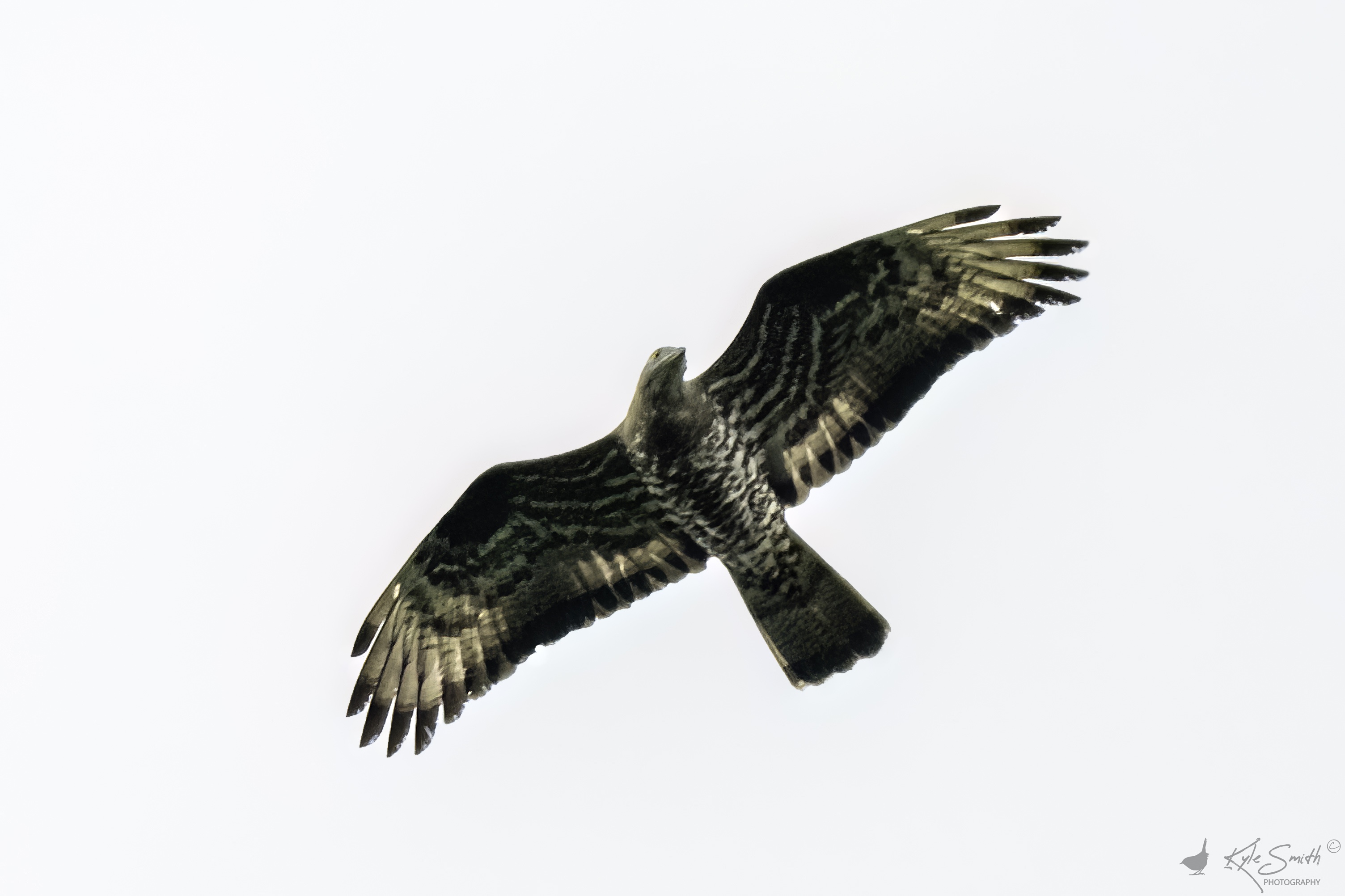
As the morning wore on, we picked up a hawfinch - a nice bonus, especially since five had been reported before we arrived, then followed by a couple of sparrowhawks. About five minutes after the sparrowhawks had vanished over the ridge, one reappeared, this time trailing behind a buzzard. I called the birds out, and Nick quickly confirmed the buzzard was a honey. We all started firing off shots as it drifted low through the valley - a challenge, as it often slipped behind the treetops. Eventually, it climbed higher into the open sky before dropping out of sight altogether.

Honey buzzard
Honey buzzard
Honey buzzard

It seemed an age before we got another sighting, again the honey buzzard with the damaged wing - it was above our head and circling. As we watched it one of the other birders called a second off to our right, which then flew over us and then climbed into the sky, higher and higher.

Honey buzzard
Honey buzzard
Honey buzzard
Honey buzzard
Honey buzzard
Honey buzzard
Honey buzzard
Honey buzzard
Honey buzzard

As the bird roses on a thermal, it suddenly snapped its wings together above its back in two sharp claps, a brief but striking display of power. The action was over in seconds, but unmistakable: a rapid clap-clap in mid-air, followed by a soaring glide. It’s a territorial or courtship display, and always one of the best ways to confirm you’re looking at a honey buzzard rather than a common.

Honey buzzard

Across the far hillside, we spotted a peregrine falcon and followed its flight for a while, though it remained frustratingly distant. We lingered a bit longer in hope, but eventually it was time to call it a day and head for home. Another fantastic day out.

Year list: 204.

Sunday, 14 April 2024

Grimsbury Reservoir, Berkshire & Otmoor :: 09 & 13 April 2024

I left work just after 6.00pm and when having dinner, noticed an update on the Banbury Birders WhatsApp that two Arctic terns had been found at Grimsbury Resevoir by John Friendship-Taylor @987jonty. There was a follow-up message from Kev Heath @kev07713 to say they were still present and that there were also yellow and white wagtails. My wife said she was going to pop to the shops and so I decided to nip back to the other end of town and see if I could tick these long-distance migrants.

Arctic terns undertake one of the longest migrations of any bird species, traveling from their breeding grounds in the Arctic to their wintering grounds in the Antarctic, and back again; they cover an astonishing distance of up to 44,300 miles round trip, equivalent to traveling more than twice around the circumference of the Earth. They typically arrive or passing through the UK in late April to early May, and breed in colonies located in the Arctic and sub-Arctic regions, including the British Isles, nesting on coastal cliffs, rocky islands, and sometimes even on floating icebergs.

I arrived to find Mark Ribbons, and Kev & Karen Heath watching the birds feed across the water, unusually not diving for fish but seemingly catching flies over the water. As the light fell, and we sheltered from occasional rain showers, the terns gracefully worked up and down the water, never diving in. Kev picked out the yellow wagtail through his scope on the far bank (also a year tick for me) but couldn't relocate the white wagtail. A good couple of mid-weeks ticks - I usually don't bird in the week.

Arctic tern
Arctic tern
Arctic tern
Arctic tern
Arctic tern

Saturday arrived, and we agreed to drop down into Berkshire for nightingale and Dartford Warbler - nothing like the sound of nightingales in the Spring. They typically arrive in the UK in April, marking the onset of spring, their arrival coinciding with the availability of suitable breeding habitat and the emergence of insects. Nightingales undertake an arduous migration journey of thousands of miles, crossing the Mediterranean Sea and Sahara Desert - the exact route and distance covered varies between individuals and populations, but they typically travel several thousand miles. Once they have established territories, Nightingales begin to sing to attract mates and defend their nesting sites. Their beautiful and melodious song is a hallmark of spring in the UK, filling the air with rich, flute-like notes during the dawn and dusk hours.

Arriving onto site we set off across the gorse-rich and bush/tree lined perimeter immediately seeing a chiffchaff coming off the ground and a very vocal common whitethroat in the hedges, giving me a run-around to get a photo; this is my first of the year.

Whitethroat

We walked on, watching for Dartford's but seeing plenty of stonechats when Kev stopped and pointed to where he'd heard the start of a nightingale call - then it went into full song, and we moved along the path to see if we could get a view. For a good 15 minutes we couldn't see it but could easily narrow it down to an area; we simply enjoyed the song. Eventually we caught some movement and could see the bird but when it stopped again it was still deep in the bush and I couldn't get a clear line for a photo - we'd have had to walk across to the bush and that wouldn't have been acceptable, especially as it was on territory. A year tick in any case. Behind and through the trees I could see a male bullfinch - that has taken a while to tick this year!

Nightingale

We saw and heard a woodlark high in the sky but out of reach and when it dropped it was far over and in the region of tall dense trees. We picked out a Dartford warbler in a low tree just as it dropped down and out of view, into a patch of low gorse. Within a couple of minutes, it popped up and shot left into a further line of gorse. Yet another year tick.

Dartford warbler
Dartford warbler

We circled back at the end of the path and found lots of dog walkers with their beasts off lead - while most were not distracted we saw one chasing a pair of muntjac deers, completely out of control - really there should be signs, especially at this time of year where there will be a lot of ground nesting birds - and to protect against dogs with insufficient training. While being flushed left and right by walkers (mostly with dogs), a wheatear fed along a stretch of grass close to us. So far this year I've been unable to get close enough to one for a photo - here was my chance. Beyond me a handful of linnets and meadow pipits fed on the ground and I picked out a whinchat but it was flushed before Kev could get on it.

Muntjac deer
Wheatear

We followed a path running parallel to the one we'd come out on, and heard another nightingale behind, deciding not to search for it. A Dartford perched in a tree ahead but against the bright sky and so it was a job to pick out the features. Another stonechat, this one a female perched low on some gorse to the left and four/five house martins dropped on a large puddle ahead before leaving as quickly as they arrived.

Dartford warbler
Stonechat

While we heard more woodlarks, today was not our day for a close encounter and so after reaching the end of the circuit we stopped for a coffee before making our way back to RSPB Otmoor to see if we could pick up any warblers recently returned.

There was a lot of water in the car park at Otmoor which rendered a number of the spaces relatively unusable/undesirable. We waited for a chap and his sone to pack up and depart to take their spot. We turned the first corner and came across a vocal and showy chiffchaff, dancing around the base of a hedgerow - it exhibited a strong supercilium which caught our attention, although it already had to be honest, especially the way it flapped its wings as we watched.

Our key now was to follow the bridleway and see some sedge warblers, which we did very quickly, however getting one out in the open for a photo was somewhat of a challenge. The birds were in general out of sight - a couple from Somerset stopped for a chat and remarked how subdued it was now, compared to when they arrived at late breakfast time. There were quite a few marsh harriers over Greenaways and some interactions with the red kites, but it was all rather quiet. There were brimstone and peacock butterflies and our first dragonfly of the Spring, but nothing really to excite.

Chiffchaff
Brimstone

We then managed to get a sedge warbler that didn't mind being seen and I got my photo. Another first of the year but we couldn't locate a reed bunting or any other migrants just in.

Sedge warbler
Sedge warbler

It had been a good day out with some cracking migrants just in, so we pulled stumps, and I dropped Kev back home. I'm away on business for the next week and so it will likely be a couple of weeks before I get out again.

Year list: 180.