Sunday, 9 September 2018

Daventry Country Park :: 09 September 2018

It has been a while since I ventured over to Daventry Country Park Spotted flycatcherbut with reports of 2 x pintail and a garganey I thought I would give it a go. Just as was about to leave home, @987jonty posted that he'd had a wigeon, marsh tit, a flower yellow wagtail and a spotted flycatcher at Grimsbury Reservoir. I haven't managed to catch up with a spotted flycatcher and thought about heading there - I haven't seen it there when I have so kept to my original plan.

The sun followed me over and the weather was good on arrival - £2 paid for parking and onto the reservoir for an anticlockwise circuit - it just feels right that way. Quite a breeze off the water as I went along the dam with no slight of the garganey or pintail.

ChiffchaffApproaching East Bay I saw some birds catching flies above the tress and stopped to watch - luck was on my side as it turned out to be a spotted flycatcher [#140]. Watching I then saw willow warbler and heard chiffchaff. I couldn't help think that I might be able to get a better view from further into the trees. A path headed in that way but soon ran out - I pushed through and watched to see what I could find. The glade opened ahead and I was treated watching spotted flycatcher, blackcap, treecreeper, willow warbler, chiffchaff, goldcrest, great spotted woodpecker and an array of tits all feeding ahead of me. In the end I stayed quite a while enjoying the show.Treecreeper

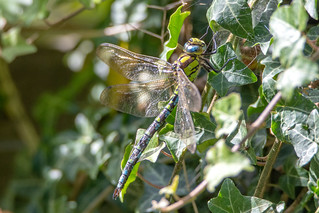
Further on I came across a southern hawker dragonfly, resting on some ivy followed by a common darter. Back on the water I spied the water's edge and picked out wigeon, teal, gadwall, shoveler, Canada geese and lapwing.

After a spot of lunch I sat on the dam and looked out to see if I could see the garganey amongst the feeding teal - no joy. Was it going to elude me again? In a last-ditch effort, I circled back to see if I could peer through the gaps in the trees to the feeding ducks. I took a series of photos and on returning home one was confirmed as the drake garganey [#141] in eclipse plumage - result!Southern hawker
Sightings today (34) included: black-headed gull, blackcap, blue tit, bullfinch, buzzard, canada goose, carrion crow, chaffinch, chiffchaff, cormorant, gadwall, garganey, goldcrest, great crested grebe, great spotted woodpecker, great tit, house martin, lapwing, lesser black-backed gull, little egret, long-tailed tit, magpie, mallard, moorhen, nuthatch, shoveler, spotted flycatcher, starling, teal, treecreeper, wigeon, willow warbler, woodpigeon and wren.

Sunday, 2 September 2018

Farmoor Reservoir :: 02 September 2018

A tremendously good time at Birmingham Symphony Hall last night, entertained by Ward Thomas, Imelda May and Texas. A late arrival home but awake by 6.30am. I decided to drop into Farmoor Reservoir as the weather was to be good and changing Monday.

The water was calm when I arrived and still too early for most to be out in boats on F2. Almost the first bird up was a little grebe diving beside the valve tower.Little grebe A number of coot were diving alongside. A father and his two children were feeding ducks and a dozen or so juvenile black-headed gulls.

I headed for the causeway and soon picked out terns working along F1; there were 6 and appeared to be the black terns [#138] I'd missed all year. Three guys were seated by the first set of buildings, watching the terns; they appeared to be over towards the other bank but we all decided they were probably closer to the middle. I continued on but didn't see anything on the causeway, other than Canada and greylag geese. As I passed one group though, Dunlina juvenile dunlin fed at the waters edge.

I reached the end of the causeway and decided to make a circuit of F1 and hope to get closer to the black terns. As I went round they always seemed to be distant, as I had feared. I did come across calling chiffchaff and a number of willow warbler. As I sat and watched the tern I saw a couple of birds cutting across the surface of the water and took a couple of photos - it turned out to be a yellow wagtail [#139] chasing a common sandpiper; these sandpiper seem to get chased a bit and I remember seeing similar behaviour at Grimsbury Reservoir, although on that occasion it was pied rather than yellow wagtail. Black tern

I took a few record shots of the terns but they never got close enough for a proper shot.

As I passed the water treatment buildings I saw another (same?) yellow wagtail and a small flock of linnet. Ahead I also saw a kestrel on a fence but it moved ahead before I got close.

I had another look along the causeway before I headed for home, but the tern were still far out. I bought a coffee to get change for the car park barrier and headed home.

Sightings (30) included: black-headed gull, black tern, Black ternblue tit, buzzard, canada goose, carrion crow, chiffchaff, common sandpiper, coot, cormorant, dunlin, goldfinch, great crested grebe, grey heron, grey wagtail, greylag goose, kestrel, lesser black-backed gull, linnet, little grebe, mallard, moorhen, mute swan, pied wagtail, swallow, teal, tufted duck, willow warbler, woodpigeon and yellow wagtail.

Sunday, 26 August 2018

WkWT Brandon Marsh :: 25 August 2018

No sooner than we arrived in the car park and put on our boots, than the heavens opened - we had to run for the cover of the Visitor Centre. No point in heading out yet as we would get soaked and hadn't bothered with waterproofs; after all it was meant to be dry (Sunday forecast to be wet). Started with lunch and watched the tits and finches on the range of feeders outside the window.

After lunch the sun came out and we decided that the shower had past. Taking our usual route round New Hare Covert we hoped to see the spotted flycatchers reported the previous day. Strangely I caught up with Charlotte and she was waiting under a tree - apparently she thought it would make good cover from the rain - although it wasn't raining ... yet. I suggested we push on to the tall trees as it would likely give us better cover (mistake). Water railWithin 25m the rain started and we hurried to some trees ahead and took refuge - the rain only got heavier and over around 5 minutes we started to get quite wet. With no let up in sight I decided to make a run for it to the larger wood - even though this would mean running through heavier rain, I was already wet. Once there we were better protected but not completely out of the falling rain. Standing still we were able to pick out a treecreeper on the opposite side of the path to our usual.

The rain started to ease and we pushed on. Just beyond the turn to the Wright Hide we came across a small flock of willow warbler to our right (Swallow Pool) - Water railat least 7. From the hide we had geese, lapwing, coot, moorhen (and young of the latter two). There were also numbers of teal and gadwall in eclipse.

On to the East Marsh hide. As we entered there was a couple already in residence - they excitedly told us that they had been watching a pair of water rail in front of the hide for the last 20 minutes. On Thursday they had been trimming and cutting banks and islands on the East Marsh pool and this must have exposed the area ahead of us - although disrupted this seems to have drawn a crowd! - two showed briefly but one chased the other back out of sight.

We waited only for a couple of minutes Green sandpiperand out popped a water rail, which I assume is a juvenile due to colouring and feathering. We were entertained but with increasingly heavy skies overhead. The rain started again and as it did a green sandpiper dropped in to the waters edge. It only stayed a moment as it was quickly chased away by feeding moorhen chicks. The chap showed us a photo to see if we could identify it and it was a greenshank - it had been in front of the hide for just a minute and been chased away by the coot and moorhens - I wasn't to see one this time. The rain chucked it down and we decided to stay put.

Carlton and Ted Jury Hides were very quiet and yielded nothing of any consequence, Willow titalthough we did see a small group of whitethroat between the two.

We dropped into the Baldwin Hide on our way back but didn't add to our sightings on the water, seeing only a small flock of long-tailed tits working along the trees at the waters edge.

When I left the hide I saw some birds chasing one another on the tops of the trees but couldn't pick out what they were. I stopped and waited but Charlotte soon got bored of this and headed up to the tea-room to pick up a hot chocolate and coffee before it shut at 3.45pm. I soon managed to view the birds and found they were garden warbler. Satisfied I went back to the reserve Visitor Centre but as I passed the Carlton ditch I saw a bird flash to my right, sporting a black cap. Waiting, it turned out to be a pair of willow tit. Absolutely gorgeous.

Sightings (36) included: black-headed gull, blue tit, buzzard, canada goose, carrion crow, chaffinch, common tern, coot, cormorant, dunnock, gadwall, garden warbler, great tit, green sandpiper, greenfinch, grey heron, greylag goose, house martin, lapwing, long-tailed tit, mallard, moorhen, pheasant, reed bunting, robin, rock dove / feral pigeon, sand martin, swallow, teal, treecreeper, tufted duck, water rail, whitethroat, willow tit, willow warbler and woodpigeon.

Friday, 24 August 2018

Grimsbury Reservoir :: 23/24 August 2018

On the Oxon Bird blog, Thursday morning, Colin Wilkinson reported green sandpiper, redstart and two wheatear at Grimsbury Reservoir. @987jonty also reported a teal and two sand martíns. At lunchtime @987jonty visited again and located the wheatear on the west side of the reservoir. With my work laptop out of action, I decided to drop in and have a look - after all, I’d managed to miss wheatear all through the spring.

I made a full circuit and couldn’t find the bird at all. As I left the site I turned to look back at the sailing club building. A small bird was hopping around the kerb and it turned out to be a female wheatear [#136]. Result.

Today, again at lunchtime, @987jonty spotted a redstart in the hedge between the cattle field and the waterworks. I was just starting lunch I thought I would drop in again. As I neared the reservoir my photo chimed and reported @987jonty had now spotted a whinchat. Although I arrived within just a couple of minutes, the whinchat had flown off across the cattle field. I chatted to John and waited to see if the restart would show - eventually John left and I continued to vigil. Eventually the redstart [#137] obliged.

I finished a circuit of the reservoir but no joy with the whinchat, or the yellow wagtails John had over.

Sightings (18) included: black-headed gull, blackbird, canada goose, greenfinch, grey heron, house martin, jackdaw, kestrel, magpie, mallard, mute swan, pied wagtail, redstart, robin, rook, wheatear, whitethroat and woodpigeon.

Tuesday, 14 August 2018

Bicester Wetland Reserve :: 13 August 2018

The August meeting of the Banbury Ornithological Society (BOS) was an outdoor meeting at Bicester Wetland Reserve; the entrance to the reserve is immediately past the Bicester Avenue retail park/garden centre on the edge of Bicester.

Bicester Wetland Reserve is managed by the BOS on behalf of Thames Water. This is a member-only site due to the hazardous nature of heavy moving equipment and hazardous areas. The site can be locked at any time by Thames Water, therefore keys are vital.

The reserve manager Alan Peters gave an introductory talk about the site and about viewing from three hides. Created in 1999, Bicester Wetland Reserve was the result of an agreement between the BOS and Thames Water. The 7 hectare site was previously used for the disposal of sewage sludge from the nearby sewage treatment works. Channels and scrapes were excavated with supporting bunds and water control mechanisms.

Green sandpiperWe split into groups as it wouldn't be possible for us all to visit the hides at the same time. David Tustian was with me and we chose to start at the far end of the reserve at the new hide by the railway. Here there is a small pool of water who's fringes are churned up into mud by grazing cattle. We entered the hide and were pleased to see a handful of green sandpiper [#134] - new for the year. These birds move between the main scrape and this pool and as we watched most did so, with others returning. Three snipe fed in the shallows and a couple of grey heron stood watch.

As we walked back we stopped at the middle hide. From here we could look back and see various wildfowl and a couple of little egrets. ChiffchaffA family of magpies made noisy conversation and four buzzard quartered the other side of the railway tracks.

As we set off back to the main hide we talked with Jo and Chris Morgan and found out that they had seen some bird ringing - a juvenile blue tit. Colin Wearn (who conducts ringing on the site) had his mist nets in place for a ringing demonstration. We got back and luckily they were just setting off to collect any other birds caught in the nets - this time a juvenile chiffchaff.

Watching from the hide a group spotted a water rail [#135] skulking in the far fringes across the water - soon lost heading right and behind reeds.

WhitethroatAnother visit to the nets yielded two more birds: another chiffchaff and a common whitethroat. I had a chat to Colin and he told me about his visits to Ascension Island to survey and study the sooty terns - he also showed me some photos and video on his camera. We also talked about his ringing demonstrations at Countryfile Live at Blenheim the previous week - he also had great photos of elephant hawk moth caterpillars in standard brown, but also green livery.

As we prepared to leave, the house martins that were skating cross the pools were first joined by a few swallows and then up to 9 swifts. No sooner had we started to talk about the swifts that a cloud of swallows descended and filled the sky. They then skimmed the pools and provided a spectacular sight.

A great visit and hopefully I can get back at the right time to catch up with the water rail in the winter.

Sightings (25) included: black-headed gull, blackbird, buzzard, canada goose, carrion crow, chiffchaff, coot, gadwall, green sandpiper, grey heron, house martin, little egret, magpie, mallard, moorhen, pied wagtail, rook, snipe, swallow, swift, teal, tufted duck, water rail, whitethroat and woodpigeon.

Saturday, 4 August 2018

Seamill and West Kilbride :: 30 July - 03 August 2018

Our summer visit to my parents in Scotland usually results in a number of coastal walks, before breakfast each morning. I almost managed each of the five days but on Thursday we opted for a shopping trip with the girls to Silverburn in Glasgow.

Ever hopeful I was on the beach by 6.40am and noted the usual suspects at the bottom of the burn leading into the sea - lots of gulls, carrion crows, rooks and jackdaws. I turned and headed for the bridge that crossed the burn hoping to see the dippers - my last few visits have resulted in zero sightings, I suspect due to the rebuilding of the wall beside the burn and the disturbance this caused. Unfortunately no sign.

Ringed ploverAlong the beach and I picked up linnet, redshank, curlew, oystercatcher and gannets out to sea. I stopped and watched some rocks, picking out some juvenile dunlin who comically hopped higher and higher up the rocks as the sea came in. Both shag and cormorants out at sea with shelduck flying past (single).

As I returned to the hotel I watched sand martins entering the pipes in the hotel retaining wall. These were joined in flight by house martin and swallows.

Dipper juvenileThe next morning I was back on the beach but on this occasion was overjoyed to see a juvenile dipper feeding ahead. This was followed shortly by close views of an adult. Out further along the coast to the Waterside Inn I had good views of ringed plover and willow warbler. Out to sea I could also see a pair of sandwich tern fishing.

A ringed plover started calling and then lead me away from where it must have been nesting. It clambered across the rocks, making sure I was paying attention and following.

On the third morning I decided to head out to Portencross beach and hoped to catch up with e sandwich terns that usually hang out on the rocks. Unfortunately there were none. DipperTo begin with there wasn't much else but eventually as the sea went out small mixed flocks of ringed plover and dunlin arrived. Not the best morning I've spent there!

On my final morning I saw some interesting looking ducks and got quite excited - they turned out to be juvenile shelduck. No sign of the dippers as I headed out but I came across a young willow warbler in the hedge ahead. As I reached the turn I saw small flocks of linnet and meadow pipit. As I watched I saw a pied wagtail chasing a linnet along the beach. The linnet dropped and then sized up to the juvenile pied wagtail. After a short standoff, the linnet flew at the pied wagtail and then off Linnet vs pied wagtailback down the beach with the wagtail in pursuit. I thought this odd behaviour but then remembered the juvenile pied wagtails at Grimsbury Reservoir chasing a common sandpiper earlier in the summer.

The ringed plover performed the same show as I passed.

Back at the burn I found that the juvenile dipper was feeding, further out of view than my previous visit. Glad they are back and looking forward to following them again.

Willow warblerSightings on my walks (42) included: black-headed gull, blue tit, carrion crow, common gull, common sandpiper, cormorant, curlew, dipper, dunlin, dunnock, eider, gannet, goldfinch, great black-backed gull, grey heron, herring gull, house martin, house sparrow, jackdaw, lesser black-backed gull, linnet, magpie, mallard, meadow pipit, mute swan, oystercatcher, pied wagtail, ringed plover, robin, rock dove / feral pigeon, rook, sand martin, sandwich tern, sedge warbler, shag, shelduck, song thrush, starling, swallow, whitethroat, willow warbler and woodpigeon.

Tuesday, 10 July 2018

Grimsbury Reservoir & Farthinghoe Nature Reserve :: 09 July 2018

An update at lunchtime confirmed that the mandarin duck was still present at Grimsbury Reservoir. It was also reported that an adult yellow-legged gull was also present so I thought I would drop in.

Mandarin duckNo sign of @987jonty so I started off on a clockwise rotation. It was unfortunate but the mandardin was sitting out in the middle of the reservoir so just record shots. The yellow-legged gull (#131) ticked I also saw a single common sandpiper being chased across the water by the many juvenile pied wagtails along the bank. Lots of song at the far end but all I managed to pick up was a single whitethroat.

In the evening was the second Banbury Ornithological Society outdoor meeting of the summer. We visited Farthinghoe Nature reserve. This lovely little reserve is managed by volunteer warden Tim Pridmore. MothThe reserve can be found off the A422 towards Purston. We parked in the farmer's yard and set off from there.

This long, narrow, amazingly diverse site is now a mosaic of developing woodland, open grassland and ponds. The meadows are improving each year as a result of the management plan which includes harvesting hay late in the year to maintain low soil fertility. This has led to the welcome return of some of the old meadow flowers such as lady’s bedstraw, meadow vetchling and snake’s head fritillary. The ponds and wet areas attract dragonflies and damselflies from the nearby lake and stream and in late July it is possible to find Green woodpeckerbeautiful demoiselle damselflies in good numbers. There is also a colony of marbled white butterflies on the site. Pipistrelle and noctule bats find an ideal hunting ground here.

Tim was so knowledgeable about all aspects of his reserve and made it a very worthwhile visit. We were limited to a small number of bird species but were luckily to see a handful of mistle thrush over and a family of green woodpeckers on the other side of the field.

I think we will all be back when the weather is more conducive to sightings. Maybe couple it with a visit to Thenford in the winter to look for hawfinches.

Sightings at Farthinghoe (16) included: blackbird, blackcap, blue tit, buzzard, carrion crow, chiffchaff, goldfinch, green woodpecker, jay, long-tailed tit, mistle thrush, pheasant, pied wagtail, robin, swift and woodpigeon.