Sunday, 26 February 2023

London, Otmoor & Stanwick Lakes :: 18/19 February 2023

Kev Heath (@kev07713) and I arrived at Staines Reservoir, stopping for breakfast on the perimeter road. As we climbed into the car a single ring-necked parakeet flew over (year tick) - how many of these would we see today!, they are now prolific across the capital. We pulled up in a layby by a track that leads up to the causeway, off the main road running between Staines Reservoir and the King George VI Reservoir. It was grey and a stiff breeze blew (roughly from the north) which made us think that the birds on the water may take shelter on the northern end below the protection of the causeway - wrong. There were a number of wigeon, coot, goldeneye and teal but the majority of the ducks were at the southern (inaccessible) end. Scanning through the ducks by the causeway, we came across a lone black-necked grebe swimming in the line of wigeon - it broke off and made its way left and further out - a record shot is all we would get.

Black-necked grebe
Goldeneye

Kev set up his scope and we scanned distant ducks, sleeping on the water and water’s edge of the concrete bowl - later I would measure the distance and they were ½ mile away! We picked out the lesser scaup in amongst the pochard and despite the distance and with only line of sight to go by, I took some photos - amazingly (with a bit of cropping) I had a record of the bird.

Lesser scaup

Did you see it? ... Kev heard a pipit go across that he was convinced was not a meadow pipit, but it was lost from view. Soon I strolled along the causeway to see what I could find - I came across a couple of meadow pipit and then in the distance a water pipit; before I could get a photo it was up and away, heading back down the causeway to Kev - I called him on WhatsApp but he had his phone on silent accidentally. The bird kept flying through and onto the western bank, but I didn't see it land. I worked further along spotting further mipitsand returned to where Kev was still stationed.

When I got to Kev he decided to do the same as me and called to say there was a light bird flitting ahead of him but when we got views it was only a very pale (white almost) mipit.

Meadow pipit

We scanned constantly to see if we could find anything else but it was only when we were walking to leave a single linnet dropped onto the fencing.

Linnet

We arrived at WWT London Wetlands at Barnes and instantly heard the call of parakeets. It didn't take until we had eyes on them, in trees and on the Visitor's Centre. They are amazing birds to be seeing in the wild - we have a few in Banbury but the population in London has exploded. The birds on the Visitor's Centre were particularly interested in our comings and goings - they appeared to be hanging around nest holes in the bricks.

Ring-necked parakeet

We headed out over the reserve and scanned the water but there was nothing unusual about - the water pipit and bittern didn't make a show. We overtook a mute swan on the path and stopped hoping to see one of the calling Cetti's warblers but with no luck. It was an enjoyable visit but not much to excite. We stopped for lunch and made a plan of action - we'd head home but drop into RSPB Otmoor on the way.

As we left, we found a couple of pairs of parakeets showing the love.

Ring-necked parakeet

We arrived at Otmoor and found the car park relatively busy but with a few spaces remaining. We scanned as we made for the bridleway but with nothing notable to report, although with significant numbers of golden plover on the ground. Marsh harriers cruised across Greenaways and beyond and on setting off along the bridleway I picked out the visiting black swan as it took to the air and departed. A good-looking bird with great white wing feathers - not sure I've ever seen one in flight before. We stopped to watch kestrels hunting and multiple marsh harriers passing low through Big Otmoor. This set up golden plovers and lapwings on a regular basis and was a fantastic spectacle.

Kestrel
Marsh harrier

We heard calls from Cetti's warblers and water rails but couldn't lay eyes on them - no surprise there. We stopped to talk with another birder and waited to see if the bittern would grace us with a view - as we talked a sparrowhawk snuck along below the height of the reeds along the ditch between us an Greenaways, eventually cutting across and behind the reeds beyond. There were a couple of curlews feeding in the far grassy fringes of Greenaways and we saw further distant passes of marsh harriers. Things are hotting up and the harriers seemed more active than recent visits. The chap we were talking to mentioned he had seen a ringtail hen harrier from the bridleway earlier - we had no repeat and made our way back to the car and home.

On Sunday morning Kev was to travel with two Karens (wife and sister) and sister Karen's partner Dean to Conway for a spot of sea watching - I had some things to do and made do with an early trip to Stanwick Lakes to see if I could see the bearded tit. I've been trying to get a decent photo (in fact any) of this species for over a year and failed to date so was really keen to have a go - reports suggested the bird showed well and reasonably regularly, although took until mid-afternoon to appear on Saturday.

I reached the "green causeway" and the area that the bird has been seen regularly. There was one birder already walking the causeway but relayed that he had neither seen nor heard the bird so far. I decided to work the redds along the causeway and it was only 20m further on that I turned to see the bird feeding atop the reed seed heads. I snapped a couple of shots and called the other birder to come and join me. Gradually others joined until we were about 10 in number. The bird took no notice of us and was happy to feed with us all close and observing - to say it was showy was a massive understatement.

Bearded tit
Bearded tit
Bearded tit
Bearded tit
Bearded tit
Bearded tit
Bearded tit
Bearded tit
Bearded tit
Bearded tit
Bearded tit
Bearded tit
Bearded tit
Bearded tit
Bearded tit
Bearded tit

Craig Churchill (Instagram @craigchurchillphotography) arrived and I recognised him from a visit to see brambling at Banbury Ornithological Society's Balscote Quarry Reserve. He remembered me too and chatted as we marvelled at how close the bird was showing. Having been afforded great views I had to depart and head home and get some household chores done before starting the new working week.

Year List:  143

Wednesday, 15 February 2023

Around Parkend & Great Tew :: 11/12 February 2023

We set out on Saturday morning with four species on our target list: hawfinch, goshawk, dipper and black redstart. Kev (@kev07713) and I stopped for breakfast on the way as we tend to on more distant trips, but were still pulling up in the parking beside Parkend Cricket Club not long after 8.00am. We watched from near the car for a short while and then popped across to talk to a couple who were now sitting on a bench to the side of the trees – this is apparently where hawfinches have been seen and are regular each year – the couple had been in the area for a couple of days and had previously seen birders watching so thought they'd have a look too. After a short while they left to have breakfast themselves. Another birder arrived – apparently a local - we joined him under the canopy of the trees on the roadside and he told us which trees the hawfinches favoured. It was only a few minutes, and we were on four … and then eight. Kev had his scope set up and we had good views but with lots of branches in the way. The birds being distant and high, photos were at a premium.

Hawfinch
Hawfinch

As we watched, another birder joined us, and then two more. We tried to give the birds space in the hope they'd drop down to feed but they never did. We thought to give it some time and dropped down to the bridge over the stream to see if any dippers were showing (Kev's sister Karen and her partner Dean @hobbylovinglife @worlebirder has seen two when they visited last). We gave it time but no such luck. We returned to the hawfinches and set up again to be joined by another birder - the birds were in exactly the same spot as when we'd left. We waited for another quarter of an hour and decided to call time and made for the church to see if we could find any crossbills. We parked up and waited - nutchatches, coal, blue and great tits, robins, blackbirds and song thrush all showed but every few minutes some dog walkers would pass through and flush the birds and it took five minutes to reset. After a few of these occurrences we decided that we should try our luck elsewhere and decided upon New Fancy to see what was showing at the viewpoint.

We left the car and bumped into the birder we'd seen in Parkend first thing. He said that he'd had a couple of crossbills quite close at the viewpoint but when there we would see any at all, close or far. We saw siskins fly over as we made our way up - I'd never visited here before and so was amazed by the vista ahead. We had ravens cronking, and flying in the distance, but few other species really. A bullfinch called to our left but never showed. Two couples joined us - we were strung along the viewpoint when one chap called a very distant goshawk - first one and then two. We watched as they separated, and one was lost from view - another ,or perhaps one of the two, was then seen over towards Cinderford. I took photos but the birds were only specks to the naked eye - bins or scope were required - Kev followed them as they displayed.

Goshawk

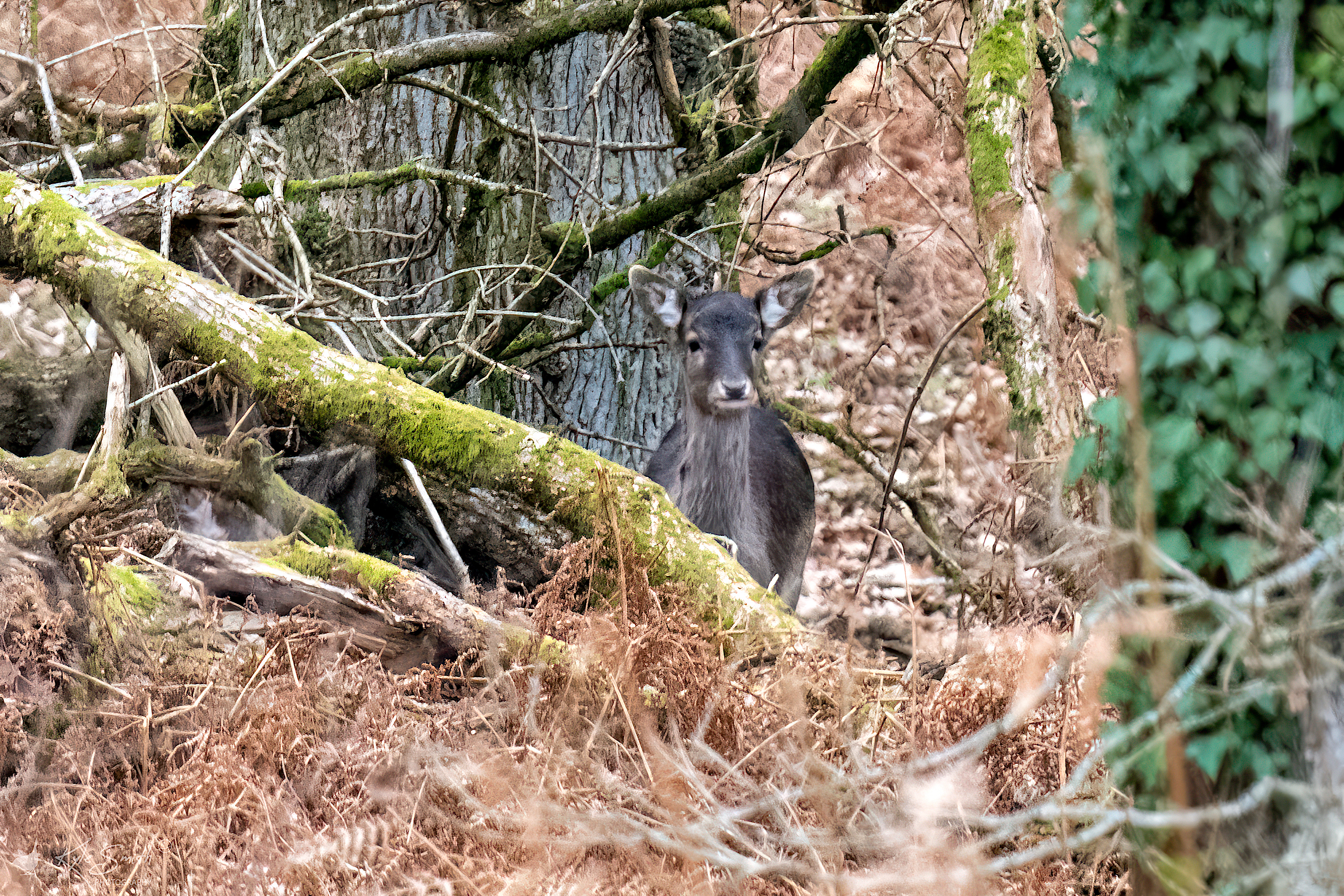
We dropped into RSPB Nagshead but found little of note, although we did encounter numbers of song thrushes, great-spotted woodpeckers, a day-flying bat and a couple of roe deer.

Roe deer

We enjoyed the visit but failed to add anything we hadn't seen elsewhere and so eventually jumped into the car and made for our final target of the day, the long-staying black redstart at Gloucester Cathedral (since mid-November). We pulled up in a parking space alongside the Cathedral and grabbed our kit from the car and as we did so a vicar passed by carrying three boxes of food. Kev stopped him to ask the best route to get into the Cathedral and he said that heading in either direction from where we were would work just as well - Kev joked with him that we could share the food, three boxes and three of us ... he'd been to a meeting with lunch to finish and with too much food they'd distributed it and he would have it for dinner too.

We turned into the Cathedral from the SE side and scanned as we went. Not really stopping as the sightings a couple of days ago had been on the W side. We felt slightly conspicuous with a scope, bins and a camera but we might need all of these if we found the bird. At the W side the number of people increased, particularly at the front entrance where numbers gathered around a statue. The statue is commonly known as Knife Angel, or to give its full title, the National Monument for Serious Violence and Aggression and is displaying here through February. The 27-foot sculpture, made from over 100,000 seized blades from 43 UK police forces, was created to highlight the negative effects of violent and aggressive behaviour. It is stunning and is lit by a rotating colour palette.

Knife angel

While I photographed the statue, Kev hooked up with a couple who were also searching for the bird - they'd already made one complete circuit and were on a second. They told Kev that the bird hadn't been reported since Thursday ... mmm.

We soon scanned in detail, slowly returning round the way we'd come, looking to make a complete circuit. We overtook the couple Kev had been talking to and when we got to a courtyard on the SE Kev called the bird on a rooftop on the opposite side. Tick! We watched as the bird dropped and returned along the apex. Kev went looking for the couple he'd met but they had vanished - what a shame since the bird was showing well.

Black redstart

We soon lost the bird and retraced our steps to see if we could get a better angle of the area it had dropped into. It then appeared and flew along a light stone wall, landing on a perch and moving like a wallcreeper.

Black redstart
Black redstart
Black redstart
Black redstart

Overjoyed with our views we watched as id departed onto the roof beyond and out of view. I walked round and stopped by a walled garden to see if I could catch the bird as it returned to the roof. A couple taking photos of the building joined me at which point the bird appeared on a wall right beside us - what a result.

Black redstart
Black redstart
Black redstart
Black redstart

We then watched as the bird worked the other way round and was lost from view.

Black redstart

We were delighted with our views, Kev had managed to take a photo through his scope, and so we packed up and returned to the car. We'd perhaps stop on the way home to look for field birds around Hawling.

We reached the area and stopped to watch a handful of red-legged partridge feeding, pheasants, a handful of hares, crows and ravens. There were small flocks of finches, largely linnet and significant numbers of redwing. It was a lovely end to a cracking day.

Red-legged partridge

The following morning Charlotte said she wasn't going to get up early and so I popped out to Great Tew where up to eight hawfinches had been showing - the first sighting of the winter was from Ade Buckel on Thursday but up to eight were seen on Saturday. This is around the same time as we had up to twenty in 2022.

I walked along the entrance to the church and held back under the tree by the first bench to keep pressure off the yews in which I presumed the birds were feeding. I found four hawfinches almost immediately in distant trees and then, as they flew left, I saw that there were at least eight. I reported their presence on the Banbury Birds WhatsApp group. I was joined by a birder from Oxford and we waited, adding further distant views. Another handful of people arrived, and I managed to hold them back for a while but eventually they broke forward to view the birds from a position level with the church. Others were arriving, as were dog walkers and everyone ended up milling around. There was little chance that they'd drop down now. I joined them at the church, watched a couple of jays, and eventually walked back and down through the village to see if any were feeding on the yews along the roadside. I walked with the Oxford birder who had decided to make his way back to the car - left in the village car park by the Falkland Arms.

Hawfinch
Hawfinch

The hawfinches were nowhere to be seen and so I eventually bid the chap farewell and made my way back to the churchyard. Even more people had arrived, and they were now standing at the rear of the church with at least seven hawfinches sitting in the high branches of a relatively nearby tree. Still out of reach for the camera - 'environmental' / record photos would be all that people would be getting. Time was getting on, so I returned to the car checking on the opposite side of the wall and around the corner, then hopped into the car and home.

Year List:  138

Wednesday, 8 February 2023

Farmoor Reservoir :: 05 February 2023

My wife had suggested she'd like to see some owls in flight, but my planned trip was replaced by her having a tennis match to play. I opted to pop down to Farmoor Reservoir to see the long-staying female scaup - I'm sure it will depart at some point, and I'd regret not having made the effort.

I started out and met a couple of birders coming the other way who told me that the scaup was showing well from the causeway on F2. There was nothing of particular note on the way there - lots of coot and cormorants. I came across the scaup where it was diving and associating with a handful of tufted ducks. The sun (behind the clouds) was casting the bird into shadow, so I altered my settings and took a few photos, the colour of the light on the water turning out well on a couple.

I decided that as I was here, I should walk around F2 dropping down briefly to the hide near the river. Back on the reservoir I noted a lone common gull and then saw distant snow geese circling the southern end. I eventually got closer and could count c75. I chatted to a chap walking his dog who thought they might be hybrids (greylag and domesticated) - he was soon on his way.

Common gull
Snow goose

It was a brief visit, but 3 miles walked. Glad to have got out and enjoyed the dry weather - you never know what is coming next.

Year List:  134

Acres Down & Shatterford :: 04 February 2023

Kevin (@kev07713) and his wife Karen (@karenheath62) had been to Hampshire in the week and had a haul of birds - Kev suggested he wouldn't mind going back as you can't go to the forests often enough. We stopped for breakfast enroute, soon after arriving at Acres Down in Hampshire in the gloom of the early morning - there was method behind our madness as lesser spotted woodpeckers are starting to be seen and there is a regular area they are seen here, often at first light. We stepped out of the car and noted firecrests around the car park - new for the year for me. I tried for a couple of photos but in the gloom they were hard to follow and I failed miserably - they were then away and into the trees across the road.

We walked down the path listening intently for either a call or a drumming but neither occurred. We heard and watched goldcrests, song and mistle thrushes, nuthatches, lots of marsh tits, and other assorted tits and finches along the route, stopping regularly to scan the trees. It was great to see so many of these forest dwellers, but we couldn't locate our bird. Kev stopped as he heard a brief call and we scanned the treetops, the calls having ceased - I eventually located the source and it was a male crossbill - I reached for my camera but of course this was the signal for the bird to take to the wing and depart - I directed Kev to it and he caught it in flight - another year tick for me.

Eventually we turned back and came across three firecrests crossing back and forth across the footpath between holly bushes on either side. We stopped and I managed to take half a dozen photos as the bird flitted through the branches - only one would be in focus or capture the bird from behind. What tremendous, little birds. We would see more but none that were easy to photograph. A good population here.

We turned around and followed a treecreeper as it landed at the base of a nearby tree and worked up the trunk - another year tick. Can you tell I've not been in woodlands much this year? We recorded all the same birds on our return to the car and despite camping out near the woodpeckers favoured area we left empty handed.

Firecrest
Treecreeper
Wren
Mistle thrush
Song thrush
Marsh tit

We walked up and around to the trails above the car park - from here you could see across the valley and had 360° views. We hoped to see more crossbills, displaying woodlark and goshawk, as Kev and Karen had seen previously.

Acres Down
Roe deer

We walked for about a mile and perched ourselves on an outcrop overlooking the area. Not a single crossbill or woodlark showed. In the far distance we spotted what may have been a pair of goshawks but by the time we got on the scope they’d dropped behind the distant trees and so 'may have been' it stayed. We toughed it out but after an hour or so we repaired to the car and made for Shatterford hoping to find the great grey shrike showing - Kev had found it three times on his last visit but always very distant - our mate Adrian Sparrowhawk had been treated to the bird sitting in a tall tree not far from the footpath - what would we get today?

We made our way from the Shatterford car park to where we could see three birders on scopes along the footpath. On the way there we passed three birders coming the other way who relayed that they had seen the bird in the very far corner by Dennys Wood. We got to where the other birders were stationed and scanned with bins and scope - the bird had disappeared around the wood and been lost from view. After 5-10 minutes Kev said he thought we should move down to where Adrian had seen the bird and from where he had distant scope views previously. We were joined by Steven Carey (@stevecarey33) carrying his serious camera gear but from this new vantage point the bird was not to be seen. We resolved to continue round, stopping at several points to scan again - with bins and Kev with his scope. Other birders came and went but none of us could locate the shrike.

We reached Dennys Wood and climbed the hill through the trees ending up on the ridge overlooking the area the shrike is seen. There would be little further opportunity to find our target and so it was a relief when Kev announced he had the bird on the scope - we all jumped on in turn and thanked Kev for his persistence. A few birders stopped as they passed and were treated with views. The bird was 650-700m away and so getting a photo, even through the scope, was not easy - Kev took a video through his scope (see his post on Twitter) and were able to watch as the bird fed on what looked like a vole. I tried hard but the bird was too far away. Eventually the shrike accidentally dislodged its prey from the tree and after grabbing it in its claws it transferred to its beak and exited, stage right - a moment I captured in video.

Great grey shrike
Great grey shrike

Kev located the shrike a couple of times as it moved along the hedgerow but eventually it was lost from view - despite waiting a further ten minutes we didn't see the bird again. On the return we came across a couple of guys lying in the scrub and Kev asked if they needed a defibrillator - they laughed and told us that they had been looking for nail fungus in the pony dung around the site. It turns out that the New Forest is its stronghold, whilst elsewhere in the UK and in a European context it is largely absent. In fact, it has been described as 'one of Europe's most threatened fungus species' and was included as 'Endangered' in a 1992 Red Data List and as 'Near Threatened' in a 2006 version. It is also a UK Biodiversity Action Plan species and has been somewhat controversially described as 'possibly the rarest fungus in Europe'. I tried not to step on it. In the UK it is thought to be exclusively associated with horse and pony dung and this is where they had found it - we were presented with some ... and we returned it to where it belonged.

Nail fungus

As darkness started to fall a couple of ravens were the last species we saw - we made for home. Although we'd dipped on some of the targets it had been a cracking day, and I was grateful to Kev for returning to an area he'd visited twice recently.

Tuesday, 7 February 2023

Ravensthorpe Reservoir :: 03 February 2023

There has been a ring-necked duck showing at Ravensthorpe Reservoir in Northants for a while now and so after lunch on Friday I decided to pack up work and visit there. I'd never been before but found the visitor's car park closed and parked with two others on the verge just outside. I'd seen two birders as I crossed the causeway and planned to join them, but before I did, they came and joined me - apparently it was easier to see the target bird from the car park than it was from the causeway. I set up my scope and had good views although a bit into the sun (behind clouds) making photos a bit in shadow despite altering the camera settings.

We enjoyed the bird for a while and another birder joined us and the two original guys went to leave - they relayed that they had also seen a mandarin duck in the smaller section on the other side of the causeway. The ring-necked duck fed and floated further and further towards the causeway and eventually we relocated there to see if the light would be any better - it was, and I was a bit happier with the photos.

Ring-necked duck
Ring-necked duck
Ring-necked duck
Ring-necked duck
Ring-necked duck
Ring-necked duck
Ring-necked duck
Ring-necked duck

I crossed the road to the other side of the causeway and although it took a while, I eventually located the male mandarin on the far edge of the pool (maybe 250m away) - it emerged from under the trees and soon disappeared into the low branches again. There were numbers of goldeneye on this smaller pool but none I could see on the main water.

Mandarin
Mandarin

The ring-necked duck had floated off and was heading back to where I had seen it originally and so took my leave and made for home - early for once.

Year List:  126