
With ten days holiday still to take before the end of April I've decided to take the rest of the week off in addition to the Easter weekend. Knowing there was no pressure to do anything specifically, and unable to travel and stay away - Charlotte knackered her back and foot and was awaiting treatment - I made a few short trips out.
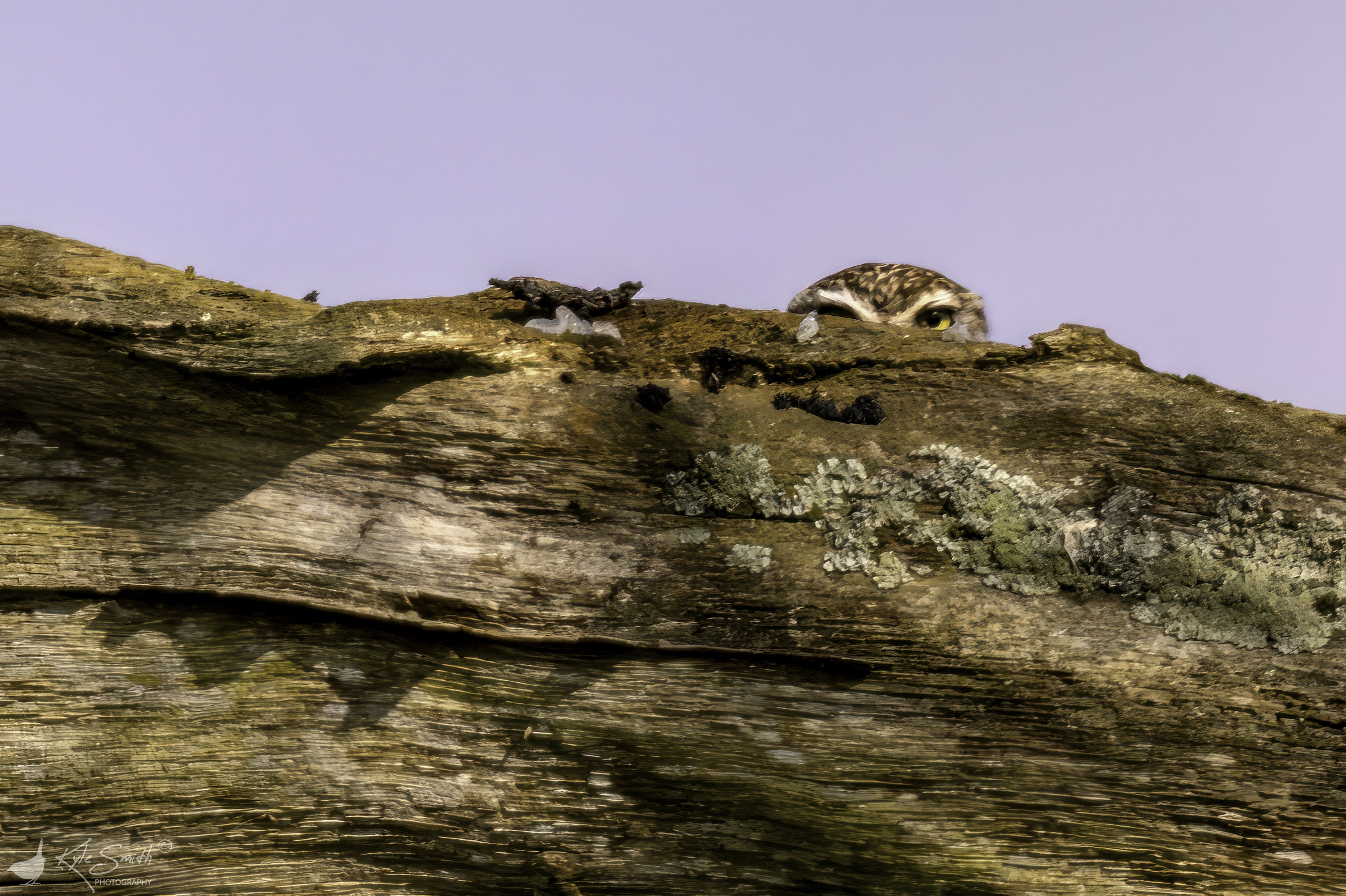
Over the last week or so a local little owl has been seen again and after a short view last week I popped out to try again in some better morning sunshine. It was only a few minutes before I found the bird and then repositioned to have a better view. During winter, little owls generally remain within their territories but become less active during the day, preferring to conserve energy and shelter in their territories. Recent sightings seem to suggest we have seen a change in behaviour -
Spring is sprung, the grass is riz.
I wonder where the birdies is.
Some say the birdies is on the wing, but that's absurd.
I always thought the wing was on the bird.
(Author anonymous)


I called Kev to let him know that there was a bird out and soon he joined me, enjoying good views in the part sun - Edwin Barson dropped by too. All too soon is was time to leave as I'd left my family all still in bed and it was probably a good idea to return before they were up and about. Just as we were about to leave the owl flew up and behind a dead branch with just the top of its head and eyes visible above, perhaps assessing the safety of its environment but definitely with its eyes on us.
Later we went for lunch at a local garden centre in Bicester and on the way out I asked if we could drive by the Bicester Wetlands Reserve field where a pair of little ringed plover are showing currently. It was very much a drive by visit but I was able to pick out the birds, although very distant for photos. With the warming weather and lengthening days, these plovers migrate back to their favoured habitats of sandy riverbanks, gravel pits, and open shorelines. Their arrival heralds the onset of the breeding season, during which they will establish territories, court potential mates, and build their shallow scrape nests on the ground. Known for their distinctive yellow ringed eyes and sandy-brown plumage, little ringed plovers patrol water edges in search of small invertebrates and insects to feed upon.

The following day we eventually got round to going out for a coffee and a walk - with Charlotte's ailments somewhere flat and with solid ground was called for and so we dropped into Farmoor Reservoir. We crossed the causeway and found a single turnstone on the F1 shore, out of the wind. There were more people than birds on and around the water, so we dropped down into a hide by the river and sat for a while. We sat with the Merlin Bird App open and watched as it recorded the species calling around us - we were amused as it reported great bittern, as we didn't hear anything resembling that - the App is good but not perfect. We returned to the Visitor Centre cafe and had a coffee returning home having had a nice walk but little in the way of interesting bird species.


Wednesday arrived, and Charlotte would be tied up with her chiropractor appointment/assessment/treatment so I decided to check if Kev @kev07713 would be allowed to come out and play - he was, and even better his wife Karen @karenheath62 said she'd come along too. We looked at the weather forecast and decided the south coast looked best/driest and opted for a visit to Lymington and the Keyhaven Marshes - we always find something of interest there. We drew up in the yacht haven after a journey interrupted with our customary breakfast stop and found it was very windy. We got kitted up and set off along the Solent Way past Normandy Marshes and Lagoon, spotting a calling Cetti's warbler as it relocated back and forth across our route - it never perched in view and the views we had were always in flight and away (as they often are).
Now out in the open we realised quite how windy it was - hopefully it might drop at some point (and soon). We stopped hoping to see a spoonbill over the marsh, lagoon, or shoreline but there were none - I think this is the first time we haven't connected with one. We reached the edge of the lagoon and picked out around twenty snipe, spotted redshank and a greenshank associating with one another, and a handful of black-tailed godwits; the godwits have undertaken a long migratory journey from their wintering grounds, often spanning thousands of kilometres, to reach their breeding sites in wetlands, marshes, and coastal areas. Upon arrival they undergo a remarkable transformation in plumage, as their breeding attire emerges in hues of rich chestnut, orange, and copper, accentuated by their striking, black-tipped tails and white wing bars. The spotted redshank in contrast had not started transitioning into its distinctive dark breeding plumage.


We fought around the lagoon against the wind, deciding to drop down to the lower path to try and get some respite. Here we had close views of avocets, a couple of ringed plovers, little egret, two female red-breasted mergansers, dunlin and redshanks. While we there a little egret perched close a couple of times but decided to depart each time I raised my camera. On the corner we popped up onto the main path on the sea wall and scanned the water and shore spotting our first swallow as it came in off the water, over the lagoon and away. The plan had been to swing round to Pennington Marshes next but Kev was getting tired of the wind pushing at us all the time and said he'd prefer to try something inland instead. We headed back to the car and into the The Haven Bar & Restaurant for a hot drink and lunch - their sandwiches are enormous; our fish finger sandwich must have contained way more than just the fingers ...


After lunch and at the car Kev noted that a little gull had been reported down on Pennington and was less troubled by the winds - a spot of lunch and some respite from the wind had made a difference. We jumped in the car and parked up in the closest car park. We heard Cetti's warblers again, had skylarks singing and a marsh harrier at distance.

Almost at the sea wall we came across a pool of water across the path and had to shimmy along a metal fence to cross it, then balance on some strategically positioned stones and branches. We were now on the east end of the fishtail lagoon and could see a couple of birders down in front of some reeds at the west end and where the bird had been reported - that’s where we were going. It was just as windy and slowed us in making our way along but soon we were there, and on the bird - we dropped down to join the other two birders. In fact, there were two little gulls: one feeding on the wing; the other mainly cruising on the water. They are agile fliers and often catch insects on the wing or pick them from the surface of the water. Quite a few have been dropping onto large inland water bodies over recent days.
Little Gulls typically pass through the UK during their spring migration, which occurs from March to May, travelling from their wintering grounds in southern Europe and Africa to their breeding grounds in northern Europe and Russia. They follow various migration routes during their journey, with some individuals traveling along coastal areas and others crossing overland. The UK's coastal regions, including estuaries, marshes, and coastal mudflats, provide important staging posts where little gulls can rest and refuel before continuing their journey. They are striking birds, especially in breeding plumage. They have dark underwings, a dark hood, and a distinctive black "W" pattern on their wings. During the winter months, their plumage becomes paler, with less contrast between the dark hood and the rest of their body.


Beside one of the little gulls was a pair of pintails and our fellow birders mentioned they'd also seen a male scaup earlier, but it had disappeared. We looked hard and often but couldn't pick it out. We eventually decided to have a look for the scaup at the east end climbed back onto the sea wall, scanning further west but unable to see anything of note - potential Dartford warbler sightings would be limited in this wind and so we didn't venture further.

We'd been joined by another couple of birders and when we stopped to watch a little grebe and a rather interesting white gull, I strolled a bit further ahead to get a better photo of the gull. Off to my right I spotted our scaup diving and when I confirmed it was our bird I called to the others.
In the UK, scaup are primarily winter visitors (a female frequents Farmoor Reservoir each winter - see my account from January >here), with numbers spending the colder months in coastal and inland waters. As spring arrives, they start their northward migration to their breeding grounds in northern Europe and Scandinavia.


Our bird dived very frequently and quickly worked up to the group and passed, presumably to where it had initially been spotted. Scaup feed primarily on aquatic invertebrates, molluscs, and small fish. During the breeding season, they forage in shallow waters near their nesting sites, diving underwater to capture prey, and occasionally also graze on aquatic plants and algae.
We retraced our steps, ?nimbly? crossing the flooded path once more, an stopped on a number of occasions to scan the marshes, sky and lagoons. Nothing further to see we packed up and set off for home, happy with the 60 species we'd picked up despite the very windy conditions. More (stronger) wind forecast for this weekend ...
Year list: 164.


