Showing posts with label bar-headed goose. Show all posts

Saturday, 24 August 2024

RSPB Frampton Marsh & Newport Wetlands :: 16-17 August 2024

I'd taken the day off to assist in taking and retrieving my wife's car for a service in Northampton. I'd offered a lunch out and managed to swing the lunch to be at RSPB Frampton Marsh, just a 2hr onward journey from Northampton. Having dropped off the car, been delayed by some roadworks on the way, we arrived and opted for an early lunch so as to allow an easy estimate of when we'd need to leave and return to pick up her car.

We set out onto the reserve and stopped to listen for bearded reedlings on the corner of the main track to the sea wall, and the path to the 360 Hide. A reed warbler flew across but there were no calls from any beardies. We pushed on and reached the mound opposite the track down to the 360 Hide, joining a lady on a scope scanning the reed bed. While I'd been waiting for my wife to drop of the keys at the garage, I'd had a look at X and seen that Dawn Erskine @dawn_mission (someone I follow on the platform) had posted they were visiting Frampton today - I was pretty sure that this was her. I went over and introduced myself, and sure enough it was her! - lovely person and we had a short chat - so good to meet people in the flesh rather than only converse on t'internet. She pointed out a bar-headed goose in front of some greylag geese and spoonbills, and mentioned she'd seen two wood sandpipers from the 360 Hide (although very distant and into the sun).

The bar-headed goose is an occasional visitor to the UK, though it is not native to the region. This species is native to Central Asia, where it breeds around high-altitude lakes and migrates over the Himalayas to winter in South Asia. Almost all sightings of bar-headed geese in the UK are usually attributed to escapees from wildfowl collections as they are popular ornamental birds due to their striking appearance.

Bar-headed goose
Spoonbill

From the 360 Hide we could see just a few very distant pools of water - the main area was completely bone dry, dry as a bone. Allowing wild pools to naturally dry out and then flood again can be highly beneficial for providing food for wintering wildfowl. This natural cycle creates a dynamic habitat that supports a rich variety of invertebrates, aquatic plants, and seeds, which are vital food sources for birds. The Reserve has a plan …

This cyclical process mimics natural wetland conditions, promoting biodiversity and providing abundant food resources that are crucial for the survival and health of wildfowl during the winter months. Managing wetlands in this way can be an effective conservation strategy to support bird populations but at this moment in time meant that there was bugger all to see. Well, that is not completely true - there were a few teal and mallards in a far pool and as I focussed in, there were the two wood sandpipers, just as advertised. Fortunately, one left the cover of a shallow island and allowed us a better look, but the heat haze and distance made any photograph a record shot at best.

Wood sandpiper

We pushed on to the Reedbed Hide and met up again with Dawn who had just seen a juvenile water rail on the far reed line - she was buzzing as it had been a target since she saw some on the internet recently. We spent a bit longer in this hide but there was nothing of specific note.

We worked around until we were on the sea wall and benefited from the breeze - it was getting quite warm. We passed avocets, redshank, dunlin, ringed plover, lapwing, black-tailed godwits, amongst others, and then bumped into Dawn yet again - she must have thought we were stalking her! Just beyond were three birders watching a single curlew sandpiper - Charlotte jumped on one of the scopes trained on the bird. Again, the heat haze and distance made photography a bit pointless.

Curlew sandpipers are regular visitors at RSPB Frampton Marsh as the reserve is particularly attractive to waders like due to its extensive mudflats, saltmarshes, and freshwater scrapes, which provide ideal feeding and roosting habitats. During migration, they stop over to refuel on their long journeys between their breeding grounds in the Arctic tundra and their wintering sites in Africa. The best time to see curlew sandpipers at RSPB Frampton is typically during the autumn migration (late summer to early autumn), when they pass through the UK in significant numbers.

Curlew sandpiper

We spotted a couple of yellow wagtails, curlews, oystercatchers, and more black-tailed godwits, but the scrapes were surprisingly quiet. We walked back to the car park as we had to pick up the car before the service reception closed and had to allow for potential traffic hold-ups on the way. As we approached the car park my eyes were drawn to what initially appeared to be a flying grey heron, but the shape didn't sit well. On inspection it turned out to be a common crane, again distant and through heat haze. To our right and on the water beyond the Visitor's Centre the number of black-tailed godwits could be seen to be increasing - soon there will be thousands.

Common crane
Black-tailed godwit

With nothing local, Kev and I thought to head for Goldcliff Pools, the sea wall and RSPB Newport Wetlands on the Saturday morning, hoping that something of interest might drop in. It was windy and after a breakfast in Newport we made for the sea wall first, along the stretch where the Baird's sandpiper had been a couple of weeks earlier - not that I'd managed to find an opportunity to visit and tick it. In fact, the wind seemed to be blowing a bit less here and we watched as flocks of ringed plovers and dunlin worked along the shore with flyby curlews.

The odd turnstone appeared too on the shore and hirundines gathered in the fields behind. After a while we decided that there was nothing more to add and made for the main RSPB Newport Wetlands Centre and parked up. We entered the reserve and walked past the Visitor's Centre as they hadn't yet opened for coffee. We stopped and watched a couple of reed warblers still provisioning some youngsters, and a particularly yellow willow warbler. We made for the main reed beds and spotted some large dragonflies on the way, including this Southern hawker which landed on the edge of the track.

Southern hawker dragonfly

We walked through the reed bed hoping that we might come across a bearded reedling but didn't hear a peep or see one in flight - their movement is often undulating, with brief glides between bursts of flapping. Their flight calls, a characteristic "pinging" sound, can be heard as they move through the reeds. No such luck in connecting today. There were more hirundines, dominated by swallows that occasionally landed on perches out in the scrub. A couple of stonechats entertained, hovering for a considerable time but at large distance. Out on the shore we could see some gulls with one of the dark birds seeming to be harassing the others, much as a skua would - Kev had some views that were hopeful, but I never had a view that would be definitive.

We had a nice walk around but eventually worked back to the Visitor's Centre for lunch, sitting outside on the deck. We were watching handfuls of moorhens when I picked out a juvenile water rail at the far end of the pool. It was initially in amongst the reeds but eventually showed a little in front. It showed for a couple of minutes before disappearing right and out of view. A nice bird and funny to think of Dawn seeing one just the day before.

Water rail

We made our way back around and through the central track and saw a kingfisher over and through. Kev mentioned that he was looking to see cinnabar moths on the ragwort, so we kept our eyes open. Soon we found a colony, localised but dozens of the blighters. Cinnabar moth caterpillars are striking and easily recognisable due to their bold black and yellow (or orange) stripes. These caterpillars are the larval stage of the day-flying cinnabar moth. They primarily feed on ragwort plants, which contain toxic alkaloids and by consuming these toxins, the caterpillars themselves become poisonous, which helps to deter birds and other potential predators. They are often seen in large numbers on ragwort, where they can sometimes completely strip the plants of leaves.

Cinnabar moth caterpillar

In an hour or so we were back in the car and heading for Goldcliff Pools - Kev has managed to be bitten 7 or 8 times but didn't mention the discomfort he was in - he had been climbing through the scrub to check out a relatively inaccessible pool. There were more hirundines gathered on the wires beside the road, and a single yellow wagtail as we arrived. We walked down the path and onto the pools, with little on view as we settled into the first hide. We went to the. second and third before we spending some time watching little grebes and assorted wildfowl on the limited available water.

We watched some pied wagtails and then to our surprise we saw a stoat running from right to left against the far reed line. They are part of the weasel family and are known for their slender bodies, short legs, and bushy tails with a distinctive black tip. Stoats are widespread across the UK and are found in a variety of habitats. Stoats have a brown upper coat, white or cream underparts, and a bushy tail with a black tip. In colder northern regions, they may turn almost completely white in winter, a phase known as "ermine," which helps them blend into snowy environments. They are larger than weasels, typically measuring 20-30 cm (excluding the tail) and weighing between 150-300 grams.

As predators, stoats play a crucial role in controlling populations of small mammals. However, they can also impact ground-nesting bird populations, especially in areas where birds are already vulnerable.
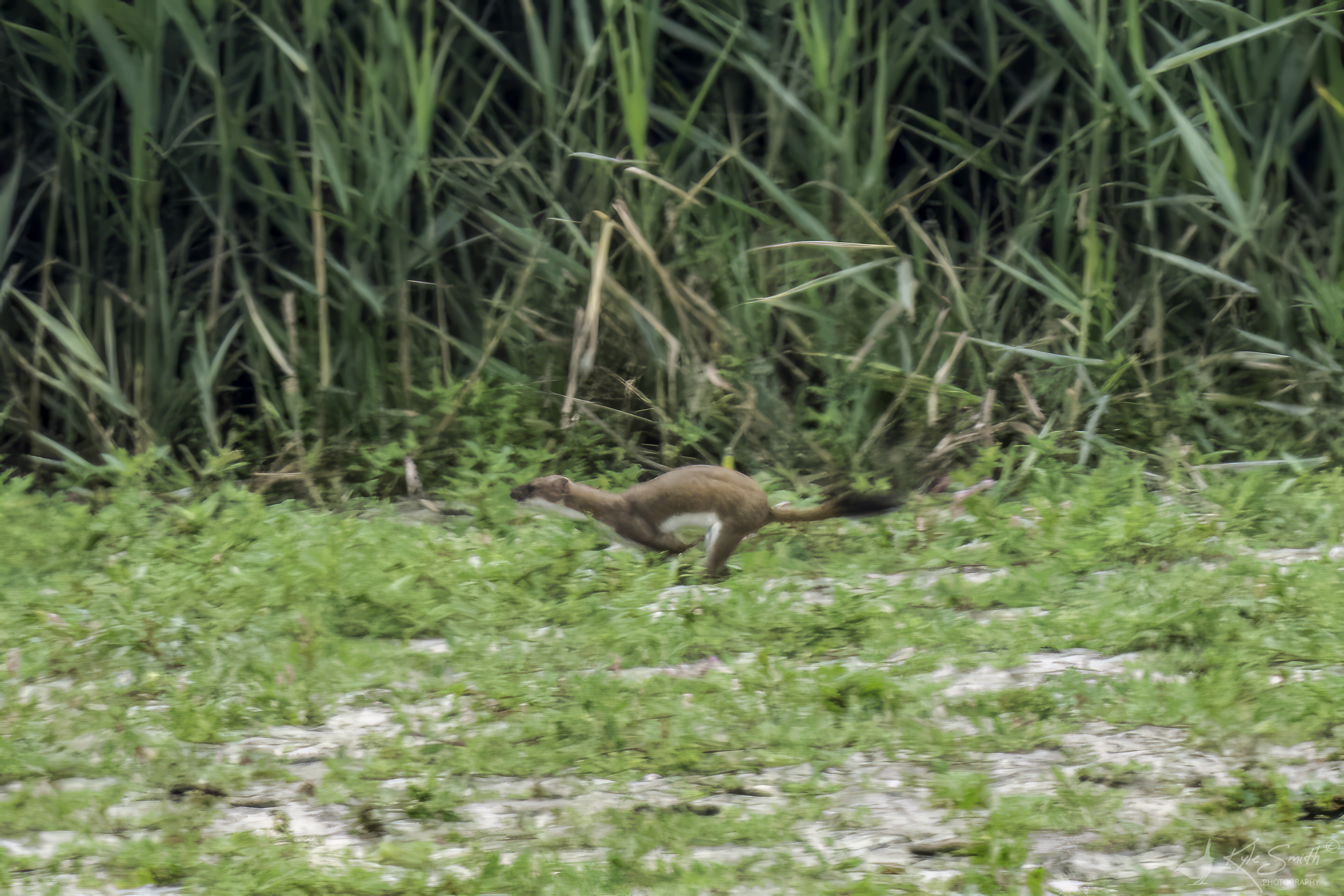
Stoat

Once the stoat has reached the leftmost reed bed, I scanned back to find a second individual out in front and distant. It paused long enough to get a slightly better photo.

Stoat
Stoat

We marched up and down trying to find something of note but in the end we had to return to the car and make for home. Our last bird of the day was another kingfisher, only heard, by the small bridge.

Thursday, 15 February 2024

Lisvane / Llanishen Reservoirs & Slimbridge :: 10 February 2024

We initially intended to go to WWT Slimbridge but decided to make a detour to Lisvane and Llanishen Reservoirs in Glamorgan first. Our friends Adrian and Bryan had recently been and seen a red-necked grebe and ring-necked ducks there, so we wanted to check it out - the ring-necked ducks were a pair. Kev's @kev07713 sister Karen @hobbylovinglife and her partner Dean @worlebirder planned to visit early doors and so we met them for breakfast in Newport before continuing to Cardiff.

Lisvane and Llanishen Reservoirs comprise two designated Sites of Special Scientific Interest (SSSI), recognised for their significant ecological importance. Lisvane Reservoir SSSI specifically highlights its role as a habitat for overwintering wildfowl. The site boasts an impressive Visitor Centre equipped with a café, complimentary WiFi, an activities hub, and rentable rooms. Other amenities include a boathouse, bird hide, education centre, nature trails, biking facilities, and extensive parking - parking fees apply. We arrived to find only a couple of cars already there and made our way to the water's edge. We scanned through the ducks, and it didn't take more than a couple of minutes until we were on the ring-necked ducks.

Ring-necked ducks are a species of diving duck not native to the United Kingdom and are primarily found in North America, where they breed in freshwater marshes and ponds across Canada and the northern United States. Males have a striking appearance with a glossy black head, neck, and chest, a white vertical stripe on the side in front of a grey/white flank, and a distinctive chestnut-coloured ring around their neck, although this ring is often difficult to see in the field. Males have a resemblance to tufted ducks and sometimes take time to separate at distance. Their diet primarily consists of aquatic plants, seeds, and small invertebrates and as proficient divers, they are capable of diving to considerable depths in search of food.

We watched the pair diving but all too soon the male began to swim away and eventually took flight, disappearing towards the far end of the reservoir. The female slowly drifted further away, prompting us to decide to begin our search for the red-necked grebe. Before we left, we were treated to the sight of a couple of grey herons landing on the bank.

Ring-necked duck
Ring-necked duck
Ring-necked duck
Ring-necked duck
Ring-necked duck
Ring-necked duck
Ring-necked duck
Ring-necked duck
Grey heron

We dropped down onto the lower path running between the two bodies of water and looked back to see at least 21 little grebes, a common sandpiper, and a grey wagtail. We saw grebes out in the water behind (Llanishen) and eventually we resolved that they were all great-crested and not our target bird. We were standing near the hide/screen when a birder strolled across to tell us that the red-necked grebe was showing just round the corner in the bay.

Red-necked grebes are native to the UK and are primarily found in Scotland, especially in the northern and western areas, although they are also spotted in England and Wales. These birds prefer freshwater habitats such as lochs, reservoirs, and larger ponds during the breeding season, while they may also occur in coastal waters during migration and winter. They are medium-sized diving birds with striking plumage and have a long neck, a slender body, and a pointed black bill. During the breeding season, their plumage features a distinctive rusty-red neck, which contrasts with the dark upperparts and white underparts but outside the breeding season, their plumage becomes duller, with the red on the neck fading. This is what we expected today in February.

We rounded the corner and easily picked out the re-necked grebe, preening on the water and at middle distance - at least it wasn't feeding in the middle. Scope views were very good.

Red-necked grebe
Red-necked grebe
Red-necked grebe
Red-necked grebe

We scanned the gulls but didn't find anything - behind in the trees a jay called as it was harassed by a handful of magpies. A nuthatch called and flew out of the trees and away. We eventually made our way back to the car and had more views of the ring-necked ducks; the male had motored from the end of the reservoir back to the female and both were easily viewable between dives. Karen got ahead of us and when I caught her up, a grey wagtail dropped onto the slope down to the water; amazingly this was the first I'd seen in 2024.

Grey wagtail

We stopped and chatted and while Karen and Dean decided to go to the Visitor Centre for a coffee, Kev and I decided to return to the car and head to Slimbridge so that I could see the Bewick's swans before they leave in the spring. It would take us just over an hour and we'd arrive early lunchtime.

Bewick's Swans are migratory birds that visit the UK during the winter months, typically arriving from their breeding grounds in Arctic Russia. They undertake one of the longest migrations of any swan species, traveling thousands of miles from their breeding grounds in Siberia to their wintering sites in Europe. They follow a well-established migration route, flying over Scandinavia and into western Europe before reaching the UK. They are smaller than the more familiar mute swans, with a distinctive appearance characterized by a small, triangular yellow patch at the base of the bill. Bewick's swans are often observed in family groups or small flocks during their winter stay in the UK and here at Slimbridge there are reportedly up to about 150.

It didn't take long before we found them from Peng Observatory and Rushy Hide.

Bewick's swan
Bewick's swan

In general, Bewick's Swans begin their northward migration in March or April. Some swans may depart earlier, while others may linger in the UK until later in the spring. Adult birds often depart earlier than younger birds or families with cygnets. Additionally, weather patterns and environmental conditions can influence the timing of migration, with favourable winds and weather conditions facilitating faster migration.

Happy to have seen the birds, we moved on towards Willow Hide and where water rails have been showing well this winter. We stopped at various vantage points and as we scanned the reeds Kev called a Cetti's warbler working low to the water but in the reeds rather than on the front. I managed to follow it along from left to right and to catch it as it paused briefly. Although I’ve heard Cetti's multiple times this year, including on New Year's Day, this was the first I could get a look at.

Cetti's warbler

The heavy rain has flooded much of the area where they have been seen and so after a short wait with no sign, we moved on to the Robbie Garnett Hide where we stumbled upon a single spotted redshank, in winter plumage. During the summer season, its appearance undergoes striking changes acquiring a distinctive breeding plumage; striking black coloration that extends from the bird's head down its neck, breast, and upperparts. This black plumage contrasts sharply with the white underparts, creating a striking visual impression. The black coloration is glossy and may appear iridescent in certain lighting conditions. We will look forward to seeing these later in the year.

Spotted redshank

Onwards to the Estuary Tower and up onto the second level, looking out across the Dumbles and Tack Piece. From here we could see many of the geese: barnacle, Canada, greylag but also Ross's, bar-headed, snow and lesser white-fronted. The lesser white-fronted goose of unknown origin was with Canada geese on the Tack Piece while the snow goose, of unknown origin, and the long-staying Ross’s goose were on the Dumbles.

There was a single distant crane but not much else we hadn't already seen - there were a few ruff (year tick) a bit closer so I snapped a couple of them - a wigeon took flight in the direction I was pointing and I snapped that too.

Bar-headed goose
Bar-headed goose
Lesser white-fronted goose
Ross's goose
Ruff and wigeon
Wigeon

There was no sign of the usual peregrine and after a while we decided to make our way to the Zeiss Hide and see if we could locate any white-fronted geese. We arrived to find there were only a few greylag geese in the area and no white-fronts - Kev continued to search and I returned to the front of the hide as I could hear water rail calling. To my left I saw a water rail dart through a gap in the reeds and I got myself ready in case I could catch it out in the open - as luck would have it, I then heard two calls and both burst from the reeds into the open, one chased down the area of cut reeds and back out of view. One had stopped long enough for me to fire off a few photos and thankfully was stationary long enough to allow something in focus.

Water rail

We continued down to Kingfisher Hide with a couple coming the other way reporting that three kingfishers had been showing. We arrived and watched with a couple beside us manging to pick up a kingfisher in a bush out front - from our angle it wasn't visible. We waited, hoping that they might perch on a post, branch, reed, or indeed visit the nest holes in the bank where they have been seen excavating in recent days. Instead, two kingfishers dropped out of the bush and away up the water channel. No photo opportunity here. We opted to visit Hogarth and Discovery Hides passing some trees where a handful of siskin and lesser redpoll were feeding.

Siskin
Lesser redpoll

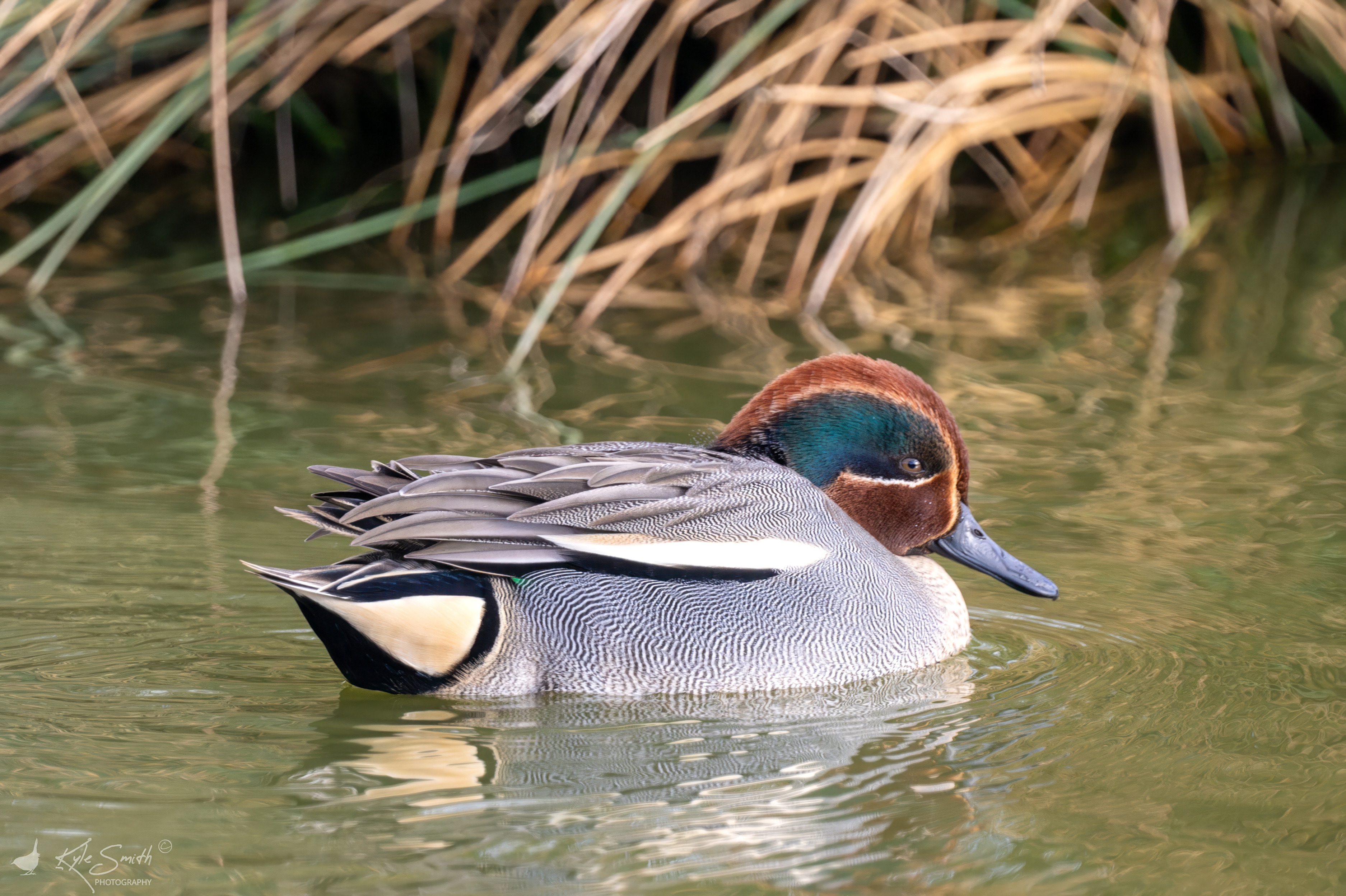
From the hides we could see a range of teal looking rather splendid, and my first avocets of the year. Looking as if they would like to settle and nest were a pair of oystercatchers. One came reasonably close, and I just couldn't resist.

Teal
Teal
Teal
Avocet
Oystercatcher
Oystercatcher

Kev recently visited Farmoor Reservoir and took some photos of cormorants which were rather stunning - he posted these photos here on X - formerly known as Twitter ... As he said, cormorants are not his favourite birds, but could not deny they looked pretty stunning – the sinensis subspecies. This subspecies typically exhibits subtle variations in size and plumage compared to others. In general, it has a glossy black plumage with some greenish or bronzy sheen, especially on the back and wings during the breeding season. Out on an island were a number of cormorants with some exhibiting some breeding plumage or also being part of the sinensis subspecies - regardless, it looked rather beautiful. I had to take a photo.

Cormorant

We stopped for a coffee in the Visitor Centre before making the journey home, now under 1&fract12; hours away.

Year list: 145.