Showing posts with label red-necked grebe. Show all posts

Saturday, 31 January 2026

Into Somerset and South Gloucestershire :: 31 January 2026

Kev @kev07713 and I were weighing up our options for Saturday when we decided on another trip down into Somerset, hoping to finally catch up with the Kentish plover we’d recently missed. There were two clear bonuses to the plan: it would give us the chance to meet up with Karen @hobbylovinglife and Dean @worlebirder, who were also thinking of heading there first thing, and there were several other quality birds in the area that would make the journey worthwhile.

The Kentish plover currently frequenting Burnham-on-Sea has become one of the most remarkable coastal birds in Britain in recent years. Now a scarce and often fleeting visitor to the UK, this individual has defied expectations by returning to the same stretch of Somerset coast winter after winter.

Once a breeding species in southern England, the Kentish plover disappeared as a UK breeding species by the late 1970s, largely due to habitat loss and disturbance. Today it is classed as a rare migrant, with most records involving single birds that stay only briefly. Against that backdrop, the Burnham-on-Sea bird stands out as truly exceptional.

First recorded there in the winter of 2019–20, it settled among the regular wader flocks on the beach and adjacent mudflats, often associating with ringed plover. Rather than moving on, it remained for extended periods, allowing prolonged views and a chance to become familiar with its behaviour and changing plumage. Even more remarkably, it returned in subsequent winters, showing clear site fidelity to Burnham-on-Sea. The story gained wider significance when tracking work later confirmed its continental origins, linking this modest Somerset shoreline with breeding grounds in northern Europe.

We made an early start, arriving on the esplanade shortly after dawn to give ourselves the best possible chance. The conditions weren’t ideal - the tide was falling (high tide at 5.17am, low at 11.51am) and dog walkers were already on the beach - but we were keen to be in position early. We’d skipped breakfast, planning instead to meet Karen and Dean for food once we were done at Burnham.

I pulled up outside the café on the esplanade - Kev and I unloaded our gear. It quickly became apparent that this stretch of parking might incur charges, whereas just 50 metres down the road it was clearly signed as free between October and March, so I moved the car while Kev set up and began scanning the area where the Kentish plover had most recently been reported. By the time I returned he already had the bird, and I jumped onto his scope for a look, just in case. It was only just visible through binoculars, but soon I had it in my own scope and noticed a small group of ringed plovers off to the left, all alert and occasionally preening. There was still little light, but I took a few insurance shots.

Some time later Karen and Dean arrived, delayed by the need to drop Dean’s car and keys at the garage for repairs, and by a stop for breakfast en route. Once the café opened, Kev went in and emerged with sausage baps, which we ate while continuing to watch the bird and scan the beach and Stert Island. On the island a peregrine was devouring what must have been a recently caught bird, while off the point there were large numbers of shelduck and dozens of curlews. A flock of wigeon whirled in and settled on the water, and increasing numbers of grey plover appeared in the distance. The light gradually improved as the sun briefly broke through, although its low angle made it rather harsh on the bird.

Kentish plover

Karen wandered off to see if she could get a better angle, and when she returned we discussed our next move. A red-necked grebe at Cheddar Reservoir seemed the obvious choice. Red-necked grebes are migratory waterbirds that breed on northern freshwater lakes and wetlands across much of northern Europe and Asia, moving south in winter. In the UK they are scarce winter visitors and passage migrants, most often recorded along sheltered coastlines between October and March, but they do occasionally turn up on large inland waters, particularly after periods of unsettled weather.

The subspecies most frequently encountered in Britain is the European form, Podiceps grisegena grisegena. Birds of this subspecies breed across northern and eastern Europe and into central Asia, migrating to wintering areas that include the north-west European seaboard. Another subspecies is Podiceps grisegena holbollii, which breeds in North America, Alaska and eastern Siberia and is exceptionally rare in Britain, with only a handful of confirmed records.

There has been some discussion surrounding the Cheddar bird, particularly regarding bill length in comparison with the typical European form, but identification of the American (Holbøll’s) subspecies would require biometric measurements or DNA evidence before it could be considered by the British Birds Rarities Committee (BBRC).

We followed Dean and Karen down to the car park at the end of the reservoir where the grebe had been reported earlier, then climbed up onto the perimeter path, immediately linking up with Dean who already had the bird in his scope. The light was good from this vantage point, but the grebe was at extreme range. I took a quick record shot before following Karen around to the edge, where we would be as close as we could get - Kev and Dean stayed put as they were taking video through their scopes.

Red-necked grebe

The light flanks seem to suggest this bird may not be holboellii - they tend to be darker overall, particularly on the flanks that are often the same or a similar colour as on their back - within the grisegena subspecies, bill length varies normally between individuals and some birds simply sit at the longer-billed end of the distribution. Juveniles also often have proportionally slimmer, sometimes seemingly longer bills compared to head size, which can give a “long-beaked” impression even if absolute length isn’t greater. There is an interesting article on the species here.

The bird was closer now, but largely in silhouette with the brighter light behind it. The priority was to study it carefully through the scope while also trying to salvage the best photographs possible from the conditions. Gradually the grebe began to drift closer and hopes rose of improved views, with Kev, Dean and a few other birders now having joined us. Those hopes were quickly dashed when a paddleboarder passed through, pushing the birds away from the shoreline, and our grebe eventually resumed feeding at distance. As if to mirror the turn of events, rain (tears) began to fall. When it eased slightly, I picked up a black-necked grebe on the far side of the reservoir, which Kev also managed to locate. The red-crested pochards previously reported appeared to have departed, but we did see a pair of goosanders before they too moved on.

Red-necked grebe
Red-necked grebe
Red-necked grebe

Dean and Karen decided to walk round to look for the black-necked grebes, but Kev and I didn’t feel the need for better views, having enjoyed excellent ones at Staines Reservoir recently. After saying our goodbyes, we jumped back in the car and headed for RSPB Ham Wall, where a pair of ring-necked ducks had been reported. Initially a single drake had been present from 19 November, with numbers increasing to two drakes by 13 December. The ducks were on a small pit east of Allotment Drove at Sharpham, and when we arrived to check the area, it dawned on us that this was the same spot where we had seen a Squacco heron back in October 2023. (blog post here).

Ring-necked ducks in the UK are rare but increasingly regular vagrants from North America, with multiple records each year. They’re considered a scarce migrant/scarce visitor, and while their status isn’t as unpredictable as it once was, they still attract interest when found because of their origins and relatively low numbers here - typically there are around 10 or more individuals recorded annually, though totals can be higher in some years. Although called “ring-necked”, the neck ring is subtle; the white bill rings are usually the most reliable field feature.

We checked the pit where the ducks had last been reported and bumped into another birder, a friend of Dean and Karen, who had apparently spotted us as we left Burnham-on-Sea. After a brief chat we split up to search in opposite directions: he headed back towards the original pit, reasoning that the birds often tuck themselves in among the reeds along the water’s edge, while we made for the larger body of water where the Squacco heron had been. Kev set up his scope and, as he raised it, the two drakes were already in view. He asked if I fancied another year tick and I took a look. The birds drifted closer together before swimming off towards the reed edge, where they began diving and feeding along the margins, the stems twitching as they worked their way through underwater and bubbles breaking the surface above them.

Ring necked duck
Ring necked duck
Ring necked duck
Ring necked duck

We could see siskins flitting in the trees overhead, marsh harriers drifting through, and caught a brief glimpse of a Cetti’s warbler before wandering down the track, where we encountered over 80 mute swans and a group of agitated long-tailed tits in a small tree. As Kev approached, he noted that a bird had dropped out and appeared to be a sparrowhawk, the likely cause of the tits’ alarm. Within a couple of minutes, Kev spotted it fanning its tail in a distant tree, presumably drying its feathers after the recent rain.

Sparrowhawk

Before we packed up, a flock of geese flew through. While I was still watching the sparrowhawk, Kev looked up and spotted a white-fronted goose among them. I raised my camera and took a shot of the flock, counting around 60 birds, all Russian white-fronted geese.

White-fronted goose

It was time to start heading home, but on the way we made a detour to Oldbury Power Station, where my wife Charlotte and I had seen black redstarts at the end of October last year (report here). We made our way around to the compounds where I have seen these birds previously. After about five minutes, I spotted a female flick up into the sky before dropping from view. I continued scanning and soon saw it again at the base of some railings, only for it to disappear once more. Kev scanned the area but drew a blank, so I took over the scope to focus precisely where I had last seen it. Within a minute, it popped up, and I was able to share it with Kev.

We decided to move onto the track along the estuary wall, hoping for a better view into the compound. Despite a thorough search, we came up empty-handed. Kev returned towards the spot we had watched from earlier, and as he reached the corner to leave the track and climb the slope, he spotted the redstart on the ground between two trailers. He called me over, and I arrived in time to watch it hopping forward, still at a distance. Kev moved on, and as I waited, the bird hopped onto a traffic cone, perching there for a couple of minutes before being flushed by a stonechat and disappearing from view. I returned to join Kev, but we couldn’t relocate it.

Black redstart
Black redstart

It was definitely time to head home, so we returned to the car, stopping briefly in the orchard along the way. There, we spotted a couple of jays, two green woodpeckers, a great spotted woodpecker, fieldfares, redwings, a goldcrest, and a mix of tits and finches. Kev also heard some siskins, though we never managed to locate them.

Another great day out, and it was wonderful to catch up with Karen and Dean again.

Green woodpecker

Year list: 153.

Monday, 31 March 2025

Broadsands, Devon :: 29 March 2025

Back in October 2022, Kev @kev07713 and I travelled to Burnham-on-Sea in search of the Kentish plover. After an incredible morning, we decided to continue on to Broadsands, Devon, where I was hoping to add cirl bunting to my life list. You can read about that day's adventures here.

Although I managed distant views of the bunting, I've since been eager to return for better views and a photo. So, when the chance arose to meet Kev's sister, Karen @hobbylovinglife, and her partner, Dean @worlebirder, for another visit to Broadsands, I jumped at the opportunity!

The cirl bunting is a relatively rare and localised bird species in the UK, primarily found in South Devon - once widespread across southern England, its population has dramatically declined. A successful RSPB reintroduction project has also established a small population in Cornwall. The shift from small, mixed farms to intensive monoculture farming has reduced food availability and rely on hedgerows and scrubby field margins for nesting and foraging. There are also now winter food shortages as they depend on weed seeds and stubble fields in winter, which have become scarce.

The males sport bright yellow underparts, black eyestripes, and a greenish-brown back whereas the females are more subdued with streaky brown plumage, resembling a yellowhammer, but with finer markings. There are thought to be around 1,000 pairs of cirl buntings in the UK which is a huge improvement from the 1980s, when numbers dropped to just 118 pairs.

The cirl bunting also has a shorter lifespan (6.1 years) than many similar-sized passerines. Species like the yellowhammer (13.2 years), chaffinch (14.9 years), and great tit (15 years) can live more than twice as long; species like house sparrows (23 years) and great tits (15.0 years) living longer, while linnets (8.3 years) and wrens (7.2 years) are closer to our buntings. Small birds generally face high predation and environmental risks, but some species with better adaptability, different feeding strategies, or migration patterns, tend to live longer.

We met for breakfast and aimed to arrive just after 8.00am, hoping to get there before the public / dog walkers became too active; an early start, especially when travelling from Banbury. Fortunately, the journey felt shorter than expected, and the break made it a comfortable and manageable hop after breakfast.

As we got ready at the cars, we immediately spotted a couple of cirl buntings among some house sparrows, chaffinches, and a dunnock - a promising start! We set up at a respectful distance, allowing the birds space to perch in the hedge and drop down to feed. I took some photos and later returned to the car for my scope, which gave me closer views and the chance to record a short video. We watched as three males and three females alternated between the hedge and the ground, until eventually a pair took flight and disappeared passed and behind us.

What a treat to have the buntings show so well and let me get that photo I'd been waiting for.

Cirl bunting
Cirl bunting
Cirl bunting
Cirl bunting
Cirl bunting
Cirl bunting
Cirl bunting

Kev wandered off and returned saying that he'd spotted a bird that he was sure was a willow warbler - we haven't heard or seen one so for this year. Kev, Karen and I walked back to see if we could confirm the ID - it was tricky as the bird was mostly flitting around the back of a dense bush and making it difficult to pick out any of the tell-tale features - a song would have helped.

Willow warblers are one of the UK’s most common summer migrants, arriving from sub-Saharan Africa each spring to breed, with early arrivals start appearing in southern England in late March and early April. They are particularly common in Scotland, Wales, and northern England, though appear to be declining in the south. They are similar to the chiffchaff but with paler legs, longer wings, and a more yellowish underside - the best way to separate the two species is by length of the primaries and by the willow's beautiful, descending, melodic warble, quite different to the repetitive "chiff-chaff" song of its close relative.

Seeing a willow warbler in March makes me feel that the spring migration is well underway. The darting behaviour we watched is classic willow warbler - they'd all be fuelling up after their long journey and although this individual was silent in a week or two we'll likely hear their beautiful, descending song as they settle into their breeding territories.

Willow warbler
Willow warbler

We had spent quite enough time with our buntings and decided to give them space while we walked up onto the cliffs for a spot of sea watching. There had been reports of surf scoter and red-necked grebes from here and it would be good to see if we could spot them. On our way up we stopped to look out over the bay and spotted a great northern diver fishing at some distance. We set up our scopes and watched for a while, hoping that our other birds might show too - but no such luck.

Great northern divers are stunning, large water birds that are seen in the south of the UK, particularly in winter and early spring. They migrate to the UK from the Arctic to spend the winter in milder waters and in summer they head back to breeding grounds in the far north, including Scotland.

They sport a stunning black-and-white patterned body with a striking black head and white throat but unfortunately, they don’t look like this in winter – then they are more subdued in appearance, usually a grey-brown body with a pale throat and darker head. They are larger than most other divers, with a strikingly long neck, a strong beak, and a noticeable 'bump' on the forehead. They are excellent divers, capable of plunging to great depths to catch fish - they can dive up to 60 meters and remain submerged for several minutes at a time. That is something on the bucket list - see divers in their summer breeding plumage - and close enough for a photo.

Great northern diver

Karen had wandered off ahead while we'd stayed to watch the diver and when we caught up with her on the clifftop vantage point, she'd already located the two red-necked grebes.

Red-necked grebes are a special sight in the UK, as they’re mostly winter visitors - seeing them in spring could mean they're on migration, possibly heading to Scandinavia or Eastern Europe to breed. They weren't quite in full breeding plumage with a deep chestnut neck and black cap but were part way there - they were good value through the scope, but distant to capture in the camera.

We picked up another great northern diver, a gannet, and Kev called a fulmar, although I didn't get on it.

We scanned for a while until eventually Dean called the surf scoter; a first-winter drake surf scoter has been reported at Broadsands since 10 December 2024 and as they often do, it was associating with a common scoter. Our bird has been difficult to see at times and I think Dean and Karen have tried unsuccessfully for it before - our luck was in today.

Surf scoters are quite rare in the UK - these sea ducks are more commonly found in North America, but they occasionally turn up along the UK's coasts during winter months, usually appearing between October and March.

The males are easily recognisable by their black plumage, bright orange bill with a distinctive yellow spot near the base, and their white wing patches. Females are more subdued with dark brownish-grey plumage but still have the characteristic bill shape. They can be harder to identify but are still distinctive once you know what to look for. Most UK records involve individuals or small groups and are often observed among other species of scoters.

It was extremely distant and required careful focus even through the scope, but its key identification features were clear, so we were satisfied. There was no chance of getting a photo, so I attempted a video, though even that proved challenging at such a distance.

After some time we decided that we would try for another bird and noticed that the hoopoe visiting at Seaton Bowls Club had been reported again and so made our way there. On arrival we got the news that it had flown a little over an hour before we got there, when the clock bell rang. It had shown well and hadn't even flushed when the groundsman cut the grass - he said it had been there for four days and fed on the green. Surely it would return ...

We waited for as long as we could before the drive home. We left Karen and Dean there - they had a shorter journey home - but the bird never returned. Shame, but it didn't spoil a cracking day out.

Year list: 151.

Thursday, 15 February 2024

Lisvane / Llanishen Reservoirs & Slimbridge :: 10 February 2024

We initially intended to go to WWT Slimbridge but decided to make a detour to Lisvane and Llanishen Reservoirs in Glamorgan first. Our friends Adrian and Bryan had recently been and seen a red-necked grebe and ring-necked ducks there, so we wanted to check it out - the ring-necked ducks were a pair. Kev's @kev07713 sister Karen @hobbylovinglife and her partner Dean @worlebirder planned to visit early doors and so we met them for breakfast in Newport before continuing to Cardiff.

Lisvane and Llanishen Reservoirs comprise two designated Sites of Special Scientific Interest (SSSI), recognised for their significant ecological importance. Lisvane Reservoir SSSI specifically highlights its role as a habitat for overwintering wildfowl. The site boasts an impressive Visitor Centre equipped with a café, complimentary WiFi, an activities hub, and rentable rooms. Other amenities include a boathouse, bird hide, education centre, nature trails, biking facilities, and extensive parking - parking fees apply. We arrived to find only a couple of cars already there and made our way to the water's edge. We scanned through the ducks, and it didn't take more than a couple of minutes until we were on the ring-necked ducks.

Ring-necked ducks are a species of diving duck not native to the United Kingdom and are primarily found in North America, where they breed in freshwater marshes and ponds across Canada and the northern United States. Males have a striking appearance with a glossy black head, neck, and chest, a white vertical stripe on the side in front of a grey/white flank, and a distinctive chestnut-coloured ring around their neck, although this ring is often difficult to see in the field. Males have a resemblance to tufted ducks and sometimes take time to separate at distance. Their diet primarily consists of aquatic plants, seeds, and small invertebrates and as proficient divers, they are capable of diving to considerable depths in search of food.

We watched the pair diving but all too soon the male began to swim away and eventually took flight, disappearing towards the far end of the reservoir. The female slowly drifted further away, prompting us to decide to begin our search for the red-necked grebe. Before we left, we were treated to the sight of a couple of grey herons landing on the bank.

Ring-necked duck
Ring-necked duck
Ring-necked duck
Ring-necked duck
Ring-necked duck
Ring-necked duck
Ring-necked duck
Ring-necked duck
Grey heron

We dropped down onto the lower path running between the two bodies of water and looked back to see at least 21 little grebes, a common sandpiper, and a grey wagtail. We saw grebes out in the water behind (Llanishen) and eventually we resolved that they were all great-crested and not our target bird. We were standing near the hide/screen when a birder strolled across to tell us that the red-necked grebe was showing just round the corner in the bay.

Red-necked grebes are native to the UK and are primarily found in Scotland, especially in the northern and western areas, although they are also spotted in England and Wales. These birds prefer freshwater habitats such as lochs, reservoirs, and larger ponds during the breeding season, while they may also occur in coastal waters during migration and winter. They are medium-sized diving birds with striking plumage and have a long neck, a slender body, and a pointed black bill. During the breeding season, their plumage features a distinctive rusty-red neck, which contrasts with the dark upperparts and white underparts but outside the breeding season, their plumage becomes duller, with the red on the neck fading. This is what we expected today in February.

We rounded the corner and easily picked out the re-necked grebe, preening on the water and at middle distance - at least it wasn't feeding in the middle. Scope views were very good.

Red-necked grebe
Red-necked grebe
Red-necked grebe
Red-necked grebe

We scanned the gulls but didn't find anything - behind in the trees a jay called as it was harassed by a handful of magpies. A nuthatch called and flew out of the trees and away. We eventually made our way back to the car and had more views of the ring-necked ducks; the male had motored from the end of the reservoir back to the female and both were easily viewable between dives. Karen got ahead of us and when I caught her up, a grey wagtail dropped onto the slope down to the water; amazingly this was the first I'd seen in 2024.

Grey wagtail

We stopped and chatted and while Karen and Dean decided to go to the Visitor Centre for a coffee, Kev and I decided to return to the car and head to Slimbridge so that I could see the Bewick's swans before they leave in the spring. It would take us just over an hour and we'd arrive early lunchtime.

Bewick's Swans are migratory birds that visit the UK during the winter months, typically arriving from their breeding grounds in Arctic Russia. They undertake one of the longest migrations of any swan species, traveling thousands of miles from their breeding grounds in Siberia to their wintering sites in Europe. They follow a well-established migration route, flying over Scandinavia and into western Europe before reaching the UK. They are smaller than the more familiar mute swans, with a distinctive appearance characterized by a small, triangular yellow patch at the base of the bill. Bewick's swans are often observed in family groups or small flocks during their winter stay in the UK and here at Slimbridge there are reportedly up to about 150.

It didn't take long before we found them from Peng Observatory and Rushy Hide.

Bewick's swan
Bewick's swan

In general, Bewick's Swans begin their northward migration in March or April. Some swans may depart earlier, while others may linger in the UK until later in the spring. Adult birds often depart earlier than younger birds or families with cygnets. Additionally, weather patterns and environmental conditions can influence the timing of migration, with favourable winds and weather conditions facilitating faster migration.

Happy to have seen the birds, we moved on towards Willow Hide and where water rails have been showing well this winter. We stopped at various vantage points and as we scanned the reeds Kev called a Cetti's warbler working low to the water but in the reeds rather than on the front. I managed to follow it along from left to right and to catch it as it paused briefly. Although I’ve heard Cetti's multiple times this year, including on New Year's Day, this was the first I could get a look at.

Cetti's warbler

The heavy rain has flooded much of the area where they have been seen and so after a short wait with no sign, we moved on to the Robbie Garnett Hide where we stumbled upon a single spotted redshank, in winter plumage. During the summer season, its appearance undergoes striking changes acquiring a distinctive breeding plumage; striking black coloration that extends from the bird's head down its neck, breast, and upperparts. This black plumage contrasts sharply with the white underparts, creating a striking visual impression. The black coloration is glossy and may appear iridescent in certain lighting conditions. We will look forward to seeing these later in the year.

Spotted redshank

Onwards to the Estuary Tower and up onto the second level, looking out across the Dumbles and Tack Piece. From here we could see many of the geese: barnacle, Canada, greylag but also Ross's, bar-headed, snow and lesser white-fronted. The lesser white-fronted goose of unknown origin was with Canada geese on the Tack Piece while the snow goose, of unknown origin, and the long-staying Ross’s goose were on the Dumbles.

There was a single distant crane but not much else we hadn't already seen - there were a few ruff (year tick) a bit closer so I snapped a couple of them - a wigeon took flight in the direction I was pointing and I snapped that too.

Bar-headed goose
Bar-headed goose
Lesser white-fronted goose
Ross's goose
Ruff and wigeon
Wigeon

There was no sign of the usual peregrine and after a while we decided to make our way to the Zeiss Hide and see if we could locate any white-fronted geese. We arrived to find there were only a few greylag geese in the area and no white-fronts - Kev continued to search and I returned to the front of the hide as I could hear water rail calling. To my left I saw a water rail dart through a gap in the reeds and I got myself ready in case I could catch it out in the open - as luck would have it, I then heard two calls and both burst from the reeds into the open, one chased down the area of cut reeds and back out of view. One had stopped long enough for me to fire off a few photos and thankfully was stationary long enough to allow something in focus.

Water rail

We continued down to Kingfisher Hide with a couple coming the other way reporting that three kingfishers had been showing. We arrived and watched with a couple beside us manging to pick up a kingfisher in a bush out front - from our angle it wasn't visible. We waited, hoping that they might perch on a post, branch, reed, or indeed visit the nest holes in the bank where they have been seen excavating in recent days. Instead, two kingfishers dropped out of the bush and away up the water channel. No photo opportunity here. We opted to visit Hogarth and Discovery Hides passing some trees where a handful of siskin and lesser redpoll were feeding.

Siskin
Lesser redpoll

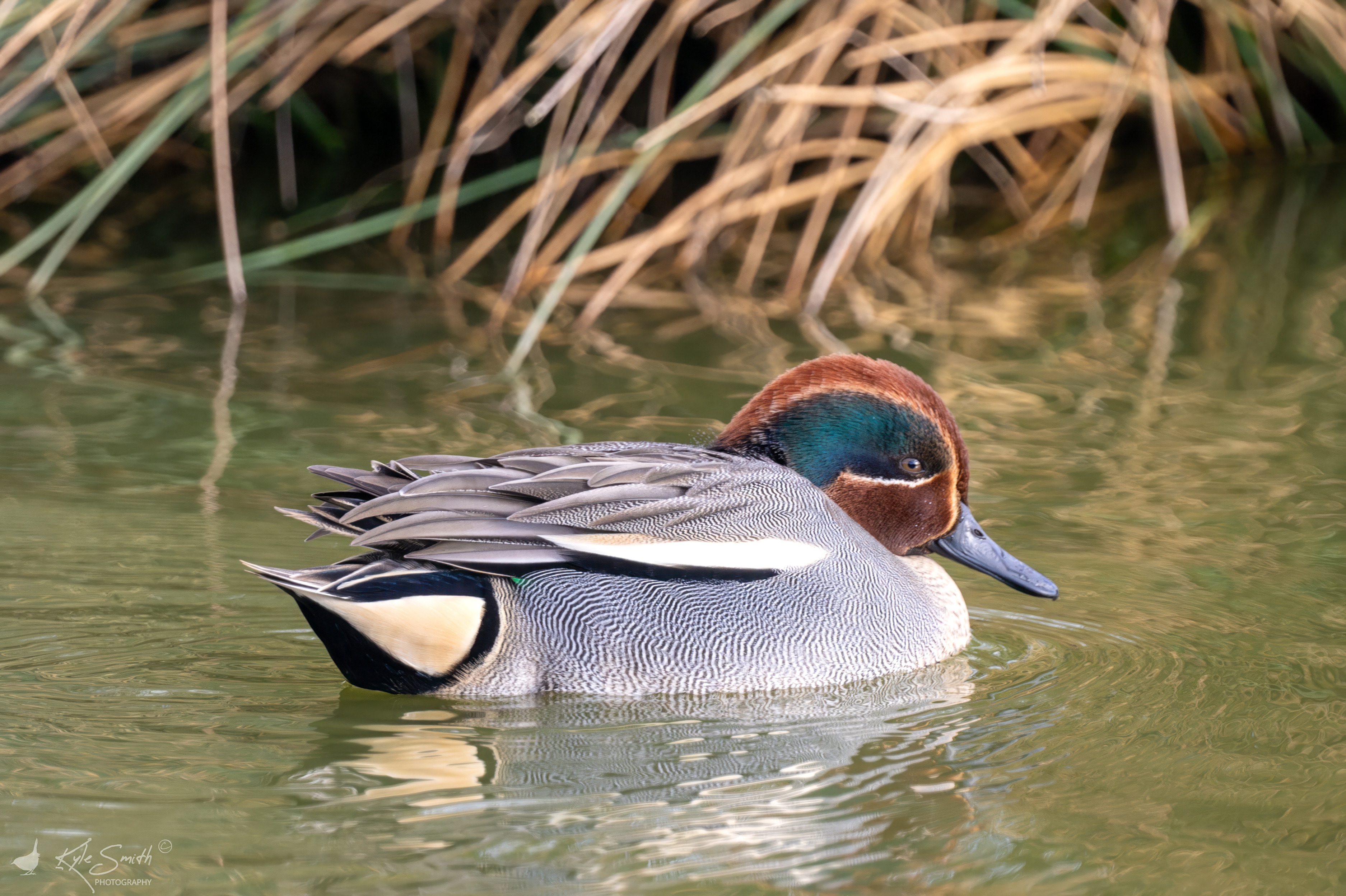
From the hides we could see a range of teal looking rather splendid, and my first avocets of the year. Looking as if they would like to settle and nest were a pair of oystercatchers. One came reasonably close, and I just couldn't resist.

Teal
Teal
Teal
Avocet
Oystercatcher
Oystercatcher

Kev recently visited Farmoor Reservoir and took some photos of cormorants which were rather stunning - he posted these photos here on X - formerly known as Twitter ... As he said, cormorants are not his favourite birds, but could not deny they looked pretty stunning – the sinensis subspecies. This subspecies typically exhibits subtle variations in size and plumage compared to others. In general, it has a glossy black plumage with some greenish or bronzy sheen, especially on the back and wings during the breeding season. Out on an island were a number of cormorants with some exhibiting some breeding plumage or also being part of the sinensis subspecies - regardless, it looked rather beautiful. I had to take a photo.

Cormorant

We stopped for a coffee in the Visitor Centre before making the journey home, now under 1&fract12; hours away.

Year list: 145.