I had been away on business for a little over a week, and by the time I got back home on Friday I was completely worn out. After dropping my bags, I collapsed into bed for a few hours. I never find napping after travel particularly pleasant, waking up usually leaves me groggy and disoriented, as though the rest has only made things worse. Still, I know it must do me some good in the long run.
Once I’d shaken off the worst of it, I got in touch with Kev @kev07713 to see if there were any birding plans for the weekend. He came back with a suggestion: a trip over to Suffolk to try for the zitting cisticola - known to some as the fan-tailed warbler - and then on to RSPB Boyton Marshes to look for the juvenile black stork that had been reported there. Both species would be excellent birds to see, and the chance of catching up with them was too good to ignore.
Kev mentioned that our friends Adrian Sparrowhawk and Bryan Manston had already been and managed to tick both birds off their lists - it sounded like a perfect plan, though I have to admit that the proposed 4.00 a.m. start gave me a moment’s pause - it’s never easy dragging yourself out of bed at that hour, especially after a draining week away.
Still, the early start would be softened by good company. Kev’s wife Karen @karenheath62, his sister Karen @hobbylovinglife, and her partner Dean @worlebirder would be joining us as well, which meant that even if the birds didn’t show, the day promised to be a fun outing in its own right. Birding trips are always about more than just the species seen, they’re about the camaraderie, the shared anticipation, and the stories that come out of the journey itself. I wouldn’t be the only one running on limited sleep - Karen and Dean were making the drive up from Weston-super-Mare to meet Kev and Karen before swinging by to collect me.
We broke the journey with a stop for breakfast, then set off again, with only about forty-five minutes left to cover before reaching our first destination. I’d spent holidays in that part of Suffolk before, but as far as I could recall, I’d never actually ventured down onto the beach at Walberswick itself.
When we arrived, we pulled into the car park, sorted out the parking, and then set off on foot. The path led us out toward the beach, where we followed the edge for about a kilometre. In the distance, we could already make out a small cluster of birders gathered in position, always a reassuring sign that we were heading in the right direction.
On the way, we picked out a ruddy shelduck, standing out boldly beside two avocets. They are a striking bird, rich orange in the morning light, and especially pleasing given that five had been reported in the area the previous day. A nice bonus before we’d even arrived at the target bird - whether wild, feral, or escapees, their appearance always adds a special highlight to any birding trip. Later we would see our bird out on the water.


The zitting cisticola always seems more at home in southern Europe than on the Suffolk coast and for me, it was a species I’d only read about in bird reports, so the chance to see one in the UK was something I was keen not to miss. In Britain and Ireland, zitting cisticola remains a very rare visitor with the first national record in Norfolk in 1976 and since then according to the BTO, there have been fewer than ten records in total.
With multiple singing males on the southeast coast, combined with documented range expansion across continental Europe, I'd read this makes it quite plausible that the zitting cisticola could be the next species to establish a breeding presence in the UK mainland. Especially in grassland and wetland habitats susceptible to climate-related shifts, this pattern of northward movement fits both ecological projections and current bird-record trends.
The zitting cisticola is a small, brown, streak-backed warbler notable for its broad, white-tipped tail, which it flicks with constant rhythm. During the breeding season, males perform an erratic zigzag or pendulum-like flight display while emitting rapid, repetitive "zit-zit-zit" calls - a behaviour that inspired its name.
We made our way along the sandy footpath, the dunes and marram grass opening up in front of us as the North Sea came into view. As we joined the group, the atmosphere had that familiar mix of excitement and quiet patience. A few whispered conversations passed along the line - “It just dropped into the grass ... should be showing again soon ...” - and then, right on cue, the cisticola flicked up into the air, although none of us managed to get eyes on it - typical - we'd have to wait for the next emergence.
Eventually it worked left along the reeds, again unseen by all but Karen, Kev's sister. However, on the next flight I got on it and watched it right along the face of the reeds - I was so intent on watching it I forgot to try to take a photo. Its flight was unmistakable: bouncing on quick, clipped wingbeats before parachuting down again into the long grasses, its tail fanned out just enough to show how it earned its name.
We were perched on the slope, trying to balance ourselves on smooth, loose stones that had a habit of giving way beneath us. Every so often we’d slide down a foot or so before managing to steady ourselves again. Dean found this especially unnerving and, after a short while, decided he’d had enough - he shifted further along the track to firmer ground, with Karen soon following his lead. I sat next to a chap that it turns out I follow on X, and he follows me - Mike @dogdoughty - it was good to put a face to a name and have a chat.
Our bird was in the air again and it wasn’t a prolonged view, but it was enough - an unmistakable little silhouette against the Suffolk sky, a bird from another climate, here on the British east coast. However fleeting the view, it was exactly why these early starts and long drives are always worth it.
Over the course of the morning, we managed to see the bird about half a dozen times. On one occasion, though, there was a moment of real confusion among the assembled birders. Half the crowd was pointing and calling in one direction, while the other half were gesturing excitedly the opposite way. For a few seconds it almost felt as though two birds must be present, though of course we knew that wasn’t the case ... it was simply the cisticola doing what it does best: vanishing into the grass one moment and reappearing in an entirely different spot the next - wasn't it?
At one point I managed to line it up in my camera’s viewfinder. My heart was racing, finger poised, but before I could get the focus to lock the bird dropped back into cover and my chance was gone. Kev fared a little better and he managed to fire off a frame or two, and although distant and hazy, they at least served as a record shot.
What makes the sighting all the more remarkable is the news that’s since come out. This week it has been confirmed that not only were there two adult zitting cisticolas present at Walberswick, but also at least three juveniles. That means this is now officially recognised as the first confirmed breeding record for the UK.

Zitting cisticola, courtesy and copyright Kevin Heath.
It soon seemed clear that we weren’t going to get much better views of the bird, and with only a handful of distant photos appearing on social media, we decided it was time to move on. We had other plans for the day, after all. As we made our way back toward the car, a line of common terns passed close along the shore, many of them juveniles. They zipped by at speed, then turned to battle their way back against the wind.
Out on the water was a chap foiling on a board - this involves riding a board that has a hydrofoil mounted underneath, extending into the water. As the board gains speed the foil generates lift, raising the board clear of the surface. This creates the sensation of flying silently above the water with reduced drag and an incredibly smooth ride. I'm not sure but I think this board had built-in electric motors and batteries that allowed the rider to foil without wind or waves - essentially a self-propelled flying surfboard.
We reached the car and quickly set the SatNav for our next target. Rather than heading for the official RSPB Boyton Marshes car park, we aimed for a spot a little further along, closer to where the juvenile black stork had been reported earlier in the day. When we arrived, a handful of cars were already parked up, but luckily there was one space right at the front.
Kev swung the car around to reverse in but immediately hit trouble. The ground was soft and sandy, the wheels digging in with little progress - one of those moments where you wonder if you’re about to be stranded - we could push. The driver of the car behind us was busy sorting gear out of his boot, and Kev politely asked if he wouldn’t mind reversing back a little so we could edge onto firmer ground. He happily obliged, and with a bit of manoeuvring we were safely parked.
Naturally, we stopped to chat, hoping for news. What he told us wasn’t encouraging: the stork had flown off and was currently missing in action. His wife had gone on ahead to see if she could relocate it, but so far there was no sign. Just as he finished speaking, though, his wife reappeared and almost at the same moment another birder passed by, reporting that the bird had been re-found less than ten minutes’ walk from where we stood. Relief all round.
It was then that our new acquaintance admitted he was feeling both pleased and frustrated. He’d driven over two hours to get here, but in his excitement had forgotten to put a memory card in his camera. No card, no photos. I asked what format he used. “SD” he replied - as luck would have it, I had my spare camera in the car, along with a couple of extra SD cards. I fetched one and handed it over so he could at least capture a few shots of the stork when we found it. I told him to keep it, but he insisted on taking my address so he could post it back.
As we got talking further, the birding world proved its usual small place: it turned out we already followed each other on X (Twitter). His name was Neil Hilton @neilthilton - and takes some great photos. We all set off.
We followed the track until it opened out beyond the trees, then veered right, keeping an eye out for the half-hidden stile. From there we had our first clear view of the pool, and there it was, the black stork, with a couple of birders already watching from the far bank. We crossed over to join them and soon had the bird in our scopes: roosting quietly on the bank, head tucked tightly into its chest, breast feathers fluffed out.
The black stork is a large, elegant stork, similar in size to the white stork but slimmer and darker, with long legs and a straight, pointed bill. Unlike adults, which show glossy black with green and purple sheen and pure white underparts, juveniles are much duller and browner overall. In juveniles, the bill is dull grey-brown or greenish, lacking the bright red-orange tones of adults. The breast feathers of a juvenile often appear slightly looser, with a “fluffed” look when the bird is at rest.
We spent some time quietly watching, waiting for any sign of movement. Every now and then the stork would rouse itself slightly to preen, carefully smoothing and arranging its feathers. At one point it ambled down to the water’s edge for a drink, an amusing reminder that, yes, it really did have two legs! After a minute or two of careful grooming, it returned to its resting posture, tucking its head back against its breast and drifting once more into slumber, opening eyes for a peek every now and then.


We picked our way carefully through the bracken and nettles, trying to find a good angle for photos - Dean bore the brunt of the experience, suffering countless stings as the plants brushed against his bare legs. Shorts had clearly been a tactical error. Just as we were navigating this mini obstacle course, Kev spotted a wasp spider nearby. Instantly, everyone’s attention shifted; the previously sleeping stork was momentarily forgotten as we admired the striking black-and-yellow orb weaver, cameras ready and phone lenses trained on its web. First recorded in Britain in 1922 at Rye, East Sussex, the wasp spider has since spread across southern England, including areas like Kent, Hampshire, and Dorset. Recent records indicate its continued expansion into central regions. Despite their formidable appearance, these spiders are harmless to humans, are non-aggressive and pose no threat.
The wasp spider is a striking orb-weaving spider native to southern Europe, which has been gradually expanding its range northwards and is now established in parts of southern and central England. The female spiders are notably large, with body lengths ranging from 14 to 22 mm and are easily identifiable by their bold black and yellow striped abdomen, reminiscent of a wasp's colouration, which serves as a warning to potential predators. The males are significantly smaller, measuring about 4.5 mm in body length, and are less conspicuously coloured.
Their diet primarily consists of grasshoppers, and other small insects - once prey is ensnared in the web, the spider wraps it in silk and delivers a venomous bite to immobilise it. Bumblebees can fall prey to wasp spiders if they collide with the orb web. While wasp spiders primarily hunt smaller, lighter insects, a bumblebee unlucky enough to hit the web can become entangled.
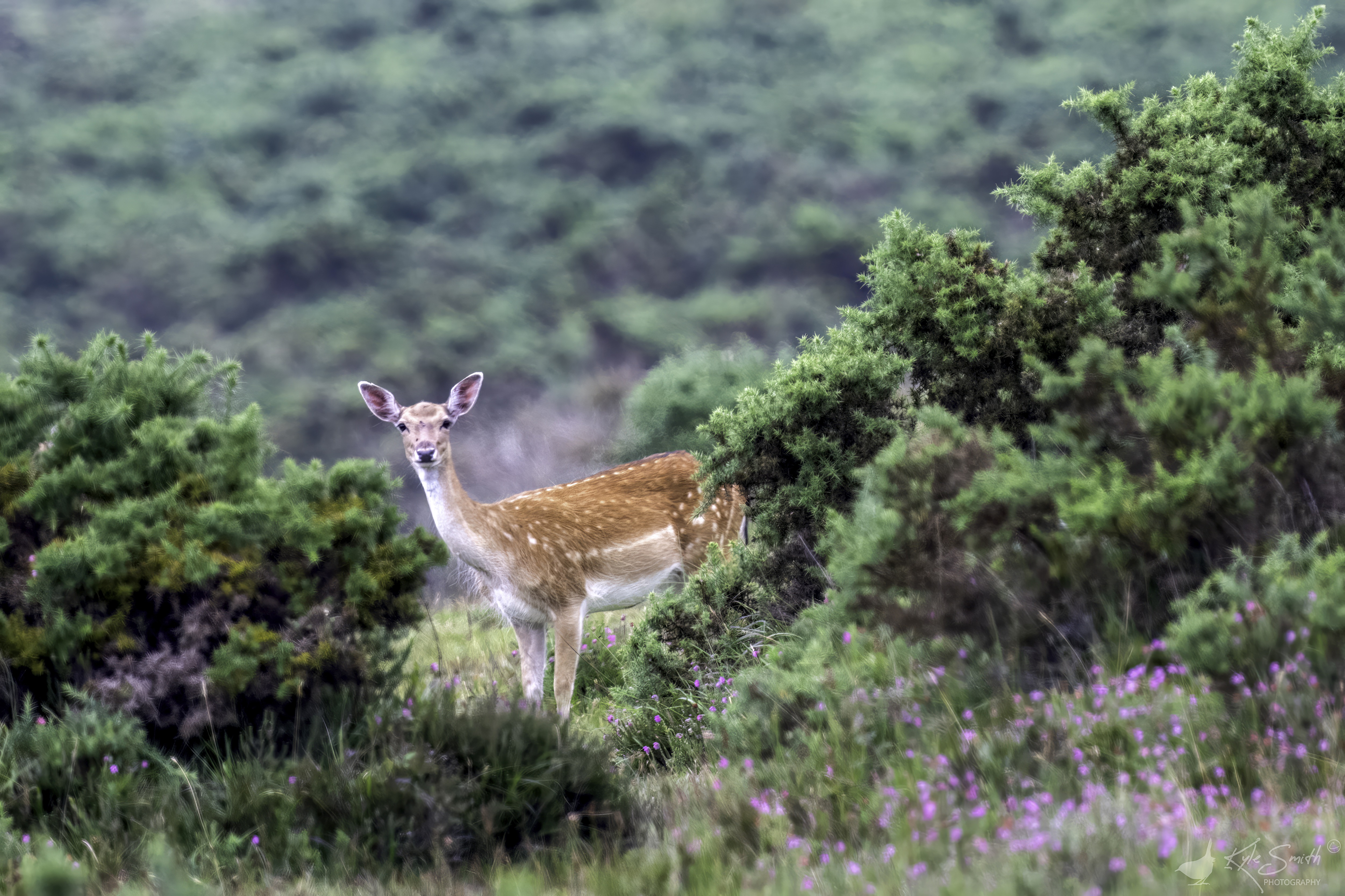
We paused considering our next move and eventually decided on a trip back up to RSPB Minsmere. On the short walk back to the car, a small group of fallow deer caught our eye on the hillside. We stopped for a couple of minutes, watching them graze and occasionally lift their heads, before they suddenly bounded away, disappearing gracefully into the trees.
We arrived at RSPB Minsmere and discovered that the two Karens and Kev hadn't visited here before. We stopped in the Visitor Centre for coffee/tea and a cake before heading onto the reserve - we had limited time before we'd need to make our way back to Banbury and so after looking around the habitat near the Centre made our way to the North Hide and started scanning.
We scanned the pools carefully and picked out a few waders - a curlew sandpiper, a common sandpiper, and a couple of spotted redshanks - before Kev suddenly raised the alert: he had a bittern in his scope. Instantly, our attention shifted. Another couple in the hide, who had previously been quietly observing, suddenly became animated and came across to join us. The man explained that he had been visiting the reserve for decades, yet this was the very first time he would have the chance to see a bittern. His French wife sat beside him, and together they enjoyed the fleeting glimpses, soaking in every moment.
The bittern was elusive, moving in and out of view, often partially obscured by reeds swaying in the breeze. Kev, having already spotted it, graciously gave everyone else the space to enjoy the sight. Finally, he managed to reposition himself and had the chance to watch the bird as it reappeared, then slipped silently back into the dense reeds.


Time was marching on and now it would be at best 8.30pm before we got home - Karen and Dean would then drive home, a further couple of hours. As we passed the Visitor Centre Kev noticed a woman taking photos around a buddleia - he surmised that she had found a hummingbird hawk moth - he was correct. She said she was leaving so Karen and I stopped to capture a few photos of our own. It is rapid and agile, hovering like a hummingbird while feeding, beating its wings extremely fast, often creating a humming sound. It is commonly found in southern England but increasingly recorded further north during warm summers - some migrate from southern Europe to the UK in summer - they are rarely bothered by humans and can be observed close up.
We set off for home, drifting in and out of sleep on the return journey - Kev making the long journey home as our driver.
Year list: 230.