Showing posts with label mediterranean gull. Show all posts

Wednesday, 21 January 2026

Hampshire day-out :: 20 January 2026

When unsure where to go, Kev and I usually find ourselves choosing between RSPB Frampton Marsh and the Hampshire & Isle of Wight Wildlife Trust’s Lymington & Keyhaven Marshes Nature Reserve. With rain forecast to clear from the southwest, we opted for our first visit to Lymington of 2026. It certainly won’t be our last, as we often return after the spring migration to catch up with little terns and a host of other species.

Keyhaven Marshes form part of an extensive coastal wetland and nature reserve stretching between the mouth of the Lymington River and the village of Keyhaven on Hampshire’s Solent coast. The landscape is a rich mosaic of saltmarsh, intertidal mudflats, lagoons, grazing marsh and shingle banks. At this time of year, the area supports large flocks of Brent geese, wigeon, teal, pintail, grey plover, dunlin, black-tailed godwit and a wide variety of other wildfowl and waders, many of which can be observed from the Normandy Lagoon.

Although access across the marshes themselves is restricted to avoid disturbing the birds, a network of sea wall paths and footpaths provides excellent views across the reserve. The sea wall linking Keyhaven and Lymington offers a flat, scenic walk, with sweeping views across the flats towards Hurst Spit and the Isle of Wight.

We arrived at our usual parking spot and made our way towards the Keyhaven Lagoon, with curlews calling overhead and Brent geese feeding in fields through flocks of curlews, Canada geese, teal, and black-tailed godwits. Climbing up onto the sea wall, we were met by a stiff wind; although steady at around 25 mph, the gusts were stronger still, making it feel far colder than the 8°C shown on the car’s display. Deciding against standing in the full force of it, we dropped down to the lower path for some shelter and scanned across the lagoon, soon focusing on the 19 spoonbills exhibiting their usual behaviour ... fast asleep.

At their feet were small groups of avocets, with both species being welcome year ticks. Recent bird records show that spoonbills are now regular visitors to the Lymington–Keyhaven Marshes, particularly during winter and migration periods, and are increasingly occurring in small flocks rather than as lone birds. Counts of up to c.19 spoonbills have been reported at Normandy Marsh, matching our observation.

Spoonbills are now a regular presence from late autumn through winter and into early spring, taking advantage of the shallow feeding habitats of the Normandy Marsh and Lagoon, as well as the adjacent lagoons. A couple of avocets had broken away from the main group and were feeding quietly in the shallows.

Spoonbill
Avocet

We stopped to chat with a local Hampshire birder, who shared details of the species he had encountered during his visit. He confirmed that activity out on the edge of the Solent was reduced, as the tide was close to its peak, pushing many birds back towards the lagoons. This was evident in the numbers of dunlin and ringed plovers gathered on the islands and along the water’s edge.

The conversation proved fortuitous, as we picked up some valuable local knowledge, including information on purple sandpipers and, more importantly, a potential roost site for hawfinches. Coincidentally, Kev and I had been discussing where we might catch up with this species, as our usual local flock appears to have moved on and has been absent for the past couple of winters.

We worked our way round to the southern edge and soon located one of the two reported spotted redshanks, perched at the water’s edge. Within a minute or two it dropped into the lagoon and began swimming across towards another feeding wader. At first, I assumed it was the second spotted redshank, but it soon became clear that the bird was a greenshank. As the redshank swam across, Kev commented that it would make a great photo - I was already on the case - before he remembered that he was carrying a camera too and joined in. Hilarious!

Spotted redshank
Spotted redshank
Spotted redshank
Spotted redshank
Greenshank
Greenshank
Greenshank

Spotted redshanks are a regular but generally scarce part of the winter and migration bird community here and they’re reliable enough that birders often look for them here in the colder months. In Britain, they are primarily a passage migrant in spring and autumn, with small numbers overwintering at key wetlands, estuaries and coastal marshes and are usually encountered singly or in small groups, rather than large flocks.

Out in the lagoon, increasing numbers of dunlin and ringed plovers gathered, mainly among the lapwings. A small group of ringed plovers in particular caught the eye as they formed a tight cluster beside a tile on a small, raised island. Adding to the wader numbers were oystercatchers, their numbers gradually building as time passed.

Ringed-plover
Oystercatcher

Kev had been on a trip down into Cornwall and back through Somerset at the weekend and had sharpened his gull identification, calling a Mediterranean gull as it passed behind us and out onto the Solent. These gulls are regularly present around here in winter, although they’re more often associated with spring and summer breeding gatherings - scarce but regular in winter, with records often in single‑figure counts at these coastal sites. In winter plumage, Mediterranean gulls lose the full black hood seen in summer but still show a distinctive darker mask behind the eye, pinkish legs and a slightly stouter bill than black‑headed gulls.

Mediterranean gull

We continued along the path when, suddenly, a bird flicked from the gorse back into cover. From its colouring, it could only be one species, a Dartford warbler. While Dartford warblers are regularly recorded around the Nature Reserve, they aren’t core marsh birds like waders. Instead, they favour the scrubby, gorse‑rich higher ground and coastal scrub surrounding the reserve. Preferring gorse, bramble, and other scrubby vegetation rather than open saltmarsh, they are usually found on the landward side of the site, where scrub grows on higher ground or rough pasture. It was therefore a pleasant surprise to encounter one between the edge of the lagoon and the Solent. I waited patiently, and after a couple of relocations, it popped out long enough for me to snap a few photos.

Dartford warbler
Dartford warbler
Dartford warbler

We had just remarked that we would normally have seen some stonechats by this point when a pair suddenly appeared ahead along the path. They moved frequently between the ground and prominent perches, with the female eventually drifting further away while the male stayed closer, giving excellent views.

Stonechat
Stonechat
Stonechat
Stonechat

We had heard reports of Slavonian grebes along the stretch where Pennington Marsh meets the sea, near the jetty, so we made our way there. Scanning the area, we spotted the same species, as already recorded, in the lagoons on the landward side of the coastal sea wall, along with another Mediterranean gull and at least 50 golden plovers. There had been a report of a merlin perched on a post feeding on prey, but we never encountered it; however, we did locate a kestrel and a female‑type cream‑crowned marsh harrier. Reaching the sea wall proved challenging, as the wind was so strong that both Kev and I lost our hats, chasing them down the slope, and we were left worrying that the scopes might be blown over. After a few minutes of scanning, we found six red‑breasted mergansers, but there was nothing else to hold us, and no sign of the grebes.

We then relocated in an attempt to connect with purple sandpipers, but this quickly became a “twitching drive-by” as the wind continued to strengthen. We abandoned the idea and while sightings would have been welcome, it would have been no fun standing in that wind. After a brief discussion, we set off again, heading for the site where a hawfinch roost had been reported. Conveniently, it was on the way home and only about twenty minutes from where we were parked.

Hawfinches gather at communal roost sites, often perching in the ornamental conifers here where they can be observed by birders. Survey data shows that hundreds may be present at these roosts - for example, around 353 hawfinches across 35 roosts were recorded in early 2024. These birds are elusive and quiet year‑round, often perched high in the canopy and difficult to see during the breeding season. In winter, however, they become more visible in the leafless trees, with their numbers often bolstered by continental migrants arriving from northern Europe.

We parked and followed the path suggested by the local birder earlier. Along the way, we came across a couple of treecreepers and nuthatches and were soon joined by another local birder carrying binoculars and a camera - he knew the area well and could advise us on which spots to focus on. Our wait began, with marsh tits calling in the trees behind us. Kev spotted a mash tit in a nearby tree, but before I could get on it, it flew out of view - I’d try again later. I thought I glimpsed a hawfinch overhead, but it disappeared into the trees and I couldn’t relocate it. Eventually, I strolled further down the track to see if a different angle would give a better view, leaving Kev and the other birder watching the favoured trees.

After a couple of minutes, I heard a whistle - it was Kev letting me know that hawfinches had dropped into the favoured tree and I hurried back, making out four birds through the branches. They quickly moved to a tree on the right, and I followed, searching for a better line of sight. Kev later told me that he thinks we had nine hawfinches in total and has video showing five of them together in a single frame.

Eventually, the hawfinches had moved to an area to the right of where they had first appeared. With the trees still swaying in the wind, the birds were revealed only intermittently, teasing glimpses through the branches.

Hawfinch
Hawfinch
Hawfinch
Hawfinch
Hawfinch
Hawfinch

It was now time to add a marsh tit to my year list. We came across at least three, busy foraging around a picnic bench where some food had been left by visitors and in the same area, chaffinches, goldcrests, coal tits, and a single firecrest flitted about, adding to the lively scene.

We had found exactly what we’d come for and were delighted to have had good views of so many of these woodland sprites. Normally, this would have meant adding the firecrest to my year list, but remarkably, this was the third site in three weeks where I had encountered one. Satisfied with our sightings, we packed up and set out for home.

Marsh tit

Year list: 127.

Friday, 27 June 2025

Normandy Lagoon, Lymington :: 14 June 2025

The weather forecast once again predicted poor conditions, though it appeared that a portion of the south coast might escape the rain - luckily, this included Lymington and the Normandy Marsh. Kev @kev07713 and I had two main targets for the day: little terns, and the female long-tailed duck. There had also been reports of a roseate tern making occasional appearances, so we’d keep an eye out for that too. If time permitted, we planned to search for a Dartford warbler, a species I’d yet to encounter this year.

We parked further up the lane than usual, as all the regular spots near the gate were already taken. After gearing up, we walked to the edge of Normandy Lagoon and within minutes of scanning with his scope, Kev located the long-tailed duck. It was distant, initially swimming before climbing out of the water to preen briefly. Soon after, it settled down and went to sleep.

Long-tailed ducks are primarily Arctic breeders that typically winter around the northern and eastern coasts of Scotland and Northumberland. While small flocks or solitary individuals occasionally reach southern regions like Dorset, Kent, and West Sussex, they are uncommon this far south in June - around 14,000 are estimated to winter in UK waters. The female, unlike the striking male, is a more subdued brown and white, with a shorter tail and faint cheek patches

Long-tailed duck
Long-tailed duck
Long-tailed duck
Long-tailed duck

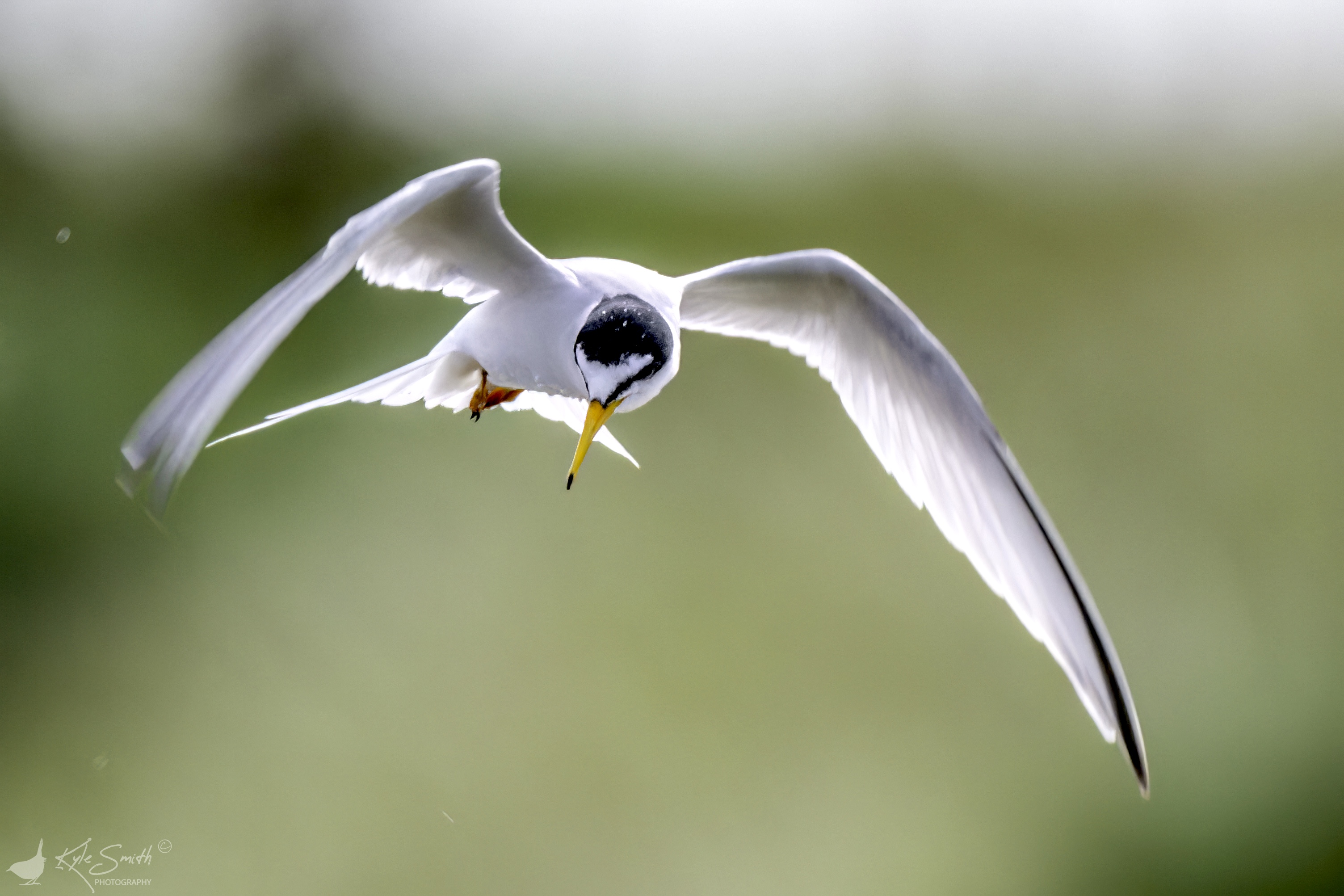
We began our walk around the lagoon and were soon watching little terns both out in the bay and across the lagoon itself. Habitat restoration efforts have clearly been made here - several islands within the lagoon have been fenced off and covered with pea-shingle to encourage nesting by little terns, as well as common and roseate terns. Along the lagoon’s edges, little terns were actively plunge-diving for small fish in a near-constant rhythm.

My initial attempts at photographing them weren’t great due to poor light direction, but after relocating to a better vantage point, I managed to capture some improved shots. With at least eight breeding pairs working the area, there were plenty of opportunities. While formal counts of breeding pairs aren’t conducted here, last year’s doubling of fledged chicks (from three to six) suggests a healthy and growing little tern population.

At one point, we watched a pair of little terns engage in a classic courtship display, spiralling high into the sky in tight circles, calling to each other all the while. Once aloft, they hovered side by side before dropping back down to one of the islands. This aerial dance is a pair-bonding ritual, often performed before or after mating, and sometimes preceding courtship feeding, where the male offers a small fish to the female.

The wind was quite strong, and it was much more comfortable walking along the narrow path below the sea wall, sheltered from the gusts.

Little tern
Little tern
Little tern
Little tern
Little tern
Little tern
Little tern
Little tern
Little tern
Little tern
Little tern
Little tern
Little tern
Little tern

Sharing the islands were numbers of common terns, many already with chicks - more than 60 pairs of common terns populated the site in 2024 and there was no indication of a reduction this year. The adult terns were bringing small fish back to the nest continuously, flying in from the Solent with fish trailing in their bills - often they would hover before landing, presumably to confirm there were no predators before landing - on other occasions the incoming bird would take off again seemingly upset that its partner wanted to take the fish - I can do it! They are busy parents and apparently one adult can deliver up to 50 fish a day to a hungry brood.

Common tern
Common tern
Common tern
Common tern
Common tern
Common tern

Out over the islands we started to spot a handful of Mediterranean gulls, landing in amongst the bleck-headed gull colony. Their call is quite distinct and Kev and I have got quite used to stopping for a look when we hear them overhead - distinctive and rather elegant call, often described as a mournful or drawn-out wail, softer and more musical than the harsher cries of the other gulls. The calls appeared to largely coincide during their arial displays and when disputes broke out when they landed. Not quite the views we had last week at WWT Slimbridge but great to see.

Since first breeding in the UK in 1968 the species has increased in number rapidly - to 2,400 pairs in 2018 (peak) before settling to around 1,200 pairs now. Once confined to the south and to eastern coasts breeding now extends into Scotland with the first breeding pairs confirmed in 2023.

On two occasions a roseate tern flew through, but I didn't manage to get a record shot of it. A pair bred here in the last two summers but as far as I know there is only one bird in the area.

Mediterranean gull
Mediterranean gull
Mediterranean gull
Mediterranean gull

Avocets disappeared from British breeding grounds by the 1840s. Remarkably they recolonised in 1947 on Suffolk's Minsmere reserve during WWII marsh flooding, sparking a dramatic recovery - a rise in breeding pair of 300% in 25 years. The wintering population has surged about 21-% since 1997, reaching about 8,700 birds. Initially concentrated on the East Anglia coast they now breed very widely. They are classified as amber-listed in the UK but are one of the few waders showing strong upward trends.

Avocets represent one of the UK's most remarkable wildlife success stories - from near extinction to now flourishing across the south coast and beyond, their expanding presence underscoring the successful habitat restoration that has taken place.

Avocet
Avocet
Avocet
Avocet
Avocet

A male stonechat seemed to be following us and perched regularly on the fence between us and the lagoon. This was not the only individual, and we had some great views of what I think was a juvenile. Since 1995, the UK breeding stonechat population has jumped by approximately 258% - a long-term surge. In particular there has been an amazing circa 700% increase in umbers over recent decades. As they stopped on posts, gorse and low shrubs they called - a sharp, staccato "chak-chak" sound, reminiscent of stones tapping.

Stonechat
Stonechat

As we began to circle back, we continued to enjoy watching the variety of birdlife, once again spotting the female long-tailed duck. She was diving frequently, then emerged from the water to preen just as before. Nearing the gate on our way back to the car, we came across reed warblers busily flitting through the reeds, their beaks crammed with food for hungry chicks. Nearby, a family of oystercatchers caught our attention.

A friend of mine who lives near the Suffolk coast had recently told me about oystercatcher chicks running around on her driveway, and seeing one here, I couldn’t resist taking a photo. The chick was covered in soft grey and white down, typical of many young waders. It was already beginning to show the species' trademark long, straight bill, though still short and muted in colour compared to the vivid orange-red of the adults.

Oystercatcher chicks are precocial, leaving the nest soon after hatching and follow their parents, and learning how to forage.

Long-tailed duck

Oystercatcher

We discussed our next move - I'd hoped to try for a Dartford warbler, but with the coastal wind picking up, it seemed unlikely we'd have much luck there. Instead, we decided to head inland to Sandy Down near Brockenhurst, where we’d seen them last year. As we pulled into the car park, we stepped out just in time to witness a Red Arrows flypast, likely on their return from the dramatic display over London for Trooping the Colour, marking King Charles’s official birthday.

Notably, this year’s Red Arrows display featured a 40% blend of sustainable aviation fuel (SAF), derived from waste cooking oil and other bio-based sources, to produce their iconic red, white, and blue smoke trails; an effort to reduce their environmental impact.

Red arrows

We set off across the heathland, spotting silver-studded blue butterflies as we went. They are strongly tied to lowland heath and limestone grasslands and are found in colonies, often small and isolated, with key strong populations located here. They have a fascinating symbiosis with ants where the caterpillars secrete a sugary substance that attracts ants, which then protect them from predictors. In return, the larvae pupate underground in the ants' nests! Adults fly mainly in June and July, staying low and close to the ground, and basking in warm, sunny patches. We spent less time photographing them than last year.

Silver-studded blue butterfly

As we approached the spot where we’d seen Dartford warblers last year, Kev paused to examine an orchid, likely a common spotted orchid. In this area, the heath variety is probably the most widespread, and while hybrids do occur here, this one looked fairly typical of the common form. The acidic heathland and boggy ground provide ideal growing conditions.

Spotted orchid

As we waited, we could see some fallow deer on the opposite hillside - their presence made easier to spot given that one was white - a striking and unusual sight. The white fallow deer are usually not albino, typically having dark eyes, not pink. Their whiteness is due to leucism, a genetic condition that reduces pigment. The deer fed in the trees, occasionally passing through partial clearings giving an opportunity to capture a few photos. Further to the left we could see roe deer sitting low in the scrub, eventually departing but stopping for its photo to be taken.

Fallow deer
Fallow deer
Roe deer
Roe deer

Our attention was drawn when we heard a soft partial call from a Dartford warbler in front of us. We located it but as I tried to take a photo, it flew back from its perch on some gorse then stopped briefly on another bush before dropping from view. Shortly after it reappeared way off to our right, against the sky - tricky light for photos. Once it dropped from there, we decided time was getting on and we started back to the car, spotting a hobby cutting across the heather.

Dartford warbler
Dartford warbler
Dartford warbler
Dartford warbler

Almost back to the car a pair of linnets dropped onto a small wet patch in the heather - although they wouldn't be the best photos I took a couple anyway.

Linnet
Linnet

We jumped in the car and made for home - another successful outing and a few year ticks.

Year list: 212.