After looking around, we were unsure where to go on Saturday. Kev @kev07713 and I hadn’t been out all week - Kev had been busy fitting windows for family, while I’d been catching up with friends and attending a funeral. As ever, RSPB Frampton Marsh felt like a safe bet. The reserve has recently been hosting snow buntings, a species I’d failed to connect with last year but one that’s always a pleasure to see. A trip to Lincolnshire might also give us the chance to visit the Fillingham great grey shrike, which many of our friends had already visited to see.
We left Banbury fairly early, deciding not to stop for breakfast on the way. The plan was to try for the snow buntings first, then head to the reserve’s Visitor Centre for some food before moving on.
After a smooth journey, we pulled into the car park and got booted up before climbing from the path onto the sea wall. Kev set up his scope to scan along the wall, guided by information shared by friends about where they’d seen the birds earlier in the week. I mentioned that the latest BirdGuides update from Friday suggested there were still seven snow buntings on the sea wall near the steps by the East Hide, further along than he’d expected.
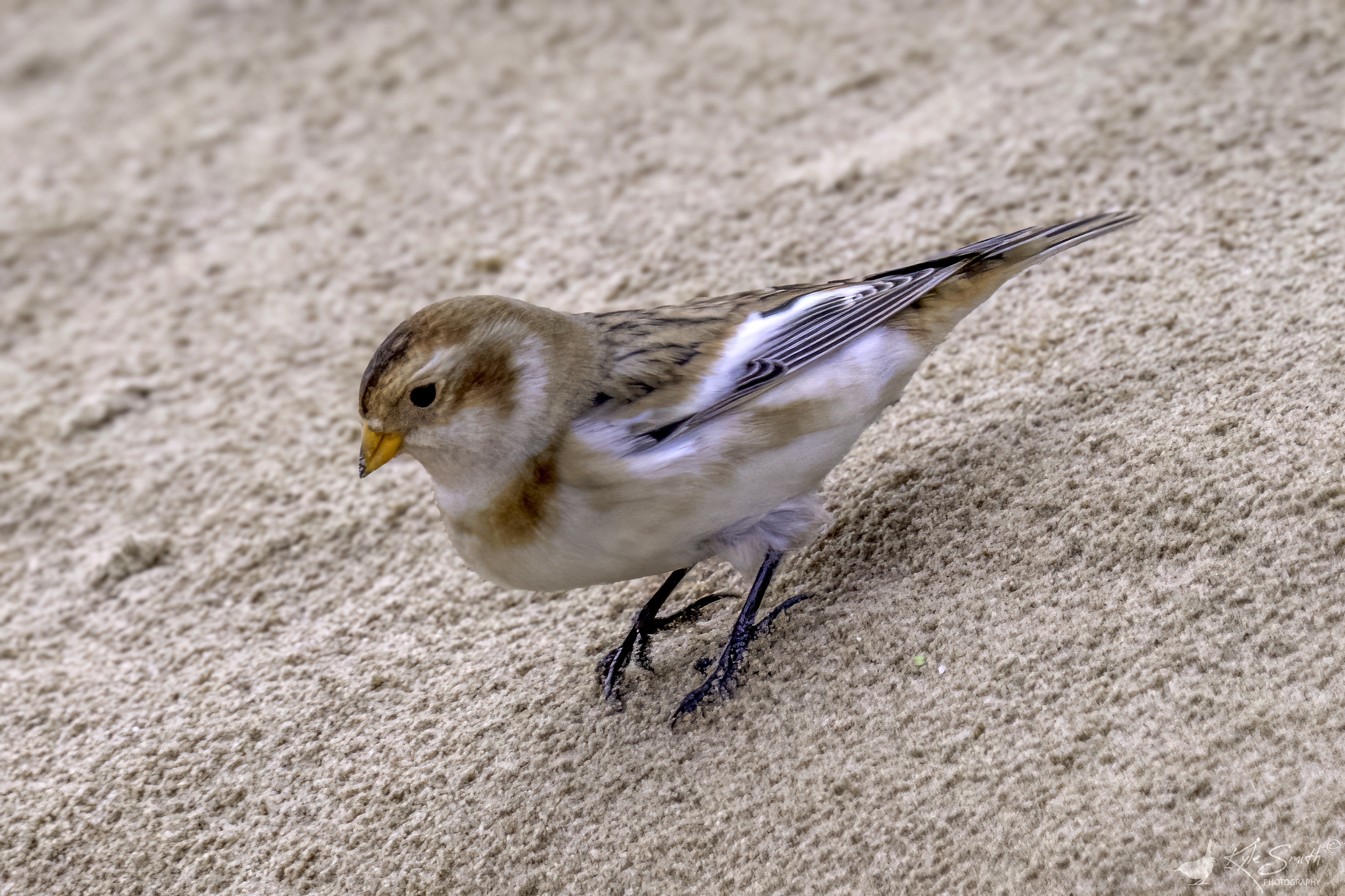
We worked our way along the track, and before long a small group of birds lifted and dropped down onto the side of the wall. Through our binoculars we could see they were our target birds, along with a single meadow pipit, settled roughly halfway between our starting point and the gate above the East Hide, just before the bend in the wall. We walked closer dropped our scopes and took some photographs. The birds offered excellent views, one pausing to stretch its wings and revealing bold black-and-white patterning in the primaries.
Snow buntings are a classic winter visitor to England, and for many birders they’re one of the highlights of the colder months. They breed way up in the high Arctic (Greenland, Iceland, Scandinavia, Russia), then move south as winter bites. In England they usually start turning up from late October, with numbers peaking November–February, and most have gone again by March. They are often found in small flocks, sometimes mixed with linnets or twite and feed mostly on seeds, running mouse-like across the ground - males in winter show that lovely mix of white, black and warm buff.
A couple of photographers approached from the direction of the East Hide and joined us in watching the birds, one of them mentioning that this was his first encounter with the species. What a lucky chap, though they’re always special to see, and all the more so with a couple of smart males among them.


We scanned both sides of the sea wall, picking up marsh harriers, buzzards, curlews, redshanks, ringed plovers, a single dunlin, and vast numbers of lapwings and golden plovers. We returned to the top of the wall by the steps and scanned again, hoping to spot a merlin perched on a post or clinging to the rungs of a fence, but drew a blank.
Dropping back down, we headed in the direction of the car, pausing to scan the scrapes and talking to a couple of the reserve volunteers heading out to catch up with the snow buntings. Here we found plenty of wildfowl: my favourite pintail, wigeon, teal, shoveler, gadwall, mallard, black-tailed godwits, huge flocks of dunlin - hundreds, if not thousands - along with greylag and Canada geese. Snipe flew through on a couple of occasions, singly and in pairs.
We continued scanning back and forth, with Kev picking out a distant peregrine on the ground, busy consuming its recently caught prey. Behind us, I picked up a sparrowhawk, initially perched on a post before flying to a low, raised structure where it remained for at least ten minutes. With kestrel already seen, we’d recorded most of the raptors, just not the desired merlin.
By now we’d spent a couple of hours scanning the area, so decided it was time to drop into the Visitor Centre for a spot of breakfast - sausage-filled rolls and coffee, which hit the spot. We chatted with the ladies on duty while checking the sightings cards, reflecting on just how much the site has changed since our last visit, when it was almost devoid of water, and birds. How good it was to see it flooded again and hosting tens of thousands of birds. As the rain began to fall, we set off back towards the car.
We confirmed our earlier decision to then follow with a visit to Fillingham, the great grey shrike having been confirmed to still be there with an update earlier in the morning. Kev drove and as we progressed, we kept our eyes open to see if we could spot any grey partridge, a species we haven't encountered this year so far - we often stop and look but almost inevitably they turn out to be red-legged and has been the case repeatedly this year and that morning.
However, as we passed a place called Ingham Cliffs, we spotted a couple of partridges out in the fields. Kev safely pulled the car over so I could look back and check them - greys! He then dropped back so we could both get a better view. The birds were crouched low in the crop, the female now almost completely hidden from view. Despite the name, grey partridges are anything but grey when you really look at them - their plumage is actually a warm, beautifully patterned mix of colours - rich chestnut and rufous tones on the face and flanks; buff and sandy browns across the body, giving excellent camouflage in farmland; finely barred flanks with bold chestnut stripes; a pale grey-brown back rather than true grey.
You’ll often see pairs forming from January through February, with most birds firmly paired by March. Through the winter they can be in small coveys, but as daylight increases and the breeding season approaches, those groups break up and birds start forming monogamous pairs. So this is a classic sign that spring, at least in partridge terms, is just around the corner.
They were once a common farmland bird but have seen a significant decline in numbers across the UK and much of Europe over the past decades. Modern intensive agriculture removes hedgerows, field margins, and rough grass strips that provide cover and nesting sites. Grey partridges rely heavily on weed seeds in winter and insects (especially for chicks). Pesticides and herbicides have reduced these food sources, particularly invertebrates in spring and summer. Some areas historically released large numbers of gamebirds (pheasants, partridges), but release strategies and shooting pressure have negatively affected wild grey partridge populations when not managed carefully.

We arrived at Fillingham and pulled onto the verge alongside a couple of other cars, with a cold wind and the hint of rain in the air. A little way along the track we could see three birders chatting and assumed that was the right direction to head in. As we approached, we realised one of them was Wayne Glossop (@WayneGlossop2). As Kev has met and chatted with him before, he stopped to say hello. Wayne mentioned he was just heading back to his car to pick something up but would return shortly and, most importantly, that the bird was showing well.
When we arrived, two birders were already in position, one with a camera and the other with a scope, though the bird wasn’t in view at that moment. It was only a couple of minutes before the great grey shrike flew across the set-aside field, hovered briefly, and then perched on the hedge we’d just walked along. Viewing from the inside line of the hedge, we stepped back a few paces to get a better line of sight as the bird remained perched there for several minutes.
Great grey shrikes in the UK are classic winter visitors - scarce, and always a bit of an event when one turns up. They breed across northern and eastern Europe and parts of Asia and are regular winter visitor, mainly from October to March, with most records between November and February, with numbers varying year to year; some winters see several birds, others very few. They favour open countryside with scattered bushes, hedges such as here, or isolated trees, especially on rough set-aside farmland, heathland, and moorland edges.
Typically they are very conspicuous, often perched on a post, hedge, or small tree, hunting by watching from a vantage point, then dropping or gliding onto prey; prey consisting of small mammals, birds, large insects, and lizards. They are famous for impaling prey on thorns or barbed wire, earning the nickname “butcher bird”. They’re a proper winter bonus.

After a few minutes our bird took to the wing, flying out across the rough field before lifting and beginning to hover, its wings beating rapidly. Kev managed to capture some video, which gives a great impression of the behaviour and can be seen in his post on X here.
While great grey shrikes typically hover only briefly, some individuals will hover for surprisingly long periods, particularly in steady winds. A good headwind allows them to hold position with far less effort, much like a kestrel, especially when locked onto prey moving below - behaviour we’d not witnessed before. On this occasion, the shrike hovered for a considerable time over the field before dropping back to a perch, longer than is usually expected for the species. This was repeated again and again as it worked across the field, often beginning from a higher position before descending to lower levels and eventually dropping into the grass.


After a while Wayne returned and the bird slipped out of view, disappearing over the far side of the hedge. One of the other birders mentioned that this was the first time in the couple of hours he’d been there that the shrike hadn’t been visible. By now the weather had closed in - the cold wind strengthened and spots of rain began to fall - so the bird was likely holed up in a dense patch of cover, taking a break from the conditions. Wayne and his companion headed off, while Kev wandered along the hedge to check whether the bird was hunting in the adjacent fields and down the gentle slope. Before long, the last remaining birder departed as well. With little action, Kev scanned behind us and picked out four more grey partridges - buses, eh!?
An older woman then joined us for twenty minutes or so while the bird remained out of view. She’d only got married the week before and hadn’t yet had the chance to come and see the shrike, but it still refused to show. Eventually she decided to return another day, being local, and by the time she reached the end of the track near the parked cars, the shrike had hopped back up onto the far hedge line. Kev whistled and, after a moment, she turned back, though she’d clearly decided to return when conditions were better. Kev and I watched as the bird worked slowly along the hedge, perching for minutes at a time before moving on to the next vantage point.


Eventually the bird reached the far right-hand corner of the field and perched there for a while. We were then joined by Toby Carter (@_TCartz) and a young woman with him, whom he introduced as Charlotte. They had apparently seen the bird earlier along the far hedge but had relocated as it moved out of view and back into the field.
We chatted for a while, and Kev mentioned Toby's latest updates and videos on Facebook, where he’s been trying something a little different. Before long, the bird resumed its earlier behaviour, hovering for prolonged periods and occasionally dropping into the grass. As the weather closed in once more, with longer spells of drizzle, Toby and Charlotte eventually headed back towards the car. Later, however, we came across them again further along the hedge, still watching the shrike.


With the weather drawing in and the light steadily fading, we decided we’d had our fill of the bird and turned for home, calling it a day.
Year list: 157.