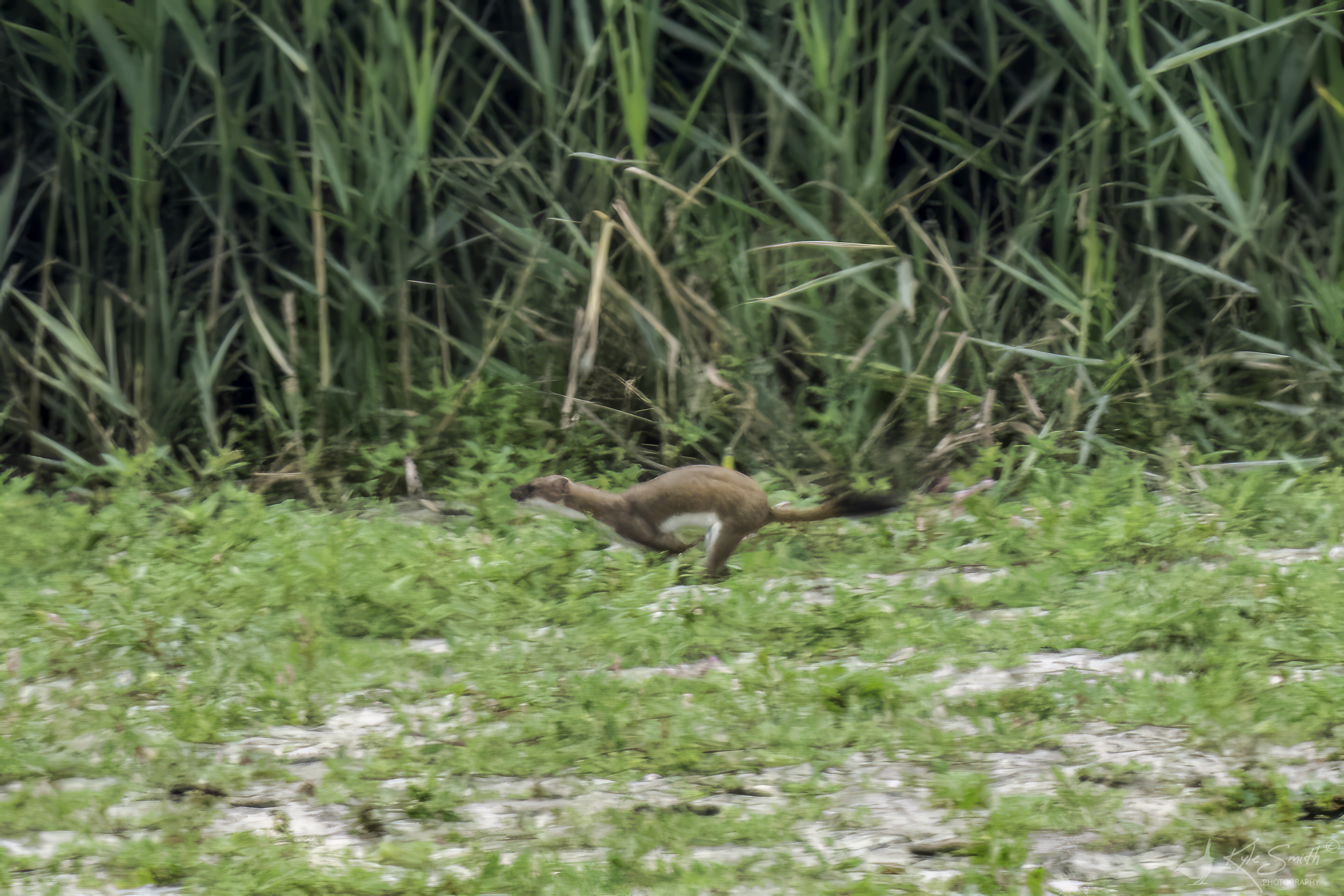
I took a few days off work, and Charlotte and I decided we would drive up the east coast of the UK to Edinburgh, and then cross to the west coast at Seamill / West Kilbride where my mum lives. We set off stopping for breakfast on the way to RSPB Bempton Cliffs - I still hadn't seen any fulmar or kittiwakes this year, and they may be a very outside chance of a late late puffin. We arrived to find a stiff breeze accompanying us as we dropped down onto the cliff and turned left.
We saw kittiwakes and gannets on the wing but disappointingly few birds on the water. Thousands of gannets can be seen nesting on the narrow cliff ledges. As the season progresses, you can see these birds taking off from the cliffs in large numbers, to fish, but now they were also accompanied by their offspring. Typically, around late September to early October, the activity on the cliffs begins to wind down - by this time, most of the gannet chicks have fledged and ready to leave the nest. Gannets, along with other seabirds, start to migrate away from the cliffs as they head out to sea. Adult gannets and their fledglings will migrate to warmer waters, often traveling to the coastlines of Western Europe and even as far as West Africa. By mid-October, most of the gannets have left (last to depart), leaving the cliffs largely devoid of bird life until the next breeding season in the spring.


There were no guillemots and so it was unlikely that there would be a puffin and soon one of the volunteers confirmed that it had been three days since the last one had been seen on the water. We'd been scheduled to visit this part of the world back in early July but I'd contracted Covid and so we'd missed our chance to connect this year. A must for next year.
Along with the gannets were kittiwakes - Kittiwakes are a prominent seabird species that can be found at Bempton, in fact one of the best places in the UK to observe them, especially during their breeding season. Kittiwakes are known for their distinctive, high-pitched calls, which sound like their name: "kitti-wake." They are often seen in large, noisy flocks, both on the cliffs and out at sea. Unlike some other gull species, kittiwakes are almost exclusively marine, only coming to land to breed.
By August, the kittiwake chicks have usually fledged, and the adults start to leave the cliffs. They spend the winter months out at sea, often in the North Atlantic, before returning to the cliffs the following spring.


Fulmars are medium-sized seabirds that resemble gulls but are more closely related to petrels and albatrosses. They have a robust body, a thick neck, and a distinctive tubular structure on top of their beaks, which is used to excrete excess salt from their bodies. Their plumage is typically grey and white, with a pale head and underparts, and darker wings and tail. I hadn't managed to connect with any so far this year and initially it didn't seem like I would find one, but then a volunteer pointed one out. They'd seen one earlier but said they were scarce today. I then saw this individual about every five minutes.
When the wind dropped a cloud of flies would appear and decend on the trail and viewpoints - not often you pray that the wind doesn't drop.

We scanned and noted an increasing number of birds on the water but ID'd them as the species we were watching on the cliffs. Out of nowhere a dark bird appeared, more than 500m out and in my head, I thought skua. However, it turned out to be a marsh harrier! - an unexpected but thrilling sight. Marsh harriers are typically associated with wetlands, reed beds, and marshy areas, but it's not too uncommon to see these majestic birds over the sea along coastal areas, especially during migration. They often glide low over the water, similar to how they hunt over reed beds, looking for prey such as waterbirds, or even carrion. It turned out that the bird had been reported doing the same the previous day.


We repaired to the Visitor's Centre for some lunch and joined others in watching swallows coming in to feed their young in nests around the Centre itself. Swallows typically nest in sheltered locations, often in man-made structures like barns, sheds, or under the eaves of buildings. Here they have found suitable nesting sites around the Visitor Centre, using ledges and other sheltered spots to build their mud-cup nests. They are known for returning to the same nesting sites year after year. This next was just to the side of the entrance door and housed four lovely chicks, ready to fledge.
We had a nice lunch, a drink, and were then ready to return to the cliffs and make our way along the cliff tops to the right.

We stopped at a couple of the viewpoints and saw increased numbers of gannets on the wing ,and on the cliffs and ledges. There were still numbers of juveniles amongst the adults, in various plumages and some working hard on their wing-flapping. On the ledges were also numbers of kittiwakes, some with no sign of young and perhaps the nests have just become a place to come and rest.


From this viewpoint we could see more fulmar, and particularly a family on a ledge, with a what appeared to be quite a young bird still present. Two individuals were running circuits around the bay and stopping to land, but at the last moment pulling out and rstarting the circuit once more. They were great to watch.


Time was ticking on and eventually we returned through the Visitor's Centre and back to the overflow car park which would close at 5.00pm. We would be staying in Scarborough overnight and made our way there and started looking for somewhere to eat. We found a lovely pub offering a range of food but opted for a Sunday lunch menu. I had a couple of pints, and we called it a day.
After a good night's sleep we had breakfast in the hotel and then set out for Yarm near Middlesbrough where we would stop for lunch in an Italian restaurant. After that we made for RSPB Saltholme and pulled up in the spacious car park, finding notices that the Visitor's Centre had no running water. Most services there are provided for by rainwater harvesting but we were warned of limited service in the cafe. I've often tried to visit while working in the area but been unsuccessful due to the opening and closing times - the site can't be accessed other than through the Centre.
We looked at the sightings board and decided which hide we would be making for and set off on a walk around the site. There were a few noisy common terns overhead but little else of interest. We stopped in a couple of hides on the way but eventually reached the hide that had boasted the most sightings today. Here we found a couple of other birders, one already packing up to leave. We scanned about and found there was little of note in view - some barnacle geese being the best. I noted a redshank feeding along the edge of a pool to our left, partly obscured by the drop in level to the water's edge. However, there was another bird, largely out of view, which I could see was a ruff. Other birds were the usual fair but we enjoyed being entertained by little egrets, swifts, swallows, and sand martins. The few black-tailed godwits we saw soon took up and left, stage right.


We returned to the Visitor's Centre and as we enjoyed tea and coffee from the café we watched sand martins coming to and from the wall provided. More swifts cut across the sky, in larger numbers than I've seen recently - I thought most had already departed for their wintering grounds.
Sightings had been a bit disappointing, but it was a pleasure to eventually visit and be able to look around. I'm sure I'll be back someday when more species are on offer.
We made our way over to Seaton Snook to walk along the beach and common, hoping to look back to Seal Sands and South Gare. As we got close, we could see a huge structure rise from the horizon, the Brent Charlie topside platform. We were amazed at the size of the platform towering above us.
The platform is now stationed at Able Seaton Port on Tees Road, where it will be dismantled and recycled over 18 months and weighing 31,000 metric tonnes, it is the largest platform of its kind to be lifted, transported, and brought ashore.
The colossal structure was delivered by the Allseas Pioneering Spirit off the coast of Hartlepool, before being transferred onto the cargo barge Iron Lady for its final tow into Able Seaton Port. Brent Charlie is the fourth and final platform from the Shell Brent oil and gas field, located off the northeast coast of Scotland, to undergo decommissioning at this site.
Dismantling oil rigs is a critical aspect of the offshore oil and gas industry's lifecycle. As oil fields are depleted and rigs become obsolete, safe and environmentally responsible decommissioning becomes essential. Seaton Port, with its facilities and proximity to the North Sea oil fields, plays an important role in this process. The dismantling of oil rigs at Seaton Port supports the transition to cleaner energy sources by responsibly managing the end-of-life phase of offshore oil infrastructure. A significant portion of the rig, particularly the steel and other metals are sorted, processed, and sent to recycling facilities.
Right beside the platform we could see the long blades of wind turbines and realised that they were also assembling and installing turbines off the coast here. This is all occurring to support the Dogger Bank Offshore Wind Farm marshalling works (largest offshore wind farm in the world) at Able Seaton Port. The installation of wind turbines off this area contributes to the UK’s renewable energy goals, helping to reduce reliance on fossil fuels and lower carbon emissions. Several turbines in the bay were new since I last visited.
We parked at North Gare Car Park and walked through the golf course, over the sand dunes to the beach. Damn, the tide was in and there was no way to walk along North Gare beach. I could see common and sandwich terns, and a couple of roseate terns across the water, and then a couple of guillemots. We had a nice walk but there was little else to add before we decided to turn and make our way back to the car. Out in the water we could see a couple of people kite surfing. Kite surfing, also known as kiteboarding, combines aspects of surfing, windsurfing, and paragliding. It involves using a large, controllable kite to harness the power of the wind, which propels the rider across the water on a board. It was entertaining to watch as the boards cut through the waves and the riders launch into the sky.


We checked into our hotel and then dined at an Indian restaurant that I've eaten in frequently - they have some of the largest naan breads we've ever seen. Charlotte's meal was a bit spicier than she'd expected, but still enjoyable.
After breakfast and checkout we set off for Amble. Nestled along the River Coquet estuary, the waterfront town of Amble boasts a harbour lined with fish shacks, seafood restaurants, and pastel-painted beach huts, serving as the southern gateway to the Northumberland Coast Area of Outstanding Natural Beauty. Importantly it was also where we'd planned to visit in July, before I contracted Covid - we wouldn't see the range of birds that would’ve been on offer in July. We checked out sailings of the Puffin Cruise boat and booked onto the final sailing of the day.
While we waited, we walked around the harbour and watched the boat come and go on earlier sailings.


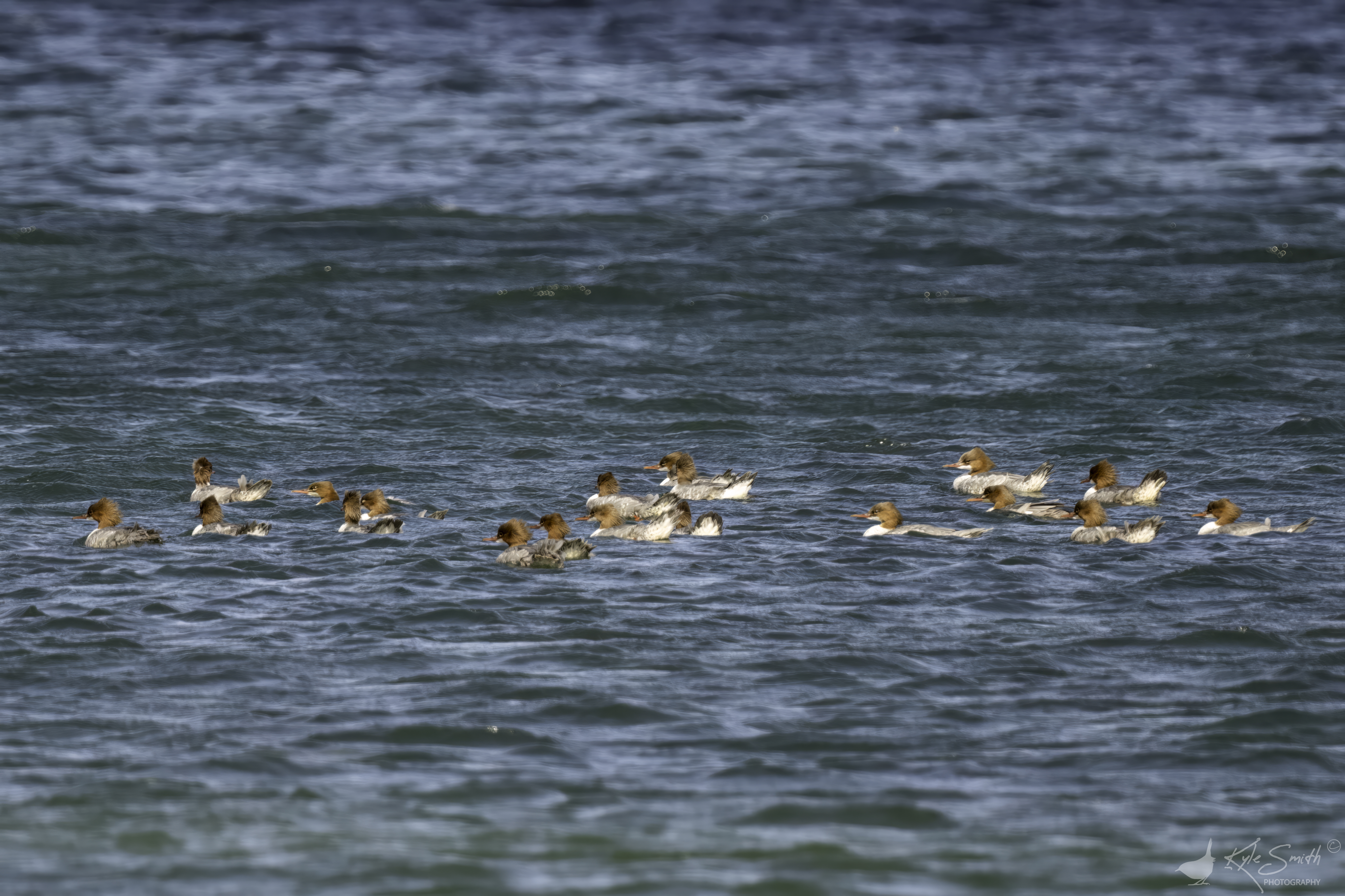
Around the harbour we saw some eider ducks and a flock of goosander, fishing around the boardwalk. A few but growing number of people fished from here, along with families using lines to catch crabs. Starlings worked along the harbour walls and around the nets and crab/lobster pots.



Fishing boats unloaded their catch, and we went off to have some fish for lunch in one of the harbourside restaurants.

We joined the queue to board the boat and were surprised to see a number of dogs board with us - less so the number of children given it was the school holidays. Off we set for an hour's trip - I could claim I'd taken Charlotte on a cruise this summer.
As we got further out from the harbour, we started to see a few guillemots bobbing on the water and gannets by, with a few individuals diving close. The noise of common terns started to drift towards us.


A sandwich tern flew close carrying a fish in its beak - tern fishing parties increased as we approached Coquet Island. We got close to shore, the boat stopped, and beside us grey seals popped up in every direction. While the island is perhaps best known for its birdlife, it is also home to a thriving population of grey seals - they are curious and approached our boat, albeit observing us at a distance with only occasional close passes.
They exhibit distinct physical characteristics at different stages of their life, making it possible to identify their age based on their appearance. Juvenile grey seals have a sleek, silvery-grey coat with scattered darker spots. Adult males are typically larger, with a broader head and neck and their coat is often darker with more distinct spots, and often scars from territorial disputes with other males. The adult females are slightly smaller with a lighter grey or brown coat, also marked with spots but generally less pronounced than in the males.


We restarted the boat and continued onto the island where we could see a colony of sandwich terns. Coquet Island hosts a significant breeding population and, on average, the island supports around 400-500 pairs. We were lucky to watch as a large number of the birds took to the sky - an amazing sight.


Further on we encountered groups of assorted terns: common, arctic and roseate. The island supports a significant number of common terns, with around 1,000-1,200 breeding pairs; a smaller population of arctic terns, with approximately 150-200 pairs; around 30-40 pairs of roseate terns. This makes it one of the most important breeding sites for roseate terns in the UK. While the populations were smaller than earlier in the year it was great to see these birds and get an impression of what we would hope to see next year.
We were informed it was five days since the last puffin had been seen around the island. The island supports a significant puffin colony, with approximately 1,000-1,200 pairs making it one of the more important puffin breeding sites in England. Charlotte will love seeing them next year when I hopefully won't fall ill. She is very patient with me as I only found her a couple last year - I owe her.


We finished our boat tour and disembarked with just enough time to drop past the car before we had a dinner reservation in The Old Boathouse in the harbour. Again, delicious fish and a lovely end to the day before setting off to check in to our hotel.

The next day we awoke, had breakfast, and set out for a drive to my mum's house in Ayrshire on the west coast of Scotland. However, we started out along the coastal trail to Edinburgh, planning to stop at Musselburgh as the halfway point, and to try for the Stejneger's scoter that has been reported there over recent months.
A road trip along the coast from Amble to Musselburgh offers a scenic journey through some of the most picturesque landscapes in the northeast of England and southern Scotland. The journey begins passing the charming seaside town of Amble, known as the "Friendliest Port." then just a few miles north you pass Warkworth, dominated by its impressive medieval castle. Continuing along the coast, you find Alnmouth, a picturesque village with a sweeping sandy beach and colourful houses. Further north, Bamburgh awaits with its iconic castle towering over the village and beach, this fortress offering breathtaking views of the coast. Continuing north, you then reach Berwick-upon-Tweed, the last English town before Scotland. After crossing the border into Scotland, there are more views of the sea and clifftop walks and onto North Berwick. The trip concluded in Musselburgh, just outside Edinburgh, known as "The Honest Toun" Musselburgh is famous for its historic racecourse, one of the oldest in the UK, and its beautiful harbour.
As we approached a drizzle started to wet the car window, a complete change from the weather previously, but as we parked up by the Racecourse the rain had stopped and we were just left with grey skies and a stiff breeze. We put on our walking boots and made our way to the sea wall and the track that would take us round to the spot favoured by our target bird.
The Stejneger's scoter primarily breeds in eastern Siberia and winters in East Asia, so its presence in the UK is a rare occurrence, with only a handful of records. Its appearances are typically noted along the eastern coasts of Scotland and England. The scoter is most likely to be seen offshore, so a spotting scope is a must to stand a good chance of identifying it. One prime spot here in Musselburgh is the mouth of the River Esk, where it meets the Firth of Forth - this area is frequented by various species of scoters, recently including the Stejneger's. Walking along the sea wall provides an elevated view of the water, which can be beneficial for scanning the flocks of ducks and picking out any rarities.
The Stejneger's is very similar in appearance to the velvet scoter but with subtle differences - you need to look for the male's distinctive yellow-orange knob at the base of the bill, which is more pronounced and differently shaped than that of either the velvet or common scoter. Our bird tends to associate with flocks of other scoters, so carefully scanning these groups is crucial. Being a rare visitor, it often takes some time and multiple visits to spot it - calm days are ideal for spotting sea ducks, as rough seas can make it difficult to observe birds that are farther out, and high tide is generally best as the birds tend to come closer to shore, making them easier to observe. We didn't have the luxury of choosing - the sea was choppy and it was an hour after low tide - we started the search.
We walked along and saw flocks of eider and common/velvet scoters beyond.

We stopped and scanned through the birds on the water, initially focussed on the scoters to our left. We worked through these and onto the next flock - all seemed to be velvet with a smaller proportion of commons. It wasn't proving easy and my scope is not the best. We continued on and talked with a few birders following who at least agreed that we hadn't yet walked past it ... probably. After about 20 minutes we talked with a birder coming in the opposite direction who confirmed that he'd seen our bird in a flock of about 100 other scoters further down the track. We relocated and started working through the birds, initially finding "just" more velvets and commons.


And suddenly there it was ... oh, and where did it go - I tried to show Charlotte but the bird had disappeared. After a few minutes I found it again, still 250m or so from our position. I raised the camera and had a go at trying to pick out the area where the bird was and snapped off a few photos. I lost it again and took some time to see it once more, snapping some record shots (I hoped).


We'd been successful, and I could add a tick for a new lifer, catching up with Kev who'd seen it back at the beginning of July. Another species I never dreamed I'd see. We spotted some bar-tailed godwits on the return, feeding in the edge of the water with a curlew. Nice to tick these for the week.
We were now scheduled to drive on, check into our hotel, and go to visit my mum - another 2 hours to go from here. The end of the birding for this trip but a nice list and makes us look forward to visiting Amble again next year.

Year list: 228.