Showing posts with label black swan. Show all posts

Thursday, 31 July 2025

WWT Slimbridge :: 26 July 2025

Looking around there didn't seem to be much around that we might travel to, at least not within easy reach. Much like Frampton Marsh and Lymington you can never have a bad day at WWT Slimbridge, so we decided to head there, arriving just as the members’ gate opened, comfortably ahead of the general public. At the entrance we were greeted by a young girl volunteering as a warden, noting down membership numbers. Her mother remarked on how impressed she was that her daughter not only had the interest, but also the enthusiasm to get up so early for it.

From that entry point it made sense to follow the track past the Rushy Hide towards the Estuary Tower Hide, which overlooks the Dumbles. There had been a report of a Caspian tern here the day before, so you never know what might turn up.

At the Rushy hide, there was quite a change since our last visit. Avocet numbers had dropped sharply, presumably because they’d nested and the young had fledged, probably moving to other parts of the reserve. I was keeping a species tally, carefully working through the ducks in search of teal - eventually, I did find a couple. Nearby, a black swan was sleeping, while redshank, green sandpipers, and several little ringed plovers with their young busily scuttled along the water’s edge.

The day before, a female garganey had been reported from the area to the left of the Robbie Garnett Hide. We were delighted when another birder picked it out - distant, but right in front of us. It certainly hadn’t been there earlier, as I had thoroughly scanned all the ducks while searching for teal. It must have dropped in while we were scanning, hidden among the crowd. Over the following days it would prove to be quite mobile, sometimes seen on the Tack Piece, “calling in” before flying back over the hedge.

The garganey is a small dabbling duck, similar in build to teal, and one of the rarest but regular summer visitors. A migratory species, it breeds in parts of Europe and western Asia, arriving in March, then winters in sub-Saharan Africa and southern Asia from August onwards. A female appearing at Slimbridge in late July might be a failed breeder leaving early, a dispersing post-breeder seeking rich feeding before migration, or a migrant from continental Europe pausing on its journey. Slimbridge provides ideal conditions for moulting birds: safe water, plentiful food along the margins, and limited disturbance.

The female, though far subtler than the strikingly patterned male with his bold white head stripe, is beautifully adapted to her wetland environment. Garganey are often secretive, foraging quietly in shallow margins or hidden among vegetation—unless, of course, they’re fast asleep in the reeds, which is how I’ve often encountered them.

After we'd chatted with others in the hide, we looked back to see our bird had vanished, presumably the small duck flying off to the left.

Garganey
Garganey

Black swan
Black swan

We stopped briefly at the Martin Smith hide, but with little in view we moved on to the Robbie Garnett hide. Here, a dozen or so green sandpipers were feeding close by, a few showing particularly well right in front of the hide. Some waded in the water, their movements captured beautifully in the reflections. Across the far bank a spoonbill was, as ever, fast asleep. A lone male ruff worked along the water’s edge, first feeding to the right and then drifting left. While scanning to count the green sandpipers, I noticed one bird that stood out - “one of these things is not like the others.” It was, in fact, a wood sandpiper.

Wood sandpipers are most frequently encountered during spring passage (April–May) and again on autumn migration (July–September). Late July through August marks their peak return passage, as birds travel south after breeding in northern Europe and Asia. In Britain the annual total usually numbers only in the low hundreds, with most sightings involving single birds, though occasionally several may gather at a good site.

This individual was feeding at some distance but eventually flew in to about halfway across the pool, allowing for a slightly better view and photograph.

Green sandpiper
Green sandpiper
Green sandpiper

Green sandpiper
Ruff and green sandpiper
Wood sandpiper
Wood sandpiper

To our amazement, the spoonbill eventually stirred from its sleep and with a stretch and a shake of its head, it began to preen, giving us a chance to see it in all its elegance. Its plumage looked dazzlingly white and the bird’s long, spatulate bill was shown off beautifully as it worked methodically through its feathers. An exotic visitor more reminiscent of a Mediterranean lagoon than a Gloucestershire wetland.

This small interlude was lovely to watch, as spoonbills often appear motionless for hours at a time. Their routine of sleeping and preening is in fact a reflection of their feeding ecology - they tend to feed intensively at dawn and dusk, sweeping their distinctive bills side to side through shallow water, then spend much of the day resting to conserve energy. In the UK they are still relatively scarce, though their numbers are slowly increasing, with breeding colonies now established in a handful of sites.

After its brief display the bird soon reverted to type, tucking its bill back beneath its wing and sinking once more into sleep.

Spoonbill
Spoonbill

From the next hide we located a great white egret, standing almost motionless in the shallows. Its large size and striking white plumage made it easy to pick out, but the bird hardly moved during the time we watched it. This still, patient behaviour is typical of the species, which will often wait for long periods before stalking and striking quickly at passing fish or amphibians. Great white egrets are becoming more frequent sightings and are now breeding in a few areas, so encounters like this are no longer quite the rarity they once were.

In front of the hide, activity was provided by a family of reed warblers moving rapidly through the reedbed. The adults worked their way among the stems, searching for insects, while the juveniles followed, less agile but clearly learning quickly. Their constant movement gave us an excellent chance to watch them at close quarters, a good example of the busy, hidden life that thrives in reedbeds through the summer.

Great white egret
Reed warbler
Reed warbler

We made our way up into the Estuary Tower and spent some time scanning the view, hoping for a glimpse of the Caspian tern reported the previous day, or perhaps something interesting passing over the Tack Piece or the Dumbles. Despite repeated checks with the scope, the scene remained fairly quiet. On the slope down to the water’s edge we noted groups of gulls, curlew, and dunlin, but nothing out of the ordinary stood out. With little else showing, we decided to retrace our steps and head across to the Zeiss Hide.

From there we picked up a pair of common cranes off to our left, feeding in the distance. These birds have become a welcome feature at Slimbridge in recent years, thanks to the reintroduction programme. Looking further out, a marsh harrier came into view, flying steadily across the reserve. It was immediately mobbed by a variety of smaller species as it passed through. Once the raptor had gone, many of the disturbed birds filtered back down to the pools. Among them we picked out a leucistic lapwing, strikingly pale compared with the rest of the flock and an unusual sight.

From here we could also see more than one hundred avocets – so this is where they were.

Common crane
Marsh harrier
Leucistic lapwing and ruff

A sudden burst of commotion broke out when news came through that the Caspian tern had reappeared. The message circulated quickly via the local WhatsApp birding group, BirdGuides, and even by a telephone call. Kev and I, along with a pair of other birders, set off at pace back towards the Estuary Tower Hide - ironically, we had managed to place ourselves about as far from the bird as it was possible to be on the reserve.

Partway there, however, another update came through: the tern had been flushed by grazing cattle from the field where it had been resting and had vanished. The birders ahead of us relayed the disappointing news, but we continued on regardless, hoping it might return.

At the Estuary Tower Hide, a small crowd had gathered, all scanning the estuary in anticipation. More people arrived in quick succession, word clearly travelling fast. Despite our collective effort, the tern never showed again, though it was reported once more the following day.

While the tern stayed away, there was still plenty of activity on the Dumbles. Increasing numbers of common cranes began to drop in, eventually building to around twelve birds, loosely gathered in pairs. As we watched the cranes settle, the black swan flew past, presumably returning from feeding elsewhere.

Common crane
Black swan

We headed back to the Visitor Centre for a bite to eat and a much-needed coffee before setting off again, this time towards the Discovery Hide. A Tundra bean goose had been reported from there earlier in the morning, and we were keen to try our luck.

On the way, however, we met several birders coming in the opposite direction, all of whom reported that the goose had disappeared. This news was confirmed as soon as we arrived at the hide - no sign of the bird. We spent some time scanning, but at first all we could pick out were greylags scattered across the pools and grazing areas. Still, the atmosphere in the hide was good, with birders chatting.

Then, just as our attention began to drift, Kev suddenly pointed and called out. There, walking steadily along the strip of land between two bodies of water, was our goose. At last, the Tundra bean goose had revealed itself, giving us the views we had been waiting for.

They breed in the Russian Arctic tundra and migrate mainly to western and central Europe; the UK is on the edge of their regular wintering range. Generally darker in plumage than greylags, with a more compact build - the bill is mostly dark with a limited orange band near the middle.

Tundra bean goose
Tundra bean goose
Tundra bean goose
Tundra bean goose
Tundra bean goose
Tundra bean goose

Time was marching on, and we returned to the Rushy hide to see what might be showing there, finding that the spoonbill must have relocated - again initially asleep, preening, and then going back to sleep after it had walked at most 5 metres.

Green sandpipers sometimes flatten themselves, lying low in shallow water when a raptor passes overhead - this “freeze” behaviour is a well-known anti-predator response. However, on hot days, green sandpipers (like many waders) will sometimes settle low in very shallow water or damp mud to cool off. The water can help regulate temperature, especially in mid-summer - this seemed to be what was happening.

A ruff fed in the shallows but again some distance from us.

Spoonbill
Spoonbill
Green sandpiper
Green sandpiper
Green sandpiper
Green sandpiper
Ruff

On our way back to the car we passed through the Slimbridge collection and were drawn to the enclosure holding masked lapwings and southern screamers, two striking species sharing the same space. We stepped inside the walk-through area just as one of the lapwings began bathing in the pool, splashing vigorously before pausing to shake out its wings.

Masked lapwings, also known as spur-winged plovers, are native to Australia and New Guinea. They are bold, noisy birds, often highly territorial, and are well known for defending their nests with loud calls and even aerial attacks on intruders. Their distinctive yellow wattles and sharp wing spurs give them a unique appearance among lapwings.

The southern screamer by contrast, is a large South American wetland bird, more goose-like in size and stature. Despite its bulky build, it belongs to the same order as ducks and geese, though it looks quite different. Its name comes from its extraordinarily loud, far-carrying call, which can be heard over long distances in its native range. At close quarters its size and unusual build make it particularly impressive.

Together in the same pen, the two species made an odd but fascinating pairing - one small and sharp, the other large and ungainly but both offering a glimpse of wetland life from very different parts of the world.

Masked lapwing
Masked lapwing
Masked lapwing
Masked lapwing
Masked lapwing
Sothern screamer

Year list: 222.

Thursday, 19 June 2025

WWT Slimbridge :: 07 June 2025

The UK weather forecast for this Saturday predicted heavy showers and thunderstorms moving eastwards, with a yellow warning issued across central and southern England for heavy rain, lightning, and thunderstorms. It seemed likely that most of the places we might consider visiting would be significantly affected by the rain. Kev and I talked about possibly giving birding a miss, but on days like this we usually decide to head out anyway — WWT Slimbridge is often our choice, as its many hides provide good shelter.

Kev checked the local forecast for Slimbridge, and it suggested it might actually stay dry first thing, with rain setting in by late morning. That gave us hope of enough time to catch up with the returning white-spotted bluethroat, a remarkable bird that’s now established a summer residency at the site. WWT confirmed it was back for its fifth consecutive year, and a couple of friends had already been down to see it again. It’s astonishing that a vagrant like this shows such strong site loyalty — I suppose it’s a bit like the great reed warbler at Ouse Fen, which seems to be doing something similar.

The white-spotted bluethroat is a striking and rare migrant to the UK. Males, like the Slimbridge bird, show off a glossy blue throat with a distinct white spot in the centre, bordered by a black band and a partial red chest. The numbers visiting the UK vary each year, ranging from none to over a dozen (as in 2013). Both the white-spotted and red-spotted subspecies appear as passage migrants in the UK.

Early morning at the Middle Point Shepherd’s Hut offers the best chance of seeing the bird, especially if the wind is light — and with the rain forecast to arrive later, this felt like a decent opportunity. One of the bluethroat’s most striking features is its song: rich, varied, and melodic, often compared to that of a nightingale. It combines clear whistles, rattles, mimicry, and repeated short phrases. Most fortunately, the song is usually delivered from a perch in reeds or bushes, particularly at dawn or dusk — unmistakable across the reedbed.

We arrived at the members’ gate to find it still closed — we were just under ten minutes early according to the sign. Luckily, a member of staff appeared from the car park and kindly let us in, checking our membership numbers as we passed through. He suggested we’d be unlikely to see the bluethroat given the forecast conditions, but we said we’d give it a try anyway. We felt more confident than he was, and as we walked along the Summer Walkway, we noticed a fair number of flies on the wing — would our optimism prove misplaced? - it didn't seem likely ...

At the Shepherd’s Hut, we immediately spotted a bird perched in the reeds on one of the bluethroat’s favoured perches — but it turned out to be a reed bunting. Kev edged around the hut and soon found the bluethroat perched closer, and called me over. We set up our scopes and took some record shots. Before Kev had time to get his phonescoping kit ready, the bird dropped from the perch and flew to the back of the reeds.

Bluethroat
Bluethroat

Over the next half hour the bird showed a handful of times and we were joined by a few other people. We got talking to one chap who was with camera, taking photos and some video - it turned out to be Lee @Wildwood_photos who posts on X under the username Wildwood Nature Photography; we'd seen some of his posts and photos before. On one ocassion the bird flew to some nearer reeds, perching in reasonable view. Although the photos appear to show the bird close, it was actually still pretty distant and the photos are heavily cropped.

In flight you could see the distinctive reddish coloued flash on its rump (upper tail coverts), contrasting with the otherwise dark tail and back.

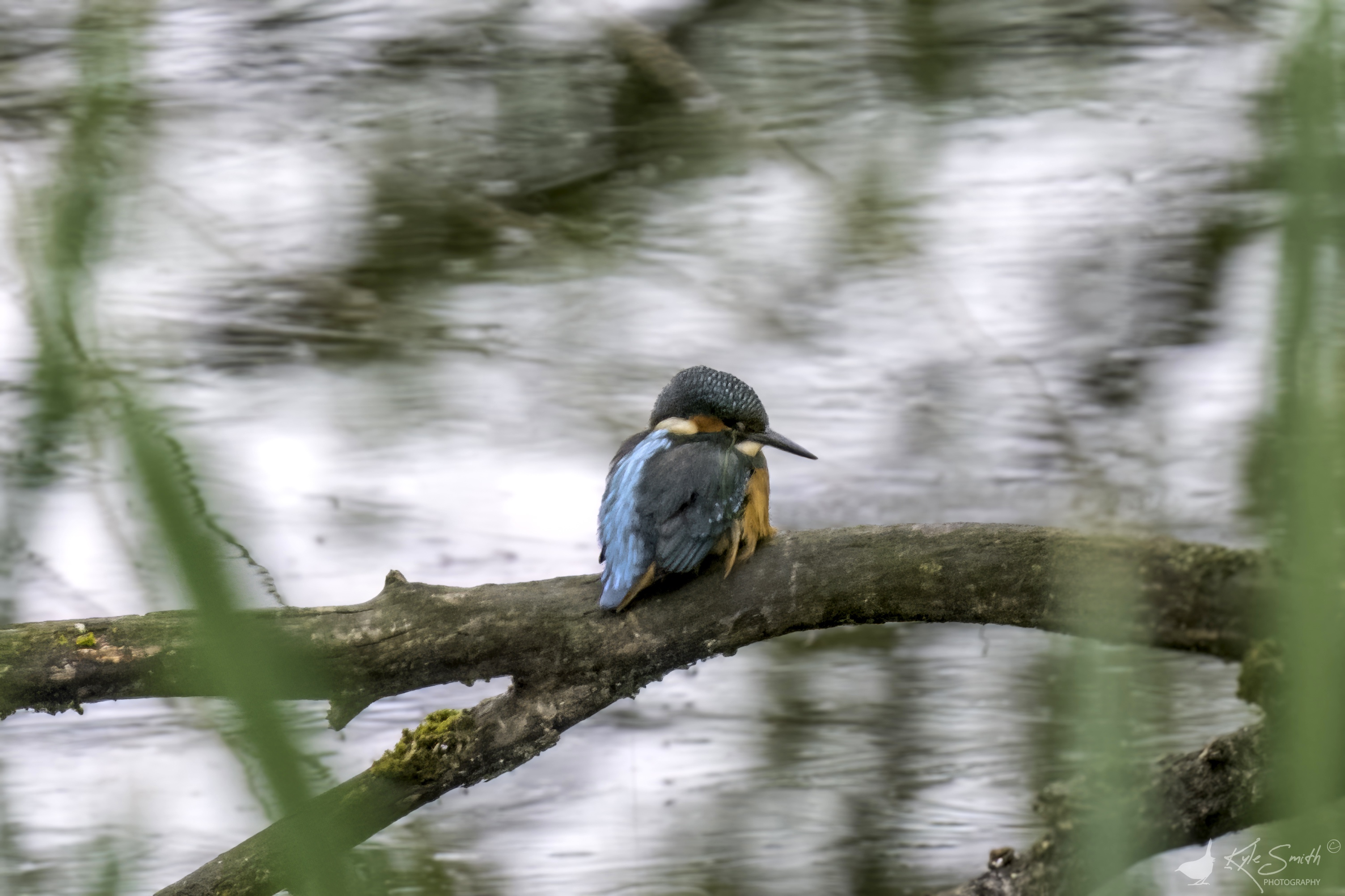
During one of the times when the bluethroat was out of sight, Lee mentioned that in recent days kingfishers had been spotted along the water behind us. I took a look and sure enough, there was a kingfisher perched on a trunk spanning the stream. It was facing away from me, so I waited patiently for it to turn its head before attempting a photo.

Kingfisher
Kingfisher

We watched as the kingfisher relocated to a tree branch and before long, one bird became two, then two became three. One of them was actively fishing, while another flew out across the reeds and seemed to reappear a little later at the far end. As I stood at the foot of the slope, one of the two remaining birds dived for a fish, missed, and then settled on a perch a little closer to where I was, tucked into the edge of a bush. It felt like my best chance for a close-up. A sedge warbler called from the same hedgeline, adding to the atmosphere.

When I returned to to the Hut Kev asked if I had any idea why we never seem to see bitterns here — after all, the habitat looks ideal. I didn’t have an answer at the time. Later, reading up, I found that bitterns are actually regular winter visitors to Slimbridge, with records almost every season. The best vantage points are apparently the Zeiss Hide, South Finger reedbeds, Middle Point, and the Rushy Pen areas.

Kingfisher
Kingfisher

After a good while, we decided it was time for a coffee and a roll, so we made our way back to the Visitor Centre — the bread in particular was excellent. Refreshed, we set off towards the Zeiss Hide, where there had been reports of a spoonbill earlier in the day. Unfortunately, there was no sign of it by the time we arrived.

From the hide, we spotted four black-tailed godwits and more than a dozen avocets feeding down in the water. A Cetti’s warbler and a couple of reed warblers were busy working through the nearest reeds. The godwits took off, circled the area, and then settled back down on the water. Meanwhile, a group of about 15 redshanks flew up and hovered together over a patch near the far edge of the pool — though we never did figure out what had caught their attention.

Avocet and black-tailed godwit

Four common cranes flew past the hide and landed very distant from us but with good scope views - these birds from the Great Crane Project have been seen regularly on the Tack Piece, visible from the Holden Tower and as far along as the Kingfisher Hide. Since the reintroduction began with the Great Crane Project in 2010, Slimbridge has served as "crane school" for hand-reared birds destined for release in Somerset.

The Great Crane Project was a collaboration between the WWT, RSPB, and the Pensthorpe Conservation Trust, supported by funding from the Viridor Credits Environmental Company. The aim was to reintroduce common cranes as a breeding species to the UK's wetlands where they had been absent for about 400 years due to habitat loss, persecution, and wetland drainage. In 2010 eggs, collected from healthy wild crane populations in Germany were hatched and hand-reared at Slimbridge - chicks were raised in a special "crane school" where human carers wore crane costumers. After fledging the juveniles were released onto the Somerset Levels with the aim of establishing a self-sustaining population. 100 cranes were released between 2010 and 2014 and there is now a population of over 200 birds (including wild-born chicks) spread across parts of Somerset, Gloucestershire, Norfolk, Suffolk, and Wales. We've even had some breeding at RSPB Otmoor in recent years.

Common crane
Common crane

Out towards the Kingfisher Hide, we spotted five cattle egrets doing what they do best — hanging out with the cattle. Most of the time they were hidden, hunkered down behind the tall grass as they fed, but every so often they’d move and offer decent scope views. Off to the left and just as distant, Kev picked out a cuckoo that had been calling. One of the other birders was keen to see it but only had binoculars, so Kev offered him a look through the scope. Each time he got close, though, the cuckoo would fly to a new perch — it was quite amusing watching this play out several times before he finally managed to get it in view.

We eventually made our way to the Kingfisher Hide itself, where a cuckoo was calling from directly overhead. Kev and I tried scanning for it through the open roof. From Kev’s angle, he had a fantastic view, and as I shifted round to find a clear line, I glimpsed the cuckoo just as it took off — that would have been my best cuckoo photo of the year.

The cattle egrets weren’t showing any better from here, so we started heading back along the track towards the Visitor Centre, stopping first at the Hogarth Hide. On the way we passed the otters and plenty of chicks — cygnets, goslings, and young shelducks. There would be more fledged birds to spot as the day went on.

Cygnet
Gosling
Otter
Shelduck
Shelduck

As we arrived at the Hogarth Hide, a light rain began to fall — not heavy enough to rush us on. We settled in and soon watched three cygnets gliding gracefully across the water in front of us. Nearly a hundred avocets dotted the two pools, accompanied by a handful of black-tailed godwits and numerous resting redshanks.

Some of the avocets fed close by, offering excellent opportunities for close-up photos — whether on the water, on land, or taking a break from incubating their eggs. Hopefully, they wouldn’t be off the nest for long. Checking the forecast for the coming weeks, it seemed unlikely that the nests would be flooded anytime soon.

Cygnet
Black-tailed godwit and redshank
Avocet
Avocet
Avocet
Avocet
Avocet

We pushed on to the South Lake Discovery Hide and bumped into Lee again, editing a couple of photos of the bluethroat and posting them onto X. We chatted as we watched a black swan cruising across the water and making a relatively close pass. Native to Australia, black swans were first introduced to the UK in the 18th century as ornamental birds for estates, parks, and wildfowl collections. Today, there are small feral populations, birds that have escaped or been released from captivity and now breed in the wild. They are not officially classed as a native or naturalised species.

They breed occasionally in the wild in the UK, though not thought to do so in large numbers. They are not known to have established a stable, self-sustaining wild population at the national level, although local feral groups persist.

First seen on the far bank, but then closer, we saw a little grebe in rather spendid summer plumage - striking smart birds. They have rich chestnut-red neck and cheeks, a velvety black cap and back, and a bright yellow gape spot (the small patch at the base of the bill) - much darker and richer-looking than in their pale, and relatively drab winter plumage.

Black swan
Black swan
Black swan
Black swan
Little grebe

To the right, more black-tailed godwits were feeding intensively, some flaunting their striking summer plumage. Nearby, an oystercatcher sat quietly on a nest just outside the hide’s window. We lingered a while, hoping to catch a glimpse of a Mediterranean gull that had been reported here earlier, but there was no sign of it now. Out on the water near a distant island, we spotted a rather suspicious-looking duck, a decoy! Needless to say, it didn’t make it onto our year list.

Black-tailed godwit
Oystercatcher
Decoy duck

Time was moving on, so we made our way back to the Rushy Hide, hoping to spot something unusual on the water. As usual, there was a gathering of redshanks, avocets, and a good number of gadwall — the gadwall looking particularly splendid in their seasonal plumage. Nearby, some shelduck chicks explored the shallow water, with one enthusiastically practicing its diving skills. Along the water’s edge, a group of geese appeared to be teaching their youngsters how to feed.

Gadwall
Shelduck
Gosling

Just then, a shout went up as a bittern flew past on our left — well, damn me! We had just been talking about them. By the time I caught sight of it, the view was from behind, but we still enjoyed good looks at a species that had previously been elusive here. Shortly after, a great spotted woodpecker and a jay made flybys, and I managed to grab some record shots of both.

Bittern
Great spotted woodpecker
Jay

The hide had grown busier, now including a young lad with a camera and a few others we assumed were family. They gathered around as he proudly showed some photos he’d taken earlier, drawing lots of oohs and ahhs — maybe just to keep him motivated? But we soon realised this young birder was serious when he confidently called out a Mediterranean gull on the island ahead, and he was spot on. We’d scanned the birds several times, but this gull must have slipped in unnoticed while we were distracted by the bittern.

Soon after, a second Mediterranean gull appeared, and both began preening — one eventually settled down. Then a large gull flew overhead, causing all the birds to take flight in unison, chasing it away from the flurry of black-headed gulls, avocets, shelduck, geese, protecting various chicks nearby. For a short while, our Mediterranean gulls disappeared, but when they returned, there were now four of them — one sporting a ring. They busily preened and gave some impressive wing flaps, putting on a show.

Mediterranean gull
Mediterranean gull
Mediterranean gull
Mediterranean gull
Mediterranean gull
Mediterranean gull
Mediterranean gull

One of the large gulls, a herring gull, flew low over the pool and seized its chance, opportunistically swooping down to snatch a black-headed gull chick. It carried its prey to the roof of a nearby building, where it stabbed into the chick, piercing the skin before beginning to feed. Not a pleasant sight, but entirely natural. While much of their diet includes fish, invertebrates, and human scraps, herring gulls readily prey on eggs, small chicks (including black-headed gull chicks), and vulnerable or injured birds.

Herring gull

Our available here time had come to an end, and we needed to head home so I could be back before my evening visitors arrived. On the journey, we ran into heavy rain and patches of flooding — we really had been lucky with the weather while we were out. A great call Kev!

Year list: 208.