Showing posts with label jay. Show all posts

Thursday, 6 November 2025

Upper Hollesley Common & The Naze :: 02 November 2025

The brown shrike is an exceptionally rare visitor to the UK, typically appearing as a vagrant from eastern Asia. Most records occur in autumn (late September to early November), likely caused by migration disorientation or strong easterly winds. This species breeds across eastern Russia, Mongolia, China, and Japan, and winters in tropical Asia, including India, Thailand, and Myanmar. To date, there have been around 46 records of brown shrike in the UK, with notable sightings in Shetland, Yorkshire, the Isles of Scilly, Cornwall, and London.

Recently, one of these rare shrikes was discovered at Upper Hollesley Common, Suffolk, near a Ministry of Defence (MOD) compound, where it has remained for over a week. The bird was first reported on Wednesday 22 October, and while initial reports were uncertain, confirmation soon followed - identifying it as a first-winter brown shrike. Early on, the bird was often seen perching along the fence line along the road and nearby bushes, easily visible from the road. More recently, it has spent more time within the MOD compound, which has restricted access, though it frequently perches on both the inner and outer fencing, offering good viewing opportunities for birders.

The MOD compound forms part of the Defence Training Estate, which includes some areas open to the public, though entry to the secure compound itself is prohibited. As a military training site, access is restricted during live firing or exercises, when red flags or lamps signal active danger zones. However, public access remains available on designated paths and registered common land under the Countryside and Rights of Way Act 2000, including much of Upper Hollesley Common. Kev @kev07713 had already visited the site the previous Wednesday with his wife and seen the shrike, but given the bird’s rarity, he was happy to visit for second helpings. Due to other commitments, we decided to go birding on Sunday rather than our usual Saturday and I planned to pick Kev up at 5.00am., allowing us to arrive early and remain flexible should any other notable species appear nearby.

The journey brought intermittent rain, though conditions improved as we arrived. It was dry when we reached the car park, and with no other birders present, we set out to search for the shrike. As we neared the fence line, the rain returned, prompting us to take shelter beneath some trees while scanning the area.

Within ten minutes, Kev called out - he had the bird in his scope and urged me to take a look to add my lifer. Up to that point, our views had been limited to stonechats, yellowhammers, skylarks, and robins. The shrike was perched far down along the fence, so we decided to move closer, taking cover near a small group of trees. From there, we managed to capture a few photos and videos before the bird dropped out of sight, remaining hidden for about twenty minutes. Despite the lingering drizzle, both we and the bird gradually began to dry out.

We spent the next couple of hours watching the shrike and a supporting cast of other species.

Brown shrike

Brown shrike
Brown shrike
Brown shrike
Brown shrike
Brown shrike
Brown shrike
Brown shrike
Brown shrike
Brown shrike

Upper Hollesley Common features a mix of coniferous woodland and heathland, providing excellent habitat for common crossbills, which feed on pine cone seeds. They’ve been particularly conspicuous in recent days, often seen drinking from puddles on the ground — several fine photographs have appeared on social media. Perhaps because of the weather, we only saw a few flying overheads with none perched or feeding on the ground.

The heathland is also home to Dartford warblers and woodlarks, both key species for this habitat. Dartford warblers often follow stonechats, so spotting one may lead to another. They are best observed on warm, calm days, as they tend to stay low in windy weather. Woodlarks are frequently heard singing from fence posts or in flight, favouring open heathland with short vegetation, particularly near pine plantations.

At first, we only heard Dartford warblers calling, but on a couple of occasions we managed brief views of one perched on low scrub, and once enjoyed a longer look as it showed well on the front fence. Every so often, a yellowhammer would drop in to share the barbed wire perch above the chain-link fence.

In the distance, a couple of woodlarks called as they circled overhead. I couldn’t seem to keep them in focus, though Kev was snapping away quite happily. Eventually, they dropped out of view.

Dartford warbler
Yellowhammer

Before long, a few other birders began to appear, their numbers gradually growing until there were around a dozen of us. Most had decided to take their chances once the rain eased, and we were able to point out where the shrike was showing best. Among them was Oli Beacock @oli_beacock, who we’ve bumped into several times before, and another birder we last met at Winterton Dunes while watching the lesser grey shrike.

We had another close pass from the two woodlarks, but once again I failed to get a photo, much to Kev’s surprise and disappointment.

As time slipped by, we checked BirdGuides to plan our next move. Oli and the other birder mentioned they were heading to The Naze, where a Pallas’s warbler had been reported earlier in the day with confirmed sightings. We said we'd do the same, parting ways with a quick “see you there.”

Oli had mentioned that the best place to park was at The Naze Tower, and we found the parking fees to be quite reasonable. The tower, located near Walton-on-the-Naze on the Essex coast, is an early 18th-century navigational landmark built to aid shipping along this stretch of coastline. It was constructed in 1720–1721 by Trinity House, the authority responsible for lighthouses and navigation aids around England and Wales.

Standing 26 metres (86 feet) tall, the octagonal brick tower originally served as a daymark; a visual reference point for sailors navigating the Thames Estuary and Harwich approaches. At the time, the surrounding low-lying coast was prone to fog and shifting sands, making navigation hazardous.

During the Napoleonic Wars, the tower was used as a signalling station, and later, in the 19th century, it was repurposed for coastguard observation. In World War II, it again took on a defensive role, used by the Royal Observer Corps for spotting enemy aircraft.

Over the centuries, coastal erosion has dramatically altered the surrounding landscape. The cliffs of the Naze continue to recede, and significant conservation efforts have been made to preserve both the tower and the fragile coastline around it. Today, The Naze Tower is a Grade II listed building and serves as a heritage attraction, housing an art gallery, museum, and viewing platform offering panoramic views across the North Sea, Hamford Water, and the surrounding nature reserve - a favourite spot for migrating birds and birdwatchers alike.

We set off in the direction indicated on BirdGuides, and before long we were caught up by another birder carrying a serious lens and tripod with a gimbal head. We decided to follow him down to the spot where good views had reportedly been had earlier in the day. On the way, we paused for a quick chat and watched two jays fly through.

Jay
Jay
Jay

We joined half a dozen birders watching long-tailed / blue / great tits, goldcrests, chiffchaffs and more working through the trees, and a siskin over. We could swear that 90% of birds were goldcrests! - some getting close as they fed around us.

Goldcrest

We searched high and low, and Oli joined us for part of the time, but despite enjoying the search and watching a variety of other species, we never managed to locate the Pallas’s warbler, although we did hear a couple of possible calls.

Eventually, time ran out, and we said our goodbyes, beginning the long journey home along the M25 and up the M40, a tiring but satisfying end to the day.

Year list: 245.

Thursday, 19 June 2025

WWT Slimbridge :: 07 June 2025

The UK weather forecast for this Saturday predicted heavy showers and thunderstorms moving eastwards, with a yellow warning issued across central and southern England for heavy rain, lightning, and thunderstorms. It seemed likely that most of the places we might consider visiting would be significantly affected by the rain. Kev and I talked about possibly giving birding a miss, but on days like this we usually decide to head out anyway — WWT Slimbridge is often our choice, as its many hides provide good shelter.

Kev checked the local forecast for Slimbridge, and it suggested it might actually stay dry first thing, with rain setting in by late morning. That gave us hope of enough time to catch up with the returning white-spotted bluethroat, a remarkable bird that’s now established a summer residency at the site. WWT confirmed it was back for its fifth consecutive year, and a couple of friends had already been down to see it again. It’s astonishing that a vagrant like this shows such strong site loyalty — I suppose it’s a bit like the great reed warbler at Ouse Fen, which seems to be doing something similar.

The white-spotted bluethroat is a striking and rare migrant to the UK. Males, like the Slimbridge bird, show off a glossy blue throat with a distinct white spot in the centre, bordered by a black band and a partial red chest. The numbers visiting the UK vary each year, ranging from none to over a dozen (as in 2013). Both the white-spotted and red-spotted subspecies appear as passage migrants in the UK.

Early morning at the Middle Point Shepherd’s Hut offers the best chance of seeing the bird, especially if the wind is light — and with the rain forecast to arrive later, this felt like a decent opportunity. One of the bluethroat’s most striking features is its song: rich, varied, and melodic, often compared to that of a nightingale. It combines clear whistles, rattles, mimicry, and repeated short phrases. Most fortunately, the song is usually delivered from a perch in reeds or bushes, particularly at dawn or dusk — unmistakable across the reedbed.

We arrived at the members’ gate to find it still closed — we were just under ten minutes early according to the sign. Luckily, a member of staff appeared from the car park and kindly let us in, checking our membership numbers as we passed through. He suggested we’d be unlikely to see the bluethroat given the forecast conditions, but we said we’d give it a try anyway. We felt more confident than he was, and as we walked along the Summer Walkway, we noticed a fair number of flies on the wing — would our optimism prove misplaced? - it didn't seem likely ...

At the Shepherd’s Hut, we immediately spotted a bird perched in the reeds on one of the bluethroat’s favoured perches — but it turned out to be a reed bunting. Kev edged around the hut and soon found the bluethroat perched closer, and called me over. We set up our scopes and took some record shots. Before Kev had time to get his phonescoping kit ready, the bird dropped from the perch and flew to the back of the reeds.

Bluethroat
Bluethroat

Over the next half hour the bird showed a handful of times and we were joined by a few other people. We got talking to one chap who was with camera, taking photos and some video - it turned out to be Lee @Wildwood_photos who posts on X under the username Wildwood Nature Photography; we'd seen some of his posts and photos before. On one ocassion the bird flew to some nearer reeds, perching in reasonable view. Although the photos appear to show the bird close, it was actually still pretty distant and the photos are heavily cropped.

In flight you could see the distinctive reddish coloued flash on its rump (upper tail coverts), contrasting with the otherwise dark tail and back.

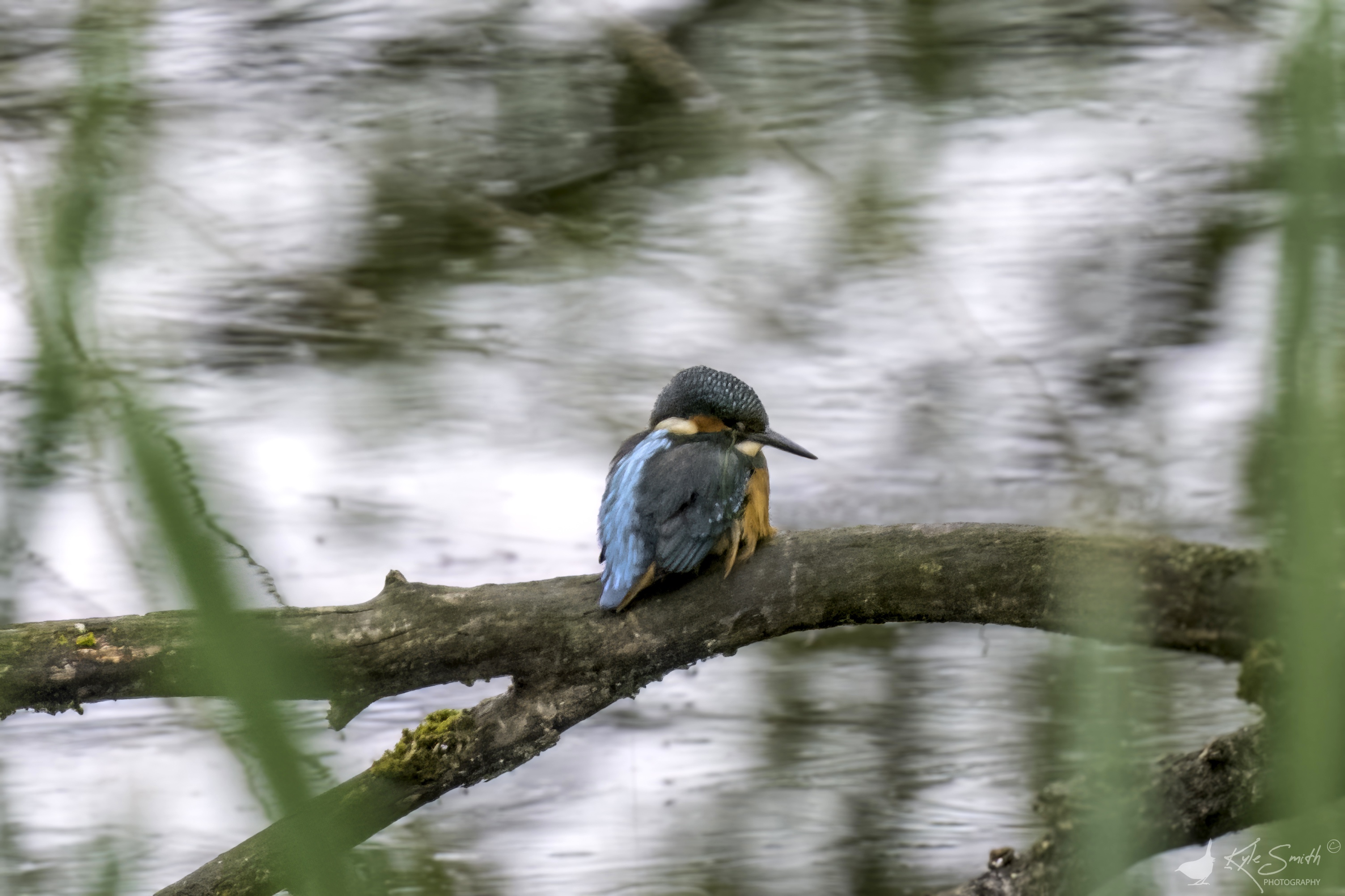
During one of the times when the bluethroat was out of sight, Lee mentioned that in recent days kingfishers had been spotted along the water behind us. I took a look and sure enough, there was a kingfisher perched on a trunk spanning the stream. It was facing away from me, so I waited patiently for it to turn its head before attempting a photo.

Kingfisher
Kingfisher

We watched as the kingfisher relocated to a tree branch and before long, one bird became two, then two became three. One of them was actively fishing, while another flew out across the reeds and seemed to reappear a little later at the far end. As I stood at the foot of the slope, one of the two remaining birds dived for a fish, missed, and then settled on a perch a little closer to where I was, tucked into the edge of a bush. It felt like my best chance for a close-up. A sedge warbler called from the same hedgeline, adding to the atmosphere.

When I returned to to the Hut Kev asked if I had any idea why we never seem to see bitterns here — after all, the habitat looks ideal. I didn’t have an answer at the time. Later, reading up, I found that bitterns are actually regular winter visitors to Slimbridge, with records almost every season. The best vantage points are apparently the Zeiss Hide, South Finger reedbeds, Middle Point, and the Rushy Pen areas.

Kingfisher
Kingfisher

After a good while, we decided it was time for a coffee and a roll, so we made our way back to the Visitor Centre — the bread in particular was excellent. Refreshed, we set off towards the Zeiss Hide, where there had been reports of a spoonbill earlier in the day. Unfortunately, there was no sign of it by the time we arrived.

From the hide, we spotted four black-tailed godwits and more than a dozen avocets feeding down in the water. A Cetti’s warbler and a couple of reed warblers were busy working through the nearest reeds. The godwits took off, circled the area, and then settled back down on the water. Meanwhile, a group of about 15 redshanks flew up and hovered together over a patch near the far edge of the pool — though we never did figure out what had caught their attention.

Avocet and black-tailed godwit

Four common cranes flew past the hide and landed very distant from us but with good scope views - these birds from the Great Crane Project have been seen regularly on the Tack Piece, visible from the Holden Tower and as far along as the Kingfisher Hide. Since the reintroduction began with the Great Crane Project in 2010, Slimbridge has served as "crane school" for hand-reared birds destined for release in Somerset.

The Great Crane Project was a collaboration between the WWT, RSPB, and the Pensthorpe Conservation Trust, supported by funding from the Viridor Credits Environmental Company. The aim was to reintroduce common cranes as a breeding species to the UK's wetlands where they had been absent for about 400 years due to habitat loss, persecution, and wetland drainage. In 2010 eggs, collected from healthy wild crane populations in Germany were hatched and hand-reared at Slimbridge - chicks were raised in a special "crane school" where human carers wore crane costumers. After fledging the juveniles were released onto the Somerset Levels with the aim of establishing a self-sustaining population. 100 cranes were released between 2010 and 2014 and there is now a population of over 200 birds (including wild-born chicks) spread across parts of Somerset, Gloucestershire, Norfolk, Suffolk, and Wales. We've even had some breeding at RSPB Otmoor in recent years.

Common crane
Common crane

Out towards the Kingfisher Hide, we spotted five cattle egrets doing what they do best — hanging out with the cattle. Most of the time they were hidden, hunkered down behind the tall grass as they fed, but every so often they’d move and offer decent scope views. Off to the left and just as distant, Kev picked out a cuckoo that had been calling. One of the other birders was keen to see it but only had binoculars, so Kev offered him a look through the scope. Each time he got close, though, the cuckoo would fly to a new perch — it was quite amusing watching this play out several times before he finally managed to get it in view.

We eventually made our way to the Kingfisher Hide itself, where a cuckoo was calling from directly overhead. Kev and I tried scanning for it through the open roof. From Kev’s angle, he had a fantastic view, and as I shifted round to find a clear line, I glimpsed the cuckoo just as it took off — that would have been my best cuckoo photo of the year.

The cattle egrets weren’t showing any better from here, so we started heading back along the track towards the Visitor Centre, stopping first at the Hogarth Hide. On the way we passed the otters and plenty of chicks — cygnets, goslings, and young shelducks. There would be more fledged birds to spot as the day went on.

Cygnet
Gosling
Otter
Shelduck
Shelduck

As we arrived at the Hogarth Hide, a light rain began to fall — not heavy enough to rush us on. We settled in and soon watched three cygnets gliding gracefully across the water in front of us. Nearly a hundred avocets dotted the two pools, accompanied by a handful of black-tailed godwits and numerous resting redshanks.

Some of the avocets fed close by, offering excellent opportunities for close-up photos — whether on the water, on land, or taking a break from incubating their eggs. Hopefully, they wouldn’t be off the nest for long. Checking the forecast for the coming weeks, it seemed unlikely that the nests would be flooded anytime soon.

Cygnet
Black-tailed godwit and redshank
Avocet
Avocet
Avocet
Avocet
Avocet

We pushed on to the South Lake Discovery Hide and bumped into Lee again, editing a couple of photos of the bluethroat and posting them onto X. We chatted as we watched a black swan cruising across the water and making a relatively close pass. Native to Australia, black swans were first introduced to the UK in the 18th century as ornamental birds for estates, parks, and wildfowl collections. Today, there are small feral populations, birds that have escaped or been released from captivity and now breed in the wild. They are not officially classed as a native or naturalised species.

They breed occasionally in the wild in the UK, though not thought to do so in large numbers. They are not known to have established a stable, self-sustaining wild population at the national level, although local feral groups persist.

First seen on the far bank, but then closer, we saw a little grebe in rather spendid summer plumage - striking smart birds. They have rich chestnut-red neck and cheeks, a velvety black cap and back, and a bright yellow gape spot (the small patch at the base of the bill) - much darker and richer-looking than in their pale, and relatively drab winter plumage.

Black swan
Black swan
Black swan
Black swan
Little grebe

To the right, more black-tailed godwits were feeding intensively, some flaunting their striking summer plumage. Nearby, an oystercatcher sat quietly on a nest just outside the hide’s window. We lingered a while, hoping to catch a glimpse of a Mediterranean gull that had been reported here earlier, but there was no sign of it now. Out on the water near a distant island, we spotted a rather suspicious-looking duck, a decoy! Needless to say, it didn’t make it onto our year list.

Black-tailed godwit
Oystercatcher
Decoy duck

Time was moving on, so we made our way back to the Rushy Hide, hoping to spot something unusual on the water. As usual, there was a gathering of redshanks, avocets, and a good number of gadwall — the gadwall looking particularly splendid in their seasonal plumage. Nearby, some shelduck chicks explored the shallow water, with one enthusiastically practicing its diving skills. Along the water’s edge, a group of geese appeared to be teaching their youngsters how to feed.

Gadwall
Shelduck
Gosling

Just then, a shout went up as a bittern flew past on our left — well, damn me! We had just been talking about them. By the time I caught sight of it, the view was from behind, but we still enjoyed good looks at a species that had previously been elusive here. Shortly after, a great spotted woodpecker and a jay made flybys, and I managed to grab some record shots of both.

Bittern
Great spotted woodpecker
Jay

The hide had grown busier, now including a young lad with a camera and a few others we assumed were family. They gathered around as he proudly showed some photos he’d taken earlier, drawing lots of oohs and ahhs — maybe just to keep him motivated? But we soon realised this young birder was serious when he confidently called out a Mediterranean gull on the island ahead, and he was spot on. We’d scanned the birds several times, but this gull must have slipped in unnoticed while we were distracted by the bittern.

Soon after, a second Mediterranean gull appeared, and both began preening — one eventually settled down. Then a large gull flew overhead, causing all the birds to take flight in unison, chasing it away from the flurry of black-headed gulls, avocets, shelduck, geese, protecting various chicks nearby. For a short while, our Mediterranean gulls disappeared, but when they returned, there were now four of them — one sporting a ring. They busily preened and gave some impressive wing flaps, putting on a show.

Mediterranean gull
Mediterranean gull
Mediterranean gull
Mediterranean gull
Mediterranean gull
Mediterranean gull
Mediterranean gull

One of the large gulls, a herring gull, flew low over the pool and seized its chance, opportunistically swooping down to snatch a black-headed gull chick. It carried its prey to the roof of a nearby building, where it stabbed into the chick, piercing the skin before beginning to feed. Not a pleasant sight, but entirely natural. While much of their diet includes fish, invertebrates, and human scraps, herring gulls readily prey on eggs, small chicks (including black-headed gull chicks), and vulnerable or injured birds.

Herring gull

Our available here time had come to an end, and we needed to head home so I could be back before my evening visitors arrived. On the journey, we ran into heavy rain and patches of flooding — we really had been lucky with the weather while we were out. A great call Kev!

Year list: 208.