Showing posts with label snipe. Show all posts

Thursday, 30 October 2025

Oldbury Power Station & WWT Slimbridge :: 25 October 2025

With Kev away on holiday, birding along the west and east coasts of Scotland before heading into Yorkshire, I had to decide on my own plan for the regular Saturday outing. I asked my wife, Charlotte, if she’d like to join me, and she agreed, giving up her regular Pickleball session since she’d already played nearly every day during her club’s holiday week. I started looking for somewhere not too far away, with decent facilities and the potential for a year tick or two. In the end, I settled on a trip to Oldbury-on-Severn and the power station in search of black redstarts, followed by a visit to WWT Slimbridge to try for the Temminck’s stint.

There’s often a black redstart at the power station around this time of year, but reports over the past few days have mentioned anywhere from four to seven birds, so the odds of finding a male seemed promising. I’d only been to the site once before,back in March 2023, when I went to see an Alpine swift (report here).

The power station is located on the south bank of the River Severn, near the village of Oldbury-on-Severn in South Gloucestershire. The station comprised two nuclear reactors of the Magnox type, each originally producing about 217MW capacity. The first of the reactors started generating back in 1967 - a good year - and when it shutdown in 2012 was the oldest operating nuclear power station in the world. Over its lifetime the station generated circa 137.5 TWh of electricity - enough to power one million homes for 20 years. The reactor buildings were enclosed in prestressed concrete pressure vessels, the first in the UK to employ this method. The site used water from the River Severn via intake/outfall structures connected by underground culverts to the turbine hall's condensing units for cooling.

The last of the station's fuel was removed in early 2016 meaning about 99% of the site's radioactive hazard had been removed. Site decommissioning is still underway with current work focussing on waste retrieval, processing, storing and dispatch. The site is scheduled to enter the "Care and Maintenance" phase in 2027 with final site clearance and demolition planned for wel into the 2090s or 2100s.

With sunrise at 6:51 a.m., there was no need for an early start - I wanted enough light for photography - so we planned to arrive around 9.00am. Pulling into the car park, we spotted another birder setting up his gear, also heading out in search of the birds. He’d been before, though he admitted he still hadn’t managed a great photo. The sky was overcast, which meant good shots might be tricky, but hope springs eternal. He set off ahead of us, though we soon caught up and followed him to the spot where the best photos had reportedly been taken. Even before reaching it, I spotted a female perched on top of a white corrugated building.

The black redstart is a rare breeder in the UK and is more regularly encountered as a passage migrant and winter visitor from continental Europe - France, Belgium, and the Netherlands. Autumn passage typically spans from September to November, with a peak in October. Its preferred habitats include old buildings, industrial sites, quarries, churches and cathedrals, and cliff faces - basically places with bare or rocky ground.

The male is sooty-grey/dark overall, with a distinct bright orange.red tail, and often with a white-ish wing patch. Females and juveniles are a duller grey-brown overall but still with the orange-red tail - juvenile males often exhibiting the white wing patch.The wing patch on juvenile males is a great clue to their age and plumage stage, and changes quite a bit between late summer and their first spring. Freshly fledged there is no wing patch but juveniles undergo a partial moult before the autumn migration and crucially develops a pale or white wing patch. Females will lack ay wing patch and are more uniformly grey-brown.

There are thought to be typically 60-80 breeding pairs nationally with autumn migrants totalling several hundred to circa 1,000 individuals - total individuals recorded annually are therefore roughly 1,000-2,000 birds. They are highly localised with key areas are London and the Thames Estuary, Brisol and Severnside, Birmingham, and along the south coast.

I was able to locate various female type birds but always at distance and after a while of enjoying them through the scope we relocated down onto the coastal path, viewing one of the Severn Bridges in the distance. Although the light was still limited it was at least reasonably still. It took five minutes or so before we located a female but it was now closer and viewable through the fence. It then dropped down and into a dogwood shrub growing up a chain-link (wire-mesh) fence - this type of fence is common around industrial areas because it’s durable, affordable, and provides visibility while still creating a boundary.

We watched two females, a juvenile male and one male visit the fence around the dogwood and eventually observed them feeding on the dogwood berries - dogberries. Black redstarts are primarily insectivores, but their diet shifts seasonally to adapt to food availability. During the breeding season and warmer months, they focus on insects and other small invertebrates, which are rich in protein and essential for raising chicks.

In autumn and winter, insect numbers drop sharply, especially in northern or urban areas. To survive, black redstarts switch to fruits and berries, which provide sugars for energy and some essential nutrients. Dogwood berries, along with hawthorn, ivy, rowan, and other small fruits, are easy to find and digest, making them a convenient winter food source.

This seasonal flexibility is one reason black redstarts can survive in urban and semi-urban areas where insect availability may be unpredictable. They’ll often forage on berry-laden shrubs, supplementing their diet with whatever is available.

Black redstart
Black redstart
Black redstart
Black redstart
Black redstart
Black redstart
Dodwood berries

We enjoyed the views, and our earlier companion soon joined us, clearly noticing that we were getting better sightings than he had. Another birder appeared on the path as a kestrel flew around the cylindrical building structures, flushing pigeons from hidden perches. The kestrel made several passes, keeping the pigeons from settling, though they continued to circle the area. After a while, the kestrel seemed to give up its search and departed. It was evident that the peregrine, occasionally reported in the area, was not present today.

Kestrel
Kestrel
Kestrel

Charlotte had walked along the path and back and mentioned that she was beginning to feel cold, so we decided to pack up and head back to the car. On the way, we crossed paths with a birder coming the other direction, who confirmed spotting some female-type birds near our original vantage point. As we continued, we glimpsed a couple more ourselves, and a couple of stonechats.

We made our way to Slimbridge, which wasn’t far away, and on arrival we decided to postpone lunch until we had seen the Temminck’s stint that had already been reported that morning. We headed around to the Rushy Hide, only to find it full, with no spaces by the windows. Luckily, being tall, we were able to peer between others and try to catch sight of the bird. I was struck again by its size, particularly as it moved just behind a shelduck. Charlotte had a little trouble picking it out at first, with only directions and little sense of its scale, but she eventually spotted it, and we watched as it fed along a narrow muddy spit.

It is adapted for foraging in shallow mud and along the edges of freshwater wetlands. Its feeding behaviour is characterised by active probing and pecking. It mainly feeds on tiny invertebrates - insects, larvae, small crustaceans, and worms - which it picks from the surface of mud, sand, or shallow water.

Unlike some waders that use a rapid, continuous probing motion, Temminck’s stint often pause briefly between pecks, carefully inspecting the surface before striking. In winter or during migration stopovers, it will opportunistically consume tiny seeds or plant material, though invertebrates remain its main diet.

They breed across northern Europe and Siberia and winter in sub-Saharan Africa, South Asia, and parts of southern Europe. In recent decades, there are about 100 records per year, with around 70 of those in spring passage - the species is extremely variable year‑to‑year, partly because Britain lies on the edge of its migration route, which makes numbers highly dependent on weather and migration patterns. There was a reportedly low count in 2021 of 54 individuals and a record influx of at least 226 in 2004.

Temminck's stint
Temminck's stint
Temminck's stint
Temminck's stint
Temminck's stint
Temminck's stint
Temminck's stint
Temminck's stint
Temminck's stint

Scanning the rest of the water we could see that numbers of birds have not built to the level we would expect for the winter months. We did however see a couple of common snipe out in the open and three spotted redshanks. After just a few minutes the stint flew onto the near bank but significantly distant and perhaps midway between the Rushy hide and Peng Observatory. From there it relocated again but this time to the back of the pool. After a further ten minutes Charlotte decided this was the time for us to visit the Visitor Centre for lunch.

Snipe
Spotted redshank
Spotted redshank

We had been listening to one of the volunteers describe bittern flights between the Zeiss and Van de Bovencamp hides, which seemed to heighten Charlotte’s eagerness to return to the reserve. There was also a reported sighting of a yellow-browed warbler in the bushes near the Kingfisher hide. We decided to head straight for the Van de Bovencamp hide, joining about half a dozen others scanning the grass, reeds, and pool beyond. On the way, we stopped to chat with some friends who had dropped by after playing golf at Celtic Manor over the past couple of days.

One of the birders mentioned seeing bitterns within the last 45 minutes, so we were hopeful that regular sightings meant we wouldn’t have to wait long. About 20 minutes later, a bittern took flight in front of us, heading toward the Zeiss hide and dropping into the reeds to the front left. I managed to fire off a couple of shots, though the bird was already passing before I could get the camera on it. We watched for signs of movement in the reeds, and noticed people in the Zeiss hide pointing their lenses, suggesting they might have had partial views.

Around 15 minutes later, a second bittern burst out from roughly the same area, this time closer. It caught the strong wind now blowing through the hide windows and sped off quickly, veering right and disappearing over the track behind us. I didn’t have time to get the camera on it, though I was the one who had spotted it first. Later, a birder dropped by and showed us a photo of the second bird flying straight toward him before turning and crossing the track.

Bittern

We spoke with a few birders who had gone looking for the yellow-browed warbler but returned empty-handed; perhaps the bird had taken shelter from the now brisk wind. Deciding to wrap up the day, we headed back towards the Visitor Centre for a cup of tea before making our way home.

On the way, we bumped into Nick and Anne Truby, who had stopped by on their return from a birding holiday in Cornwall. Unfortunately, the trip hadn’t been as rewarding as they’d hoped, and both had been under the weather with colds - Anne was still feeling unwell. We chatted briefly before continuing on our way.

Year list: 244.

Friday, 11 April 2025

Draycote Water & RSPB Ham Wall :: 04/05 April 2025

On Friday afternoon at work, I kept seeing repeated WhatsApp updates about a passage little gulls at Draycote Water. By mid-afternoon, the count had risen to 31 individuals. Deciding I'd clocked enough hours for the week, I left a bit early, swung by home to grab my camera and scope, and headed to the site hoping some would still be around. On arrival, I discovered the parking system had changed since my last visit - payment was now based on arrival times recorded by camera monitoring, with fees charged at the end of the stay.

I made my way up to the path beside the Visitor Centre and set up the scope to scan the water. At first, there didn’t appear to be any gulls in sight, but through the scope I spotted some movement between Biggin and Toft Bays. Watching carefully, I managed to pick out a gull that was unmistakably a little gull.

The little gull is the world's smallest gull species - adults in summer plumage are characterised by a black head, pale grey back, and dark underwings. Just like black-headed gulls, non-breeding adults display a black cap and ear spot. They are primarily observed during migration, in spring from mid-March to mid-May, especially during east or southeast winds and increasingly with winds accompanied by rain. Autumn sightings are less frequent.

The UK typically hosts between 200 and 800 individuals - notably, little gulls were recorded to successfully breed in the UK for the first time at the Loch of Strathbeg Reserve in 2016. Well worth the money to view them. Their feeding flight is often described as buoyant and fluttery - quick wingbeats, fluttering just above the water's surface picking up insects or small prey off the surface without fully landing. Here at Draycote they were likely taking advantage of hatches of (aquatic?) insects.

I walked along Farborough Dam to the point, where at lower water levels a sandy spit appears. I set up the scope again and watched little gulls work into the wind, feeding in their distinctive way amongst handfuls of herring and lesser black-backed gulls. The gulls were a good 450-500m away and although good to watch on the scope, it would be a more difficult to get a photo - I had a go.

Little gull
Little gull
Little gull

Wing surfing - also called wing foiling - is a watersport that blends elements of windsurfing, kitesurfing, and foiling. Out in the water were a couple of people doing just that. As can be seen in the photo below you use a handheld inflatable wing (not attached to the board or rider) and a board, usually with a hydrofoil - a long fin with wings that lifts the board above the water. Amazing to see out and in the air!

Wing surfer

I only had a short window to stay, as I was due back home in time for dinner. But before heading off, I caught sight of three common terns fishing just beyond the little gulls but practically as far away as they could be. Two year ticks for the price of one. I packed up, paid my dues, and made for home.

Common tern

Kev @kev07713 and I discussed a few options for our Saturday birding trip and settled on RSPB Ham Wall, with glossy ibis and garganey both viewable from VP1 in recent days. Karen @hobbylovinglife and Dean @worlebirder were also going to be on site, from early as they were assisting in a breeding survey - perhaps we'd bump into them later.

Cattle egrets are a familiar sight around the Glastonbury area, with winter roosts sometimes exceeding 700 birds. They’re not often seen on the main reserve, but as I’d yet to tick one off my year list, I was quietly hopeful of spotting one somewhere nearby.

The drive to breakfast was already proving rewarding: we saw two Barn Owls—one quartering a field alongside the road, and another flushed unexpectedly from the roadside verge. Then, in a field next to the M5, two cattle egrets stood among grazing sheep - frustratingly, there would no safe spot to stop! As we left the motorway at the Dunball/Bridgwater exit, another flock of over 50 cattle egrets caught our eye in a field of sheep. We planned to check again on the way out, but by then, they’d moved on.

From the breakfast car park, things kept ticking along - literally. Two oystercatchers were perched on the roof of an industrial building, with sand martins and swallows swooping in the distance. In the reeds beyond, we heard a Cetti’s warbler calling, spotted a reed bunting, and picked out a willow warbler. Who would've thought breakfast could bring two year ticks?

Arriving at the reserve, I waited in the car park while Kev checked out the facilities. A flash of colour caught my eye as a Kingfisher zipped across the car park, heading for the main reserve. A large bird then swooped in from the right, disappearing behind the trees - I tried my best to turn it into a bittern, but it was a grey heron.

We walked on to the bridge and paused before reaching the main track, where we heard a sedge warbler singing, though we couldn't quite locate it. No doubt we’ll tick one soon for the year list - the place was alive with blackcaps in full song.

A little further along, by a narrow drain, we stopped to watch a barn owl being mobbed by a couple of crows before it ducked into cover. At the end of the channel, we spotted Karen and Dean also watching the scene unfold. As I waited, hoping the owl might reappear, a Kingfisher darted low along the reed tops - unseen by Karen and Dean, though they later said they’d heard its call. I pointed out where it had landed, and within moments Kev had it in view.

As we continued toward VP1, the soundtrack of blackcaps and chiffchaffs surrounded us. When we arrived at the viewing platform, a chiffchaff fed just a few feet away, completely unbothered by us or the handful of birders nearby.

Chiffchaff

From the platform we were able to see three ruff out in the water. Numbers peak during April, as birds move north from wintering grounds (mainly Africa) to their Arctic and sub-Arctic breeding areas. They are most often seen at wetlands, scrapes, flooded meadows, and RSPB reserves with shallow pools such as here. We usually see good numbers of them on the East coast reserves, such as Titchwell, Frampton Marsh, and Cley. We always keep an eye out for white-headed or black-faced males - their breeding plumage is stunningly diverse but none of these individuals were yet in their best plumage.

In the same vicinity we saw a spotted redshank, transitioning to its breeding plumage. March to May is their northbound migration period but peak passage tends to be in April, sometimes lingering into early May. By late spring, most have moved on to their Arctic breeding grounds in Scandinavia and northern Russia. In mid-spring to summer, they sport jet black plumage with subtle white spotting - really striking. It would work around ahead of us, always at distance. A few common redshanks fed close by. Also at distance were a handful of remaining pintails.

Ruff
Spotted redshank
Pintail

As we scanned the area, we spotted several common snipe probing the exposed mud in search of food. Suddenly, a bird darted across the water, possibly a sparrowhawk, sending most of the waders and some ducks into the air. We had actually been hoping for a bit of a shake-up like this, especially with the garganey nowhere in sight and still no sign of the glossy ibis.

I was especially taken with a group of around 30 snipe that took to the air together, circling the pool in front of us before sweeping overhead. After another pass, they settled again, scattering across the pool at distance.

Common snipe are both resident and winter visitors in the UK, but many of the wintering birds head back to northern Europe in spring. Breeding birds do stay, particularly in wetland habitats, and from March to May, they begin their courtship displays. One of the most evocative sounds of the season is the male’s “drumming” flight display - soaring high in circles before diving rapidly, the wind rushing over their outspread tail feathers to create that distinctive, "drumming" sound.

Bitterns continued to call in the distance, though we never quite managed to catch sight of one. A common crane lifted into the air and disappeared far off - probably the same bird Kev had spotted earlier in the morning, though he’d been the only one lucky enough to see it.

Snipe

Hoping the glossy ibis was simply feeding out of sight, tucked just over the brow between us and the water, I followed the track, crossed a bridge, and continued along another path. This route gave me a view of the area hidden from the platform, but no luck - the ibis wasn’t there.

While scanning the scene, a green sandpiper suddenly took flight and passed by quite close. I was so focused on tracking it through my binoculars that I completely forgot to take a photo! Kev and a few other birders saw it too and confirmed the ID - a year tick.

On the walk back, I heard a Cetti’s warbler calling nearby - close but hidden as ever - and then came across a blackcap singing its heart out in a tree. I couldn’t resist stopping to enjoy the song.

Blackcap
Blackcap
Blackcap

After another twenty minutes or so, one of the other birders on the platform called out ... the glossy ibis was coming in. It landed a little off to the left, only really visible if you stood up on the benches. I took a few photos, but it wasn’t ideal, so I decided to loop back around in the hope of getting a clearer view from the other track.

That decision paid off. I ended up taking quite a few shots, and eventually got some I was happy with, as the ibis emerged from the denser cover and moved into better light.

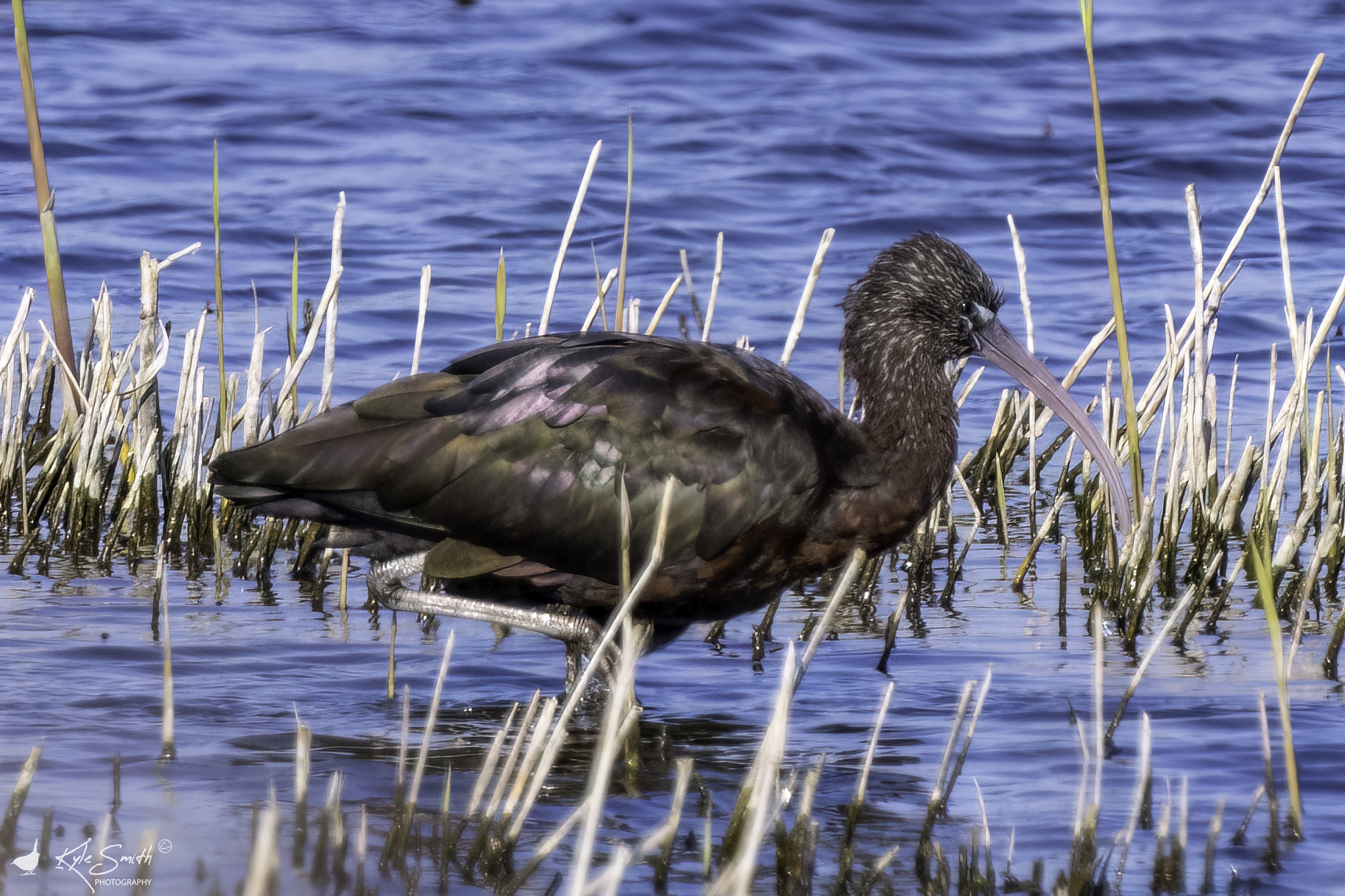
Once a mega rarity in the UK, the glossy ibis has become increasingly regular over the past two decades, with sightings now annual and sometimes long-staying. Though still scarce, their numbers are definitely growing. Kev had already seen one at Summer Leys in Northamptonshire, where a bird has been present since November 2024 - five months and counting.

This bird gave excellent views. Glossy ibises are surprisingly confiding when feeding, and I had the chance to properly take in the stunning iridescence, the glossy greens, bronzes, and purples catching the light.

Glossy ibis
Glossy ibis
Glossy ibis
Glossy ibis
Glossy ibis
Glossy ibis
Glossy ibis
Glossy ibis
Glossy ibis
Glossy ibis
Glossy ibis
Glossy ibis
Glossy ibis
Glossy ibis

I returned to VP1 and rejoined Kev - he was getting a bit restless, as I’d been gone a while. We decided to head down to VP2 after Karen called to say an osprey had passed overhead in that direction. She’d even sent a photo. We figured it might have been hard to spot from VP1, and if it was still around, VP2 could offer a better view.

As we wandered along the track, blackcap and chiffchaff called from the hedgerows, and a sparrowhawk zipped through. I was trailing slightly behind Kev and missed a peregrine he caught sight of. But I did get a great view of a great white egret just off to our left in the drain - it was surprisingly close and didn’t seem at all bothered by people watching it.

I always tend to associate great white egrets with yellowish-orange bills, as some of the birds here were showing. This one, however, had a black bill and is likely an adult in breeding plumage. The colour change typically occurs between March and May as they prepare to court and nest. Its sheer size also gave it away.

Great white egrets have become regular breeders in the UK, particularly in southern England. By 2021, the British population had grown to around 50 breeding pairs, which fledged 73 young that year. In 2023, a record 88 chicks fledged from 53 nests in the here in the Avalon Marshes area of Somerset. Judging by the activity around the reserve, it looks like this success might well be repeated this year.

When we reached VP2, we noticed several birds dropping into the reeds, possibly suggesting breeding behaviour. Karen and Dean were nearby, keeping tabs on this and other signs of nesting activity. We agreed to catch up with them later for a chat. There were birds out on the water, but still no sign or sound of bitterns.

A reed warbler called further down the track, and when Karen and Dean arrived, I thought I glimpsed it relocate, but not clearly enough to tick it for the year list. It won’t be long, though. Overhead, we saw a scattering of marsh harriers, a few red kites, several buzzards, and another sparrowhawk cruising the sky.

Great white egret
Great white egret
Karen & Dean
Karen & Dean
Karen & Dean
Marsh harrier

We made our way back down to VP1 for one last check, hoping the garganey might finally be showing, but no such luck. The same mix of birds was still present, though we were briefly entertained by two unusually bold chaffinches hopping around Karen and Dean’s feet.

Eventually, we decided to pull stumps and head to the car park. Karen and Dean had shared a tip about a nearby site with a known little owl tree, not too far from the reserve, so we figured it was worth a try.

On the way back, we paused at the stone bridge to watch a few grass snakes basking in the sun, curled up along the warm stonework. We stood for a while, before meeting Karen and Dean at the reserve café for a quick drink and a snack. Then, we set off for our final target of the day.

Grass snake

We arrived at the spot and parked our cars safely further up the lane, out of the way of any passing traffic. Then we walked back down, scanning the trees for any sign of our target. It only took a few minutes before I spotted a pair of eyes staring right back at me - I called the others over.

Spring is a great time to watch little owls, as they become more active and easier to spot. They nest in tree cavities, old buildings, and occasionally barns, laying their eggs around April and May. With their distinctive features and quirky behaviour, they’re always a delight to watch - full of character.

As usual, I took far too many photos.

A chap stopped for a chat and mentioned there were footpaths running through the nearby field, though they wouldn't offer a better angle on the branch the owl had chosen and might risk disturbing it. So, we kept our distance and simply enjoyed the view.

Little owl
Little owl
Little owl

All too soon we were back at the car and saying our goodbyes. Another cracking day birding in the southwest - Karen and I joked about seeing each other next weekend as we have met up on each of the last three. I wonder what we'll do and where we'll be next weekend ...

Year list: 161.