Showing posts with label barnacle goose. Show all posts

Sunday, 4 January 2026

WWT Slimbridge & Aust :: 02 January 2026

To properly kick off our birding year, Kev @kev07713 and I decided on a trip to WWT Slimbridge, and we were delighted when his wife, Karen @karenheath62, chose to join us. Overnight, the weather in Banbury had taken a turn for the worse, with snow falling and estate roads left icy and snow-covered, but Kev drove steadily and without drama. We made good progress down to Slimbridge, taking an imaginative route choice as we drew closer. Although there were already plenty of people on site, we were still early enough to need to enter through the Members’ gate.

We stopped by the Peng Observatory to work through the ducks and geese in the welcome warmth, enjoying the numbers of Bewick’s swans and pintails. Before long, though, we were keen to get out onto the reserve and see what else we could find.

Bewick's swan
Bewick's swan

We headed for the Estuary Tower but paused first to overlook Rushy from the hide, then passed through the new gate beside the Martin Smith Hide. Before we could turn back into the hide, we came across a small group of people gathered at the junction, apparently waiting for a firecrest to reappear. It had been seen on the far side of the track but had flown across and dropped out of view.

In the week ending 7 December, Slimbridge’s Latest Sightings report noted a firecrest present along the Withy Bed path throughout the day, with a second bird seen near Welly Boot Land. Our own notes also record our sighting on 6 December, while other trip reports from late December mention further firecrest sightings along the Decoy boardwalk.

We joined the wait, scanning patiently and picking up plenty of goldcrests along the way. After about fifteen minutes, a birder behind us called that the firecrest was showing in some ivy. It took a moment to pick it out, but there it was. I tracked the bird with the camera but couldn’t get it clear or in focus, and then it flew back across the track - had I missed my chance?

Fortunately, the bird dropped low into a bare bush and began working its way into the open, darting from branch to branch. This time I finally locked on, and as it paused briefly, I managed to grab a couple of shots.

Firecrest
Firecrest

From the Martin Smith Hide we scanned the pools, working through the wigeon and teal in the hope of picking out the green-winged teal that had been present on previous days, but without success. We then turned our attention to the distant geese, where a handful of white-fronted geese were visible but no sign of any tundra bean geese - there had been up to 12 reported a day ago. Large numbers of golden plovers were mixed in with the teal and lapwings along the edges of the pools, and the ducks frequently dashed onto the water, sending the lapwings and plovers swirling into the air as a peregrine regularly cruised through, searching for an opportunity.

We continued on to the Robbie Garnett Hide and scanned once more for the geese and the hoped-for green-winged teal. Beside us, another birder was already scanning far out to the left into the shallows, reporting that he thought he’d picked out a little stint. We swung round and quickly got onto it - then another, and then a third. Three birds feeding in the shallows alongside the dunlin, a very good tick.

Golden plover Lapwing teal

Eventually we moved on to the Estuary Tower and began scanning through the geese, picking out the regular Ross’s goose and bar-headed goose combo, more white-fronted geese, barnacles, and a couple of decidedly farmyard-looking geese. Kev continued his habit of spotting birds in entirely different counties, calling a peregrine flapping way, way, way off to our left, apparently having just pinned down a recent catch.

We worked through the common cranes and counted eleven, far too distant for photographs, before three lifted off and relocated closer, off to the right.

Common crane
Common crane

We carried on working through the flocks when a birder to our right mentioned he had what he believed was a tundra bean goose in his scope. We joined him, and there it was among the geese we’d already scanned, clearly having dropped in after we’d moved on.

As we worked through the group more carefully, I gradually counted a total of ten bean geese.

A reserve volunteer then came down from the outside platform to let us know there were a couple of pink-footed geese off to the left. It didn’t take long to pick them up - birds we’d somehow also missed earlier, despite having scanned the geese near the two farmyard-looking individuals. Armed with news of the bean geese, the volunteer then charged back up the stairs to pass the information on.

We dropped into the South Lake Discovery Hide in the hope that the green-winged teal might have relocated there - it hadn’t - or that there might be some black-tailed godwits - there weren’t. We scanned through the ducks and could only add eight avocets to the day list.

Avocet

We hoped to connect with redpolls in the alders but could only manage two “possibles”. While searching, however, we did pick up a lone chiffchaff calling and a great white egret flying over. We then retired to the Visitor Centre for a spot of lunch, before setting off for Aust in the hope of catching up with the penduline tits - up to three reported lately. Interestingly, the penduline tits are using a different area from the one where we saw an individual in mid-November last year.

Instructions advised parking in Aust village and accessing the area via a footpath off Common Lane, near the Boar’s Head pub, with viewing restricted to the footpath. From there it was a 15–20 minute walk to the area where the birds have been recorded in the stands of Typha. Birders heading back told us they’d seen the bird earlier, though it had since gone to ground, with two of the three having flown off earlier in the day.

We arrived to find around half a dozen other birders already in place and scanned both ahead of and behind us. The bird hadn’t been seen for over an hour but was almost certainly still somewhere in the area.

We waited for about an hour before one of the chaps to our left came over to tell us that one of the guys beside him had seen the bird on the far side of the reeds, but it had since dropped; the woman to my right then said she had it briefly in the same area before it dropped again. Then a couple of minutes later someone called that it had appeared on our side and much closer - it took us a moment to lock on but thankfully it was feeding in front of us. As I raised my camera I got a couple of tugs on my camera strap - it was Adrian Sparrowhawk. His companion Bryan Manston greeted us in a more conventional way - "Hello - and happy new year".

Penduline tit
Penduline tit
Penduline tit
Penduline tit
Penduline tit

Eventually the bird took to the air, flying high and over to a patch of brambles, presumably to roost, even though it was only a few minutes after 3.00pm.

It wasn’t seen again, but we did enjoy a good chat with a birder using Swarovski’s new stabilised scope, the AT Balance 18-45x65. The scope uses a combination of a gyroscope and voice-coil motor (VCM), sampling movement more than a thousand times per second to counteract shake and deliver a continuously smooth, stable image. Battery-powered, it offers up to twelve hours of use in the field, and the stabilisation produces impressively sharp, steady views - ideal for fast, reactive wildlife observation. The chap couldn’t speak highly enough of it, also remarking on how compact and lightweight his setup now felt - I'm sure it would be seriously helpful when videoing through the scope, even in wind.

With no further sightings, we walked back to Aust village with Adrian and Bryan, said our goodbyes, and began the journey home. It’s always satisfying when a plan comes together - having dipped this species on several previous occasions, it was particularly pleasing to connect on my last two attempts.

Year list: 75.

Thursday, 23 January 2025

WWT Steart & Slimbridge :: 11 January 2025

While I was in Scotland, a Least sandpiper had been spotted at WWT Steart, causing quite a bit of interest. Kev @kev07713 had gone to see it over the weekend and returned with his wife on Thursday. By then, I had been back at work. On both occasions, he saw the bird at the water's edge, off to the left of the Quantock Hide. As we discussed plans for Friday night, Kev guessed I’d want to go down and tick off a lifer. He was happy to go again, provided we headed somewhere else afterward.

Saturday morning arrived, and we set out for WWT Steart under icy conditions and some fog, which made progress slow. However, we had left on time, so there was no need to rush. By the time we stopped for breakfast near Bridgwater, the temperature had risen into positive figures. Soon after, we reached the reserve car park.

As we got out of the car and started booting up, we noticed a couple further along doing the same, equipping themselves with scopes, binoculars, and cameras before heading out just ahead of us. Kev, familiar with the route, led the way along the track and we were overtaken by a buggy carrying two men, likely reserve staff, as we neared the hide.

From a distance, we saw the men walking around the back of the hide, heading toward the water’s edge, close to where Kev had previously seen the bird - Kev didn’t seem too pleased. We joined a group of birders already stationed in the hide and they mentioned that they "might" have seen the bird earlier, as two small waders had been spotted: one was a little stint, but the other had not been identified.

A short while later, a little stint appeared in a channel about 75 meters away. I had brought my new scope and was able to follow the bird as it foraged constantly, moving steadily to the left.

Little stint
Little stint

The Least sandpiper is a rare vagrant to Western Europe, with approximately one sighting annually in Britain and Ireland, mostly between July and October. It breeds primarily in the Arctic tundra and migrates to Central and South America for the winter. This tiny shorebird can be distinguished from other stints by its pale, typically greenish or yellowish legs, more extensive breast streaking, and browner colouration. It holds the title of the smallest shorebird in the world, comparable in size to a sparrow or robin and roughly three-quarters the size of a Dunlin.

A call suddenly went up from a lady, who we later learned was Steph Murphy, standing beside her husband Rob. They turned out to be the couple who had arrived just before us. Steph had spotted a small wader flying across from the left, near where the reserve staff had been earlier, and landing at about 12 o’clock relative to where we stood. Despite her sighting, none of us could relocate the bird.

After about 10 minutes, one of the birders at the front of the viewing screen announced that he’d found it. Following his directions, there it was, the Least Ssndpiper, a life tick for me, foraging at the water’s edge in much the same manner as the little stint earlier.

At roughly 75 meters away, and given the bird’s size, it was challenging to capture even a record shot, but that didn’t stop me from trying. The sandpiper frequently disappeared into gullies, only to reappear moments later. By this time, Kev had joined another birder, Rich Mooney, in the hide itself, and I decided to retreat and join them.

As I reached the hide, the bird, which had been out of sight for about five minutes, reappeared. It was joined by a couple of dunlins and later by two little stints. Seeing the size comparison between these small waders in the same field of view was fascinating.

Least sandpiper
Least sandpiper
Least sandpiper
Little stint and Least sandpiper

As people began to pack up and discuss their next moves, I assumed a few would stay behind, hoping the bird might venture closer. However, since this was Kev's third visit, we decided to head back up the motorway to WWT Slimbridge.

The car park at Slimbridge was, as usual, quite full, but we passed through reception without encountering any queues. Before long, we were out of the Centre and heading toward Rushy Pen to see the Bewick's swans and a whooper swan that had been reported earlier. When we arrived, we found only a handful of Bewick's Swans and no sign of the Whooper. There was much more ice on the water here compared to what we had seen earlier in Somerset. Most of the ducks and geese were crowded onto the right-hand pool, which likely explained why the swans had largely deserted the area.

Despite this, the usual suspects were present, including one of my favorites, the elegant pintails.

Bewick's swan
Pintail

We decided to head toward the Estuary Tower Hide, hoping to spot more of the Bewick's swans from there. On the way, we paused to check under the feeders, and as we’d hoped, a water rail was feeding out in the open, giving fantastic views. For such a typically secretive bird, they show remarkably well here.

I tried not to linger too long, mindful that Kev had already seen one earlier in the month, and we were keen to make our way around the rest of the reserve.

Water rail
Water rail
Water rail
Water rail

Arriving in the Estuary Hide we climbed up to the enlosed viewing area, rather than to the open area above - it was cold and there was frost/ice on the glass walls. Looking out from here we still couldn't see the Bewick's swans and there was little life looking back along the track. Out on the horizon were a couple of flocks of geese, mostly Canadas and greylags but also some barnacles with a Ross's.

Ross's goose

We watched for a while, and had a few swigs from our coffee flasks before making tracks back to the Centre. I stopped to see the water rail again briefly but soon had a call from Kev that some cranes had dropped in at the back of Rushy. We set up and watched two groups of four birds, one with two juveniles. After a few minutes one of the groups took to the wing and departed left.

Common crane
Common crane

We didn't stop at the Centre and made our way to the hides over the other side, stopping when I spotted a flock of finches around the top of a tree. We wandered over to find that they had dropped into some closer alders and found there were goldfinches, siskins and lesser redpolls all feeding on the conical fruits. People must have seen us watching as we were joined by a couple of handfuls of others coming to see what we were on. We watched for a while and completely failed to get a clear shot of a siskin.

Lesser Redpoll

We turned to move on and almost instantly came across a Cetti's warbler working through some reeds against a fence. It was showing beautifully but never out of some cover and so I could only manage a record shot. A minute or so later it flew back through the fence and over to the far bank of a pool.

Cetti's warbler

We were still hopeful of location more of the Bewick's swans but had seen that the white-fronted geese had been reported from the Van de Bovenkamp hide and showing well. Even before reaching the hide we spotted a few in a distant grass field and as I took some record shots (just in case), a water rail flew up to our left and dropped almost as soon as we got on it - apparently very active at the moment. We entered the hide and could see handfuls of white-fronted geese, and a single pink-footed goose. They fed on the grass and stayed their distance.

White-fronted goose
White-fronted goose

We moved on to the Kingfisher hide and looked out across the grass, eventually spotted more than a couple of dozen snipe and a handful of dunlin foraging. There were three more white-fronted geese beyond and quite a few tits and finches around the feeder but nothing more of particular note.

Snipe

As time was getting on, we decided to leave and make a quick stop to see some owls on the way home. When we arrived, we found plenty of people already there. We circled around to find a good vantage point, pulling off the road to let traffic pass.

It was getting late, and within minutes, a barn owl flew up the field from some nearby barns and disappeared into the field beyond. Kev set up his scope and managed to spot a short-eared owl perched on a distant wall, though it was partly obscured. We waited, hoping for some action from the short-eared owls as the light faded, but none came. It wasn’t until the light had nearly disappeared altogether that we finally saw a couple of shorties hunting over the field behind us. Unfortunately, in such poor light and at that distance, getting a photo was impossible. Perhaps another day.

Barn owl
Barn owl

Another lovely day out and a lifer (for me).

Year list: 90.

Tuesday, 15 October 2024

RSPB Titchwell :: 12 October 2024

Located on the Norfolk coast, the RSPB Titchwell reserve is known for its diverse habitats, including salt marshes, freshmarsh reedbeds, and lagoons, which attract a wide variety of wildlife during autumn.

In October, Titchwell transforms into a prime destination for migrating birds, with the arrival of thousands of waders and wildfowl such as teal, wigeon, and Brent geese signalling the approach of winter. The reedbeds provide ideal spots to observe marsh harriers quartering low in search of prey, and if you're fortunate, you might catch sight of elusive bearded tits (reedlings). Strolling along the coastal paths, the sweeping views of the North Sea and saltmarsh come alive with the warm tones of autumn.

Kev @kev07713 and I paused for breakfast in King's Lynn on our way, yet still arrived at the site before 08:30. The car park was nearly empty, with only a few cars scattered around. As we laced up our walking boots and put on our coats, flocks of redwings, a dozen or more at a time, repeatedly burst from the tree canopy, circling the treetops above. We wandered through the overflow car park, hoping to catch the call of a yellow-browed warbler in the trees. Instead, we continued to spot redwings everywhere - there must have been hundreds in the area.

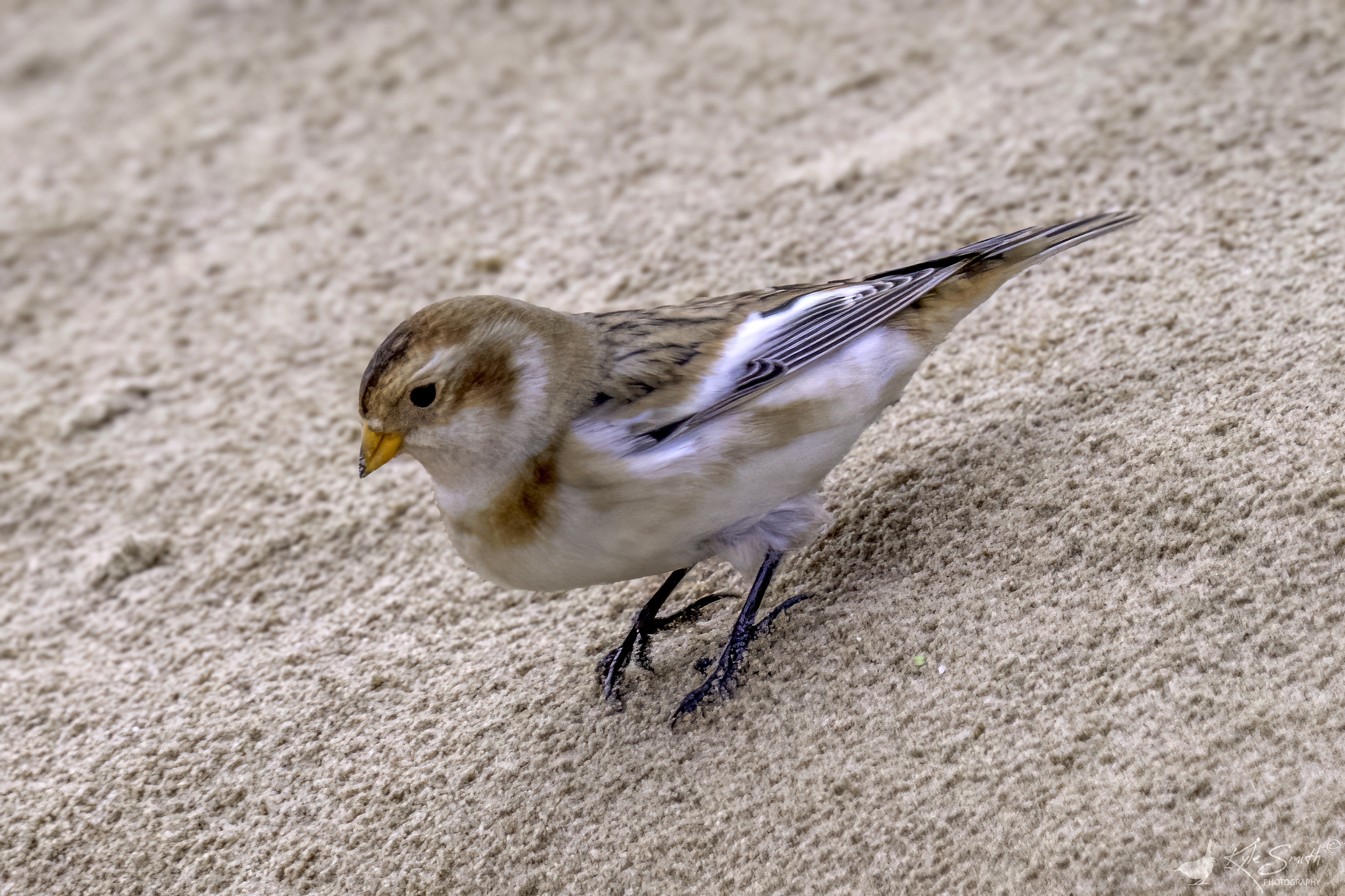
As another couple of cars arrived, we decided that it would be a good idea to head for the beach before it got busier - there had been reports of two snow buntings and these were the main target species for the day. Snow buntings are a winter highlight in Norfolk, often seen along the coastal areas during the colder months. These small, striking birds, with their partly white plumage and black markings, are typically found on beaches, dunes, and salt marshes, blending in with their surroundings. One of the best places to spot snow buntings in Norfolk is at spots like Salthouse, Cley, and Holkham, where they gather in flocks, feeding on seeds and insects - it was a nice surprise to see them reported here. They arrive from their Arctic breeding grounds in late autumn and stay through winter. As it happened, I failed to see any when at Holkam at the beginning of the year and so this was a welcome opportunity.

On the way, we paused to listen to bearded tits (reedlings) calling from both sides of the track. Three of them lifted from the reeds, flying just a foot above the seed heads before diving back down. There wasn’t a chance for a photo, and despite waiting and walking slowly, all we heard were more calls. Still, it was a year tick for me.

We reached the beach and turned right, heading in the direction where snow buntings had been reported the day before. Eventually, we met a female birder coming from the opposite direction. She told us the birds had landed near her but had flown off toward the inlet further ahead. She and another birder had tried but couldn’t relocate them. As we walked towards the area, we kept scanning, but still no luck.

We stopped at several points, trying different angles for a better view, and soon I spotted the bird. I called Kev over, and we had it in his scope. It wasn’t the most striking example, but a year tick for both of us. We waved over a couple of other birders, and just as they joined us, a second bird appeared in the same spot, both feeding continuously. We posted an update on Birdguides, and soon a stream of birders began heading our way.

Snow bunting
Snow bunting
Snow bunting
Snow bunting
Snow bunting

The birds had moved back up the inlet and disappeared from view. The far corner wasn’t far behind the dunes along the beach, so Kev and I decided to head back, thinking they might hop over onto the beach. A man with a camera joined us, and soon enough, our theory proved right - the two buntings were moving along the edge of the reeds growing through the sand dunes. We got ahead of them, staying low on the sand, and waited as they approached. Unfortunately, the birder beside me was closer to the dunes, which may have caused the buntings to turn and head back the other way. I managed to get a few photos, so we left them be after that. Looking back along the dunes it looked like quite a twitch was taking place.

Snow bunting
Snow bunting
Snow bunting
Snow bunting
Snow bunting
Snow bunting
Snow bunting
Snow bunting
Snow bunting

We scanned along the water's edge and spotted bar-tailed godwits, curlew, oystercatchers, turnstones, redshanks, and sanderlings, while out to sea, only great crested grebes were visible. As we continued scanning the horizon, we eventually added cormorants and common scoters to our day list.

Making our way back through the reserve, we stopped to try and spot the spoonbill, which had reportedly been seen around the saltmarsh, but we had no luck. While we searched, we watched a herring gull catch a crab, drop it in shallower water - perhaps to clean it - before picking it up again for a meal.

On the freshmarsh, a flock of golden plovers took to the sky, wheeling around in formation. Avocets, ringed plovers, dunlins, black-tailed godwits, and redshanks occupied the small islands and spits scattered across the marsh.

Herring gull
Golden plover

We had already seen a single pink-footed goose when a flock of barnacle geese flew by. Soon after, the many Brent geese left the water and moved to the grassland on the opposite side of the path. Overhead, both male and female marsh harriers quartered, while a kestrel hovered, scanning the grasslands below. Kev spotted a distant stonechat, and occasional flocks of meadow pipits and finches flew nearby. However, there didn’t seem to be anything unusual among them - though, as we later heard, friends spotted twite mixed in with a finch flock the following day ...

Barnacle goose
Brent goose

We eventually made our way back and onto the boardwalk, searching for the yellow-browed warbler reported the day before. Though the rain began to fall, it never became heavy enough to force us to seek shelter. We focused on trying to spot any mixed tit flocks moving through the trees and along the way, we paused to watch a jay hopping around in an open area of short grass. It didn’t seem too bothered by our presence, but before long, someone approached from the opposite direction and flushed it. We managed to spot one other bird before we got further into the trees.

Jay
Jay

We spotted some long-tailed and blue tits in a sycamore tree and then heard the calls of a goldcrest - and our yellow-browed warbler. A couple of birds dropped into the trees beside us, and we turned quickly to check if one was the warbler -just more blue tits. Grrr. Despite waiting, listening, and watching closely, we couldn’t locate it. So, we headed to the Visitor Centre for lunch.

The Visitor Centre provided a cozy spot to enjoy a sandwich and hot drink before venturing back out. We decided to try the car park on the other side of the trees where we had first heard the yellow-browed warbler. Within minutes, we heard its call again, but it quickly moved farther away, back toward the spot we had first heard it. After five minutes, we looped back to the original area and stood in the now heavier rain, waiting. After about 45 minutes, we still hadn’t heard any more calls. This bird is fast becoming my bogey bird.

Although we saw a few mobile tit flocks, the warbler remained elusive, and we never saw or heard it again. We returned to the car and headed home. Titchwell is an amazing place, and I’d managed to add a couple of species to my year list. But the yellow-browed warbler clearly hadn’t read the script and eluded me once more.

Year list: 239.