Saturday, 24 August 2024

RSPB Frampton Marsh & Newport Wetlands :: 16-17 August 2024

I'd taken the day off to assist in taking and retrieving my wife's car for a service in Northampton. I'd offered a lunch out and managed to swing the lunch to be at RSPB Frampton Marsh, just a 2hr onward journey from Northampton. Having dropped off the car, been delayed by some roadworks on the way, we arrived and opted for an early lunch so as to allow an easy estimate of when we'd need to leave and return to pick up her car.

We set out onto the reserve and stopped to listen for bearded reedlings on the corner of the main track to the sea wall, and the path to the 360 Hide. A reed warbler flew across but there were no calls from any beardies. We pushed on and reached the mound opposite the track down to the 360 Hide, joining a lady on a scope scanning the reed bed. While I'd been waiting for my wife to drop of the keys at the garage, I'd had a look at X and seen that Dawn Erskine @dawn_mission (someone I follow on the platform) had posted they were visiting Frampton today - I was pretty sure that this was her. I went over and introduced myself, and sure enough it was her! - lovely person and we had a short chat - so good to meet people in the flesh rather than only converse on t'internet. She pointed out a bar-headed goose in front of some greylag geese and spoonbills, and mentioned she'd seen two wood sandpipers from the 360 Hide (although very distant and into the sun).

The bar-headed goose is an occasional visitor to the UK, though it is not native to the region. This species is native to Central Asia, where it breeds around high-altitude lakes and migrates over the Himalayas to winter in South Asia. Almost all sightings of bar-headed geese in the UK are usually attributed to escapees from wildfowl collections as they are popular ornamental birds due to their striking appearance.

Bar-headed goose
Spoonbill

From the 360 Hide we could see just a few very distant pools of water - the main area was completely bone dry, dry as a bone. Allowing wild pools to naturally dry out and then flood again can be highly beneficial for providing food for wintering wildfowl. This natural cycle creates a dynamic habitat that supports a rich variety of invertebrates, aquatic plants, and seeds, which are vital food sources for birds. The Reserve has a plan …

This cyclical process mimics natural wetland conditions, promoting biodiversity and providing abundant food resources that are crucial for the survival and health of wildfowl during the winter months. Managing wetlands in this way can be an effective conservation strategy to support bird populations but at this moment in time meant that there was bugger all to see. Well, that is not completely true - there were a few teal and mallards in a far pool and as I focussed in, there were the two wood sandpipers, just as advertised. Fortunately, one left the cover of a shallow island and allowed us a better look, but the heat haze and distance made any photograph a record shot at best.

Wood sandpiper

We pushed on to the Reedbed Hide and met up again with Dawn who had just seen a juvenile water rail on the far reed line - she was buzzing as it had been a target since she saw some on the internet recently. We spent a bit longer in this hide but there was nothing of specific note.

We worked around until we were on the sea wall and benefited from the breeze - it was getting quite warm. We passed avocets, redshank, dunlin, ringed plover, lapwing, black-tailed godwits, amongst others, and then bumped into Dawn yet again - she must have thought we were stalking her! Just beyond were three birders watching a single curlew sandpiper - Charlotte jumped on one of the scopes trained on the bird. Again, the heat haze and distance made photography a bit pointless.

Curlew sandpipers are regular visitors at RSPB Frampton Marsh as the reserve is particularly attractive to waders like due to its extensive mudflats, saltmarshes, and freshwater scrapes, which provide ideal feeding and roosting habitats. During migration, they stop over to refuel on their long journeys between their breeding grounds in the Arctic tundra and their wintering sites in Africa. The best time to see curlew sandpipers at RSPB Frampton is typically during the autumn migration (late summer to early autumn), when they pass through the UK in significant numbers.

Curlew sandpiper

We spotted a couple of yellow wagtails, curlews, oystercatchers, and more black-tailed godwits, but the scrapes were surprisingly quiet. We walked back to the car park as we had to pick up the car before the service reception closed and had to allow for potential traffic hold-ups on the way. As we approached the car park my eyes were drawn to what initially appeared to be a flying grey heron, but the shape didn't sit well. On inspection it turned out to be a common crane, again distant and through heat haze. To our right and on the water beyond the Visitor's Centre the number of black-tailed godwits could be seen to be increasing - soon there will be thousands.

Common crane
Black-tailed godwit

With nothing local, Kev and I thought to head for Goldcliff Pools, the sea wall and RSPB Newport Wetlands on the Saturday morning, hoping that something of interest might drop in. It was windy and after a breakfast in Newport we made for the sea wall first, along the stretch where the Baird's sandpiper had been a couple of weeks earlier - not that I'd managed to find an opportunity to visit and tick it. In fact, the wind seemed to be blowing a bit less here and we watched as flocks of ringed plovers and dunlin worked along the shore with flyby curlews.

The odd turnstone appeared too on the shore and hirundines gathered in the fields behind. After a while we decided that there was nothing more to add and made for the main RSPB Newport Wetlands Centre and parked up. We entered the reserve and walked past the Visitor's Centre as they hadn't yet opened for coffee. We stopped and watched a couple of reed warblers still provisioning some youngsters, and a particularly yellow willow warbler. We made for the main reed beds and spotted some large dragonflies on the way, including this Southern hawker which landed on the edge of the track.

Southern hawker dragonfly

We walked through the reed bed hoping that we might come across a bearded reedling but didn't hear a peep or see one in flight - their movement is often undulating, with brief glides between bursts of flapping. Their flight calls, a characteristic "pinging" sound, can be heard as they move through the reeds. No such luck in connecting today. There were more hirundines, dominated by swallows that occasionally landed on perches out in the scrub. A couple of stonechats entertained, hovering for a considerable time but at large distance. Out on the shore we could see some gulls with one of the dark birds seeming to be harassing the others, much as a skua would - Kev had some views that were hopeful, but I never had a view that would be definitive.

We had a nice walk around but eventually worked back to the Visitor's Centre for lunch, sitting outside on the deck. We were watching handfuls of moorhens when I picked out a juvenile water rail at the far end of the pool. It was initially in amongst the reeds but eventually showed a little in front. It showed for a couple of minutes before disappearing right and out of view. A nice bird and funny to think of Dawn seeing one just the day before.

Water rail

We made our way back around and through the central track and saw a kingfisher over and through. Kev mentioned that he was looking to see cinnabar moths on the ragwort, so we kept our eyes open. Soon we found a colony, localised but dozens of the blighters. Cinnabar moth caterpillars are striking and easily recognisable due to their bold black and yellow (or orange) stripes. These caterpillars are the larval stage of the day-flying cinnabar moth. They primarily feed on ragwort plants, which contain toxic alkaloids and by consuming these toxins, the caterpillars themselves become poisonous, which helps to deter birds and other potential predators. They are often seen in large numbers on ragwort, where they can sometimes completely strip the plants of leaves.

Cinnabar moth caterpillar

In an hour or so we were back in the car and heading for Goldcliff Pools - Kev has managed to be bitten 7 or 8 times but didn't mention the discomfort he was in - he had been climbing through the scrub to check out a relatively inaccessible pool. There were more hirundines gathered on the wires beside the road, and a single yellow wagtail as we arrived. We walked down the path and onto the pools, with little on view as we settled into the first hide. We went to the. second and third before we spending some time watching little grebes and assorted wildfowl on the limited available water.

We watched some pied wagtails and then to our surprise we saw a stoat running from right to left against the far reed line. They are part of the weasel family and are known for their slender bodies, short legs, and bushy tails with a distinctive black tip. Stoats are widespread across the UK and are found in a variety of habitats. Stoats have a brown upper coat, white or cream underparts, and a bushy tail with a black tip. In colder northern regions, they may turn almost completely white in winter, a phase known as "ermine," which helps them blend into snowy environments. They are larger than weasels, typically measuring 20-30 cm (excluding the tail) and weighing between 150-300 grams.

As predators, stoats play a crucial role in controlling populations of small mammals. However, they can also impact ground-nesting bird populations, especially in areas where birds are already vulnerable.
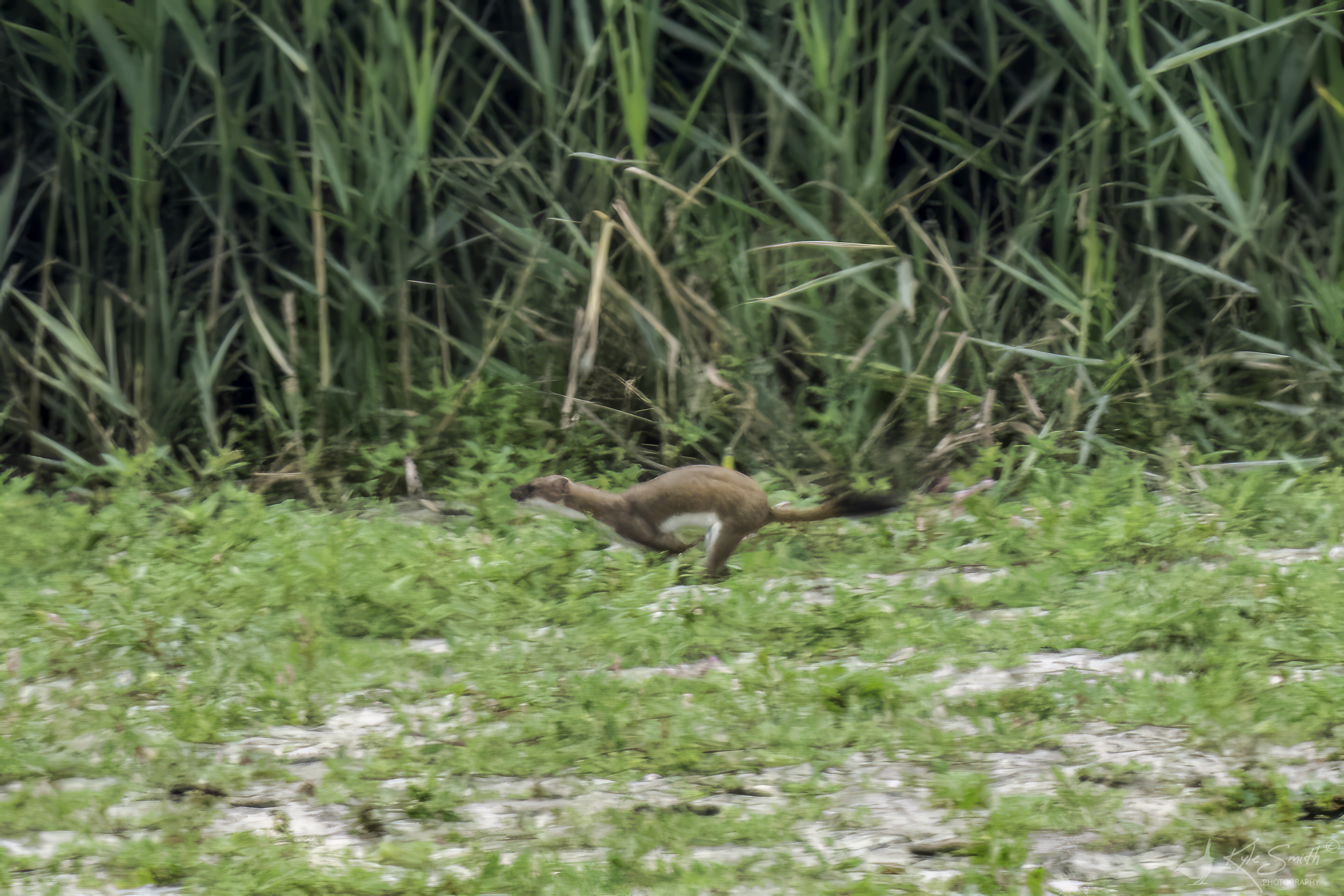
Stoat

Once the stoat has reached the leftmost reed bed, I scanned back to find a second individual out in front and distant. It paused long enough to get a slightly better photo.

Stoat
Stoat

We marched up and down trying to find something of note but in the end we had to return to the car and make for home. Our last bird of the day was another kingfisher, only heard, by the small bridge.

Monday, 12 August 2024

RSPB Otmoor :: 10 August 2024

With Kev @kev07713 away with his wife Karen in Cornwall and on the Scillies, I looked around for what to do on Saturday. There had been a rosy starling down on Keyhaven Marshes, Lymington earlier on Friday but it had flown at a little after 2.00pm. There wasn't anything else within reach - all major bird activity looked to be on pelagic trips or from distant seawatch sites.

Instead I opted to make my way down to RSPB Otmoor to see the leucistic juvenile marsh harriers reported through July - late to the party as usual - there are two individuals likely exhibiting the genetic condition called leucism. This causes a reduction in pigmentation, resulting in birds that have much paler feathers than normal but retain some colour, unlike albinos which have no pigmentation at all. One of the harriers is noticeably larger than the other, indicating they may be of different sexes. Additionally, an adult male with unusually pale plumage has been observed on the reserve. However, a source on X suggests that this colouration might result from inadequate or unbalanced nutrition and/or stress during the growth of juvenile feathers. This could have led to the feathers becoming fragile and resulting in pale and translucent patterns. I'd seen photos and it was worth connecting with them.

I arrived at 6.15am to find I was the first on site; it might be the first time this has happened as even when in the dark previously, someone got there first. I made my way to and along the bridle path, hearing and then seeing a couple of green woodpeckers but seeing little else. A roe deer welcomed me as I reached the kissing gate to make my way down to 1st Screen, soon prancing further out into Greenaways.

Roe deer

I could see another birder with a camera back down the track, but I decided to push on to 1st Screen and set up and wait for the marsh harriers. It wasn't long before I was joined by Paul Mallarini and we exchanged sightings - a bit sparse. There wasn't anything of note on the water either. We could see a couple of distant marsh harriers but not those I was waiting for, and though they flew briefly, much of the time they just roosted on top of far bushes. While there was little of note, the species count ticked along. A kingfisher landed directly in front of Paul but as we raised cameras it spooked and departed out across the water. Eventually Paul and I decided to leave - he headed back to the car park while I continued down to 2nd Screen. As we left Peter Barker and Co arrived and we exchanged pleasantries before I set off listening to and seeing a number of sedge warblers, green woodpeckers, and chiffchaff along the way.

Sedge warbler

I got to 2nd Screen and immediately saw all three egrets (little, great white and cattle) roosting on exposed mud; they were all preening and in the company of a grey heron.

The great white egret is a larger and less common species than the little egret, with an all-white plumage, long black legs, and a yellow bill. It has been increasing in numbers in recent years, with breeding first recorded in the early 2000s, they are now seen regularly.

The cattle egret is the rarest of the three egret species - smaller than the great white and more robust than the little egret. It has a stockier build, with a short, thick neck, and during the breeding season, they display distinctive orange-buff plumes on their head, chest, and back. There were c.12 individuals which I think was about half the number reported the previous day. The first recorded breeding of cattle egrets in the UK occurred in 2008 in Somerset. This marked a significant expansion of the species into the UK, reflecting broader changes in bird distribution patterns across Europe, likely influenced by climate change.

Three egret species
Cattle egret

In front and to the right were handfuls of snipe and a single common sandpiper; the ringed plover from the previous day had departed. I heard water rails call but there were no views. Within ten minutes Peter and his posse arrived, joining the search for anything in the fringes, but nothing was found.

I started back to the 1st Screen and soon after I got there one of the leucistic juveniles appeared across the reedbed on the far hedge line. It dropped and perched on a bush, just before the second appeared. For a minute or so both birds took to the air but never close enough for me to get them in the same frame. At this distance and with a grey sky I was only ever going to get record shots - they were beautiful. After another few minutes they dropped from view.

Marsh harrier
Marsh harrier
Marsh harrier
Marsh harrier
Marsh harrier
Marsh harrier
Marsh harrier

I walked back to the bridleway and met another birder - we walked and chatted, occasionally splitting but eventually joining up again. I could see one of the leucistic marsh harriers across at the back of Greenaways, but it didn't venture into range and soon dropped from view.

We reached the car park and I decided that I'd take a stroll down Long Meadow and see if I could find any common redstarts. I saw a single willow warbler and a few chiffchaff, but no redstarts. I started back and spotted a couple of birds dropping into a bush in the meadow and through bins could see they were lesser whitethroats. They left into the hedgerow along the edge of the meadow, and I walked on.

Looking back I saw another four lesser whitethroats drop in and then two blackcap, a spotted flycatcher, and a bullfinch - quite a haul for a single bush! Soon they all departed and were replaced by two more lesser whitethroats, likely the pair from earlier.

Lesser whitethroat
Lesser whitethroat

The weather was not improving, and a very light drizzle started to fall - not enough to make you wet. I checked out all the bushes again on my return down the meadow but added nothing more, failing to locate a redstart.

A decent species count for the morning at 52.

Wednesday, 31 July 2024

RSPB Snettisham :: 27 July 2024

I so wanted to go for the spotted sandpiper at Cheddar Reservoir and many of my friends had managed to do so over the last couple of days, but at work there were things to do and no opportunity to drop out. I am desperate to connect with one as I missed the individual at Upton Warren a couple of years ago - this error of judgement comes up from time-to-time.

On Friday night I discussed birding options for the following day with Kev @kev07713 and he said that the traffic had been horrendous when he'd visited that day and that he would skip a return for seconds on this occasion (he had been on the road for 10 hours but only with the bird for 1½) - in any case, given the disturbance from birders getting closer and closer and eventually flushing the bird, he expected it to depart overnight in clear conditions (in fact it did depart and so it was a great call to do something else).

The obvious next choice was RSPB Snettisham offering an array of waders; another good reason for visiting there was to meet up with Kev's sister Karen @hobbylovinglife and her partner Dean @worlebirder who planned to do the same.

I picked Kev, Karen and Dean up from Kev's house at 05.00am, Karen and Dean having travelled up to Banbury in the early hours from Gloucestershire. We didn't have to get there too early as it is best to plan visits around high tide for the best chance to see large flocks. High tide would be 11.10am but we needed a couple of hours before to hopefully catch the semipalmated sandpiper as the tide came in, and before the birds were flushed onto the freshmarsh lagoons and up the coast.

We stopped in Kings Lynn for a leisurely breakfast and as we were finishing up Alan Boddington @alanbodd sat down at the table beside us - we had a good natter. Eventually we all set off heading for the Snettisham with a report on BirdGuides that the semipalmated sandpiper had been located.

Arriving in the car park we set out seeing ducks and gulls on one of the lagoons, with a dozen or so Egyptian geese. We moved quickly but listened out as we hoped to connect with the turtle doves this site is known for.

Egyptian goose

Turtle Doves prefer open woodlands, hedgerows, and areas with scattered trees and bushes. They are often found in farmlands, gardens, and scrublands; primarily feed on seeds, particularly those of arable weeds and cereals. They forage on the ground and are often seen feeding in fields and along field margins. They are summer visitors to the UK, arriving in late April to May and departing by September. During this period, they can be seen and heard here at Snettisham.

Their distinctive purring call can help locate them in dense vegetation, hedgerows and field edges where they may be feeding or perching.

Onto the sea wall we could see a congregation of birders a couple of hundred metres ahead - we stopped with a birder looking through his scope, finding that he was on a turtle dove. It wasn't calling but was perched atop a line of bushes at some distance - it would be the only one we'd see. The most recent estimates suggest that there are fewer than 2,000 breeding pairs of turtle doves remaining in the UK. This number represents a drastic decline from previous decades, so is a special encounter. Regardless, we had a date with the semi-p sandpiper and so pushed on.

Turtle dove

The semipalmated sandpiper is a small shorebird native to North America and a rare vagrant to the UK with only sporadic sightings, usually involving single birds. They undertake long migratory journeys from their breeding grounds in the Arctic to their wintering grounds in South America. Most UK records occur during migration periods, particularly in August to October.

In breeding plumage, they have a mottled brown back, white underparts, and a distinctive black centre stripe on their crown. In non-breeding plumage, they are more uniformly greyish-brown above and white below. The name "semipalmated" refers to the partial webbing between their toes, which can be a helpful identification feature.

We joined the birders already in place and they put us on the bird - we had views through the scopes, but the distance made it tricky to capture anything but a dodgy record shot; it didn't help that I'd left the camera on full frame which made it even harder to pick out the bird. This was a lifer for Karen, and she excelled with her photos (here) which were much more detailed than mine - the extra reach with her bridge camera. There was no chance we’d be able to see the webbing on the feet.

Semipalmated sandpiper

We watched the bird for a while, but it didn't seem to be making any effort to close the gap to us. Numbers of little terns, a couple of Mediterranean gulls, and sandwich terns flew through with significant numbers of godwits, knot, dunlin amongst others feeding on the mud. Suddenly there was an eruption of waders into the sky, and we followed them as they swirled around - the reason for the agitation soon became clear as two Arctic skuas appeared, one of each of the colour morphs: a dark morph (uniformly dark brown) and a light morph (paler underparts with a dark cap and back).

The Arctic skua is a medium-sized seabird with a sleek, dark body and pointed wings. They are notorious for their piratical behaviour, often chasing and harassing other seabirds to steal their food, a behaviour known as kleptoparasitism. They are agile fliers and are often seen engaging in spectacular aerial chases.

Arctic skuas breed on coastal moorlands and islands in the UK, particularly in Scotland, including the Shetland and Orkney Islands, and occasionally in northern mainland Scotland. After the breeding season, they migrate to the southern hemisphere, wintering at sea in the subtropical and tropical oceans. The UK population is relatively small and has been declining with an estimated 1,200 to 1,500 breeding pairs, varying annually based on breeding success and environmental conditions.

In Norfolk they are typically seen during their migration rather than as breeding residents. They flew straight through.

Knot dunlin godwit
Arctic skua
Arctic skua
Arctic skua
Arctic skua
Arctic skua

We were able to pick out a few little stints and the same number of curlew sandpipers. The curlew sandpiper is another notable bird species that can be observed at Snettisham. In breeding plumage, it has rich chestnut-red underparts and mottled grey and brown upperparts. In non-breeding plumage it is pale grey above and white below, with a white rump and supercilium (eyebrow line). It is also a long-distance migrant, breeding in the Arctic and wintering in Africa, Asia, and Australia. They are typically seen in the UK during their migration periods. High tide is an optimal time to see them as they gather with the other waders at roosting sites.

The tide was advancing and some of the waders were getting closer - we'd all lost the semipalmated sandpiper.

Curlew sandpiper
Curlew sandpiper

The tide was flushing many of the knot, godwits, dunlin, oystercatchers and others from the bay, many flying over us and into the freshmarsh lagoon behind - a great spectacle. We decided to walk along to a hide where you could watch the assembled waders congregating on small islands. Spotted redshanks hung out with some cormorants. A Mediterranean gull and several sandwich terns roosted with assorted gulls on the island directly in front.

Mediterranean gull
Sandwich tern

There was an update from South Screen that a white-rumped sandpiper had been found and so we quickly set off and found the hide already full of birders, packed in like sardines. Fortunately, we are all slim (haha), and soon all four of us had managed to squeeze in and had eyes on the bird. Initially it was asleep, popping its head out sporadically - eventually a tern dropped in beside moving it right and giving us a better view - even a wing-stretch.

The white-rumped sandpiper is a small shorebird from North America that occasionally appears as a rare but regular vagrant in the UK. In breeding plumage, it has a greyish-brown back with black streaks, a white rump (hence the name), and a distinctive white stripe over the eye. In non-breeding plumage, it is more uniformly greyish with less distinct markings. The white rump, usually visible in flight, is a key distinguishing feature. It also has a relatively long primary projection beyond the tail, giving it a pointed-winged appearance.

White-rumped sandpiper

The white-rumped sandpiper was roosting with numbers of dunlin and knot; a spoonbill and domestic white goose were on the slope behind.

Red knots are migratory birds, passing through the UK during their journeys between their Arctic breeding grounds and wintering areas in West Africa; some also spend the winter in the UK. In breeding plumage, they have striking reddish-orange underparts and mottled gray and brown upperparts. In non-breeding plumage, they are more uniformly grey above and white below. They are known for their spectacular flocks, often seen in large numbers, especially during high tide roosts at Snettisham.

The best time to observe them is during high tide when they gather in large flocks on the mudflats and beaches; the sight of thousands of birds in flight is a remarkable spectacle.

Knot dunlin

We spotted another curlew sandpiper in the flock and continued scanning to see if we could add anything else, but then retired to the sea wall and a couple of benches for a coffee and lunch break.

Waders
Waders

While we still scanned the birds, picking out another little stint, we worked our way back along the sea wall and towards the car. We stopped on several occasions still daunted by the number of birds in view - I have never seen so many little terns in one place, Adrian Borley @AdrianBorley reporting a personal count of a minimum 357 a couple of days later ...

Little tern appear to have had a successful breeding season in Norfolk, particularly at Snettisham. Snettisham is part of the Wash, a large estuarine system that is crucial for many bird species. The successful breeding of little terns here highlights the importance of maintaining and protecting such habitats. This success is significant given the challenges faced by this species.

Reports indicate an increase in the number of nesting pairs at Snettisham with measures leading to a higher survival rate of chicks. Despite the successful season, little terns continue to face threats such as habitat loss, climate change, and disturbance; continued efforts are still needed.

Little tern

We had a great visit, but everyone was starting to feel weary and we elected to stop at the cafe at the entrance to the reserve for a drink and freshen up before the journey home - never stopped there before and well worth remembering it is there.

Year list: 224.

Tuesday, 23 July 2024

Normandy Marsh & Longslade View, Brockenhurst :: 20 July 2024

Friday conversation was short - Kev @kev07713 said there was nothing that we had to go and see locally and so suggested a trip down to Normandy Marsh, Hampshire for a breeding pair of roseate terns. I snapped at the chance as I'd missed the chance to holiday in the northeast a few weeks earlier and see these wonderful birds.

Roseate terns nesting in Hampshire, marks a rare instance of this species attempting to breed on the south coast of England. One of Britain's rarest and most localised breeding species, roseate terns are typically found nesting almost exclusively on Coquet Island in Northumberland. However, a notable exception has occurred this year, with a pair settling in a tern colony at Normandy Lagoon, a saltmarsh on the Hampshire coast.

First reported here on May 14, the presence of this rare pair initially prompted the Hampshire Ornithological Society (HOS) to minimise publicity to protect the birds. As the roseate tern is rarely seen breeding away from Northumberland (or Ireland), volunteers have been constantly monitoring the nest to prevent disturbances during the brooding of the eggs - a dedicated team of HOS volunteers have conducted 24-hour monitoring using thermal-imaging cameras.

The roseate tern closely resembles the common tern in many ways, including size, but can be distinguished by its black bill with a red base, whereas the common tern has a red bill with a black tip. They derive their name from the subtle, rosy flush that tinges their summer plumage, although this colouration is often much fainter in reality than it appears in photographs, making it challenging to spot. Not having ever seen one it might prove even more challenging for me.

So after a spot of breakfast on the way we parked up and made it round to the sea wall, joining a handful of birders already in place, one of whom we know from previous trips to the south coast - Jeremy Mcclements @jeremymcclemen1. My hopes were dented when we were informed that the birds had already departed out onto the Solent - both juveniles were now flying and not in view. Apparently, it would have been better to come on Wednesday …

While we waited, the colony of little terns entertained us in the lagoon behind, including some of this year's fledglings. In addition to the usual hover and diving technique, they chased around the lagoon and out onto the Solent to fish. They were closer in that when I visited back on 23 April to see the marsh sandpiper - report here. They thrive at this site, consistently delighting all who come to see them.

Little tern
Little tern
Little tern
Little tern
Little tern
Little tern

A shout went up from a chap to our left as he stumbled upon one of the juveniles on a low grassy island about 150m offshore. There were good scope views. Then a second juvenile was spotted not far from the first, but more obscured from view. In a short time, the first bird took to the wing, circled back and joined the second. At this distance there were only ever going to be record shots.

Roseate tern
Roseate tern
Roseate tern
Roseate tern
Roseate tern

I had my tick but somehow not seeing an adult bird seemed to take some of the shine off - the group all watched out for any returning adults, visiting to feed the juveniles. We waited and checked out many passing common terns, and the occasional sandwich tern.

Behind us a pair of ringed plovers dropped in, a dunlin sat alone - 'Billy no mates' - avocets fed back on our left, a linnet watched us from a fence, and a black-tailed godwit stalked the water's edge.

Black-tailed godwit
Linnet

Hours passed by, no one called any of the adults returning, and it was suspected they were likely visiting but just dropping food to the juveniles as they passed through. I watched as a tern, likely common, flew over the island carrying a fish. I snapped a couple of photos for something to do and then noticed a juvenile joining it. From the photos I could see that the juvenile looked to be one of our roseates, and then noted that the adult bird had a longer black beak and a red base. I checked with knowledgeable friends who confirmed I'd seen an adult - unfortunately after the event - I feel bad now for now calling it, although never having seen one I really wasn't sure. When sea watching I've been told to call everything and not worry about being wrong - better to get everyone on it and check - why I didn't this time I don't know.

Roseate tern
Roseate tern
Roseate tern
Roseate tern
Roseate tern
Roseate tern

We'd been here for almost three hours but had bagged my target bird. Over on the opposite shore half a dozen powerboats passed by, making quite a racket, and presumably creating quite a wake. The United Kingdom Offshore Power Boat Racing Association (UKOPRA) were running the Solent 80 powerboat race, featuring approximately 25 powerboats with competitors expected to be travelling at speeds exceeding 50 knots. The course would began at the Roway Wreck beacon, proceeded to the Pullar buoy, and then circumnavigate the Isle of Wight. Key turning points included St Catherine’s Point, Bridge buoy, North Head, and several other buoys in the Western Solent and its approaches. The race was set to finish near a special mark 3G Cowes Week 2026, located south of the Beaulieu River entrance by 2.00pm.

Powerboat
Powerboat
Powerboat

We returned to the car and noted that the restaurant at the Yacht Haven was full and decided to make our way home but keep our eyes open for a heath we could stop and look around. By Sandy Down, just south of Brockenhurst we could see extensive heathland to the west and drove through to find somewhere to stop - we came across a car park at Longslade View. This is likely the smallest of the car parks overlooking this valley and is accessed via a long, straight track that is heavily potholed; no problem for Kev's car ...

We parked and followed a track that ran parallel to the road we'd come in on, seeing a stonechat at the far end of the car park - lost by the time we set off. Initially we could neither see nor hear any birds but eventually numbers of meadow pipits appeared, along with a handful of skylarks.

We spotted large numbers of small blue butterflies which turned out to be silver-studded blues. These butterflies are a striking and rare species found in specific habitats across the UK and whose presence is an indicator of healthy heathland and grassland ecosystems. They are small, with a wingspan of about 25-31mm, the males have bright blue upper wings with a narrow black border while the females have brown upper wings with orange spots along the edge. Both sexes have a characteristic row of metallic silver-blue spots (studs) on the underside of their hindwings.

They thrive in heathland, calcareous grasslands, and coastal dunes. They are most commonly found in southern England, particularly in Dorset, Surrey, Devon, and here in Hampshire. Smaller populations exist in East Anglia, North Wales, and the Sefton Coast in Merseyside. Adults are usually on the wing from late June to early August.

They often live in small, localised colonies that can be quite isolated from each other - some populations have shown signs of recovery due to dedicated conservation efforts, but the species remains vulnerable and reliant on continued habitat management.

Silver-studded blue butterfly

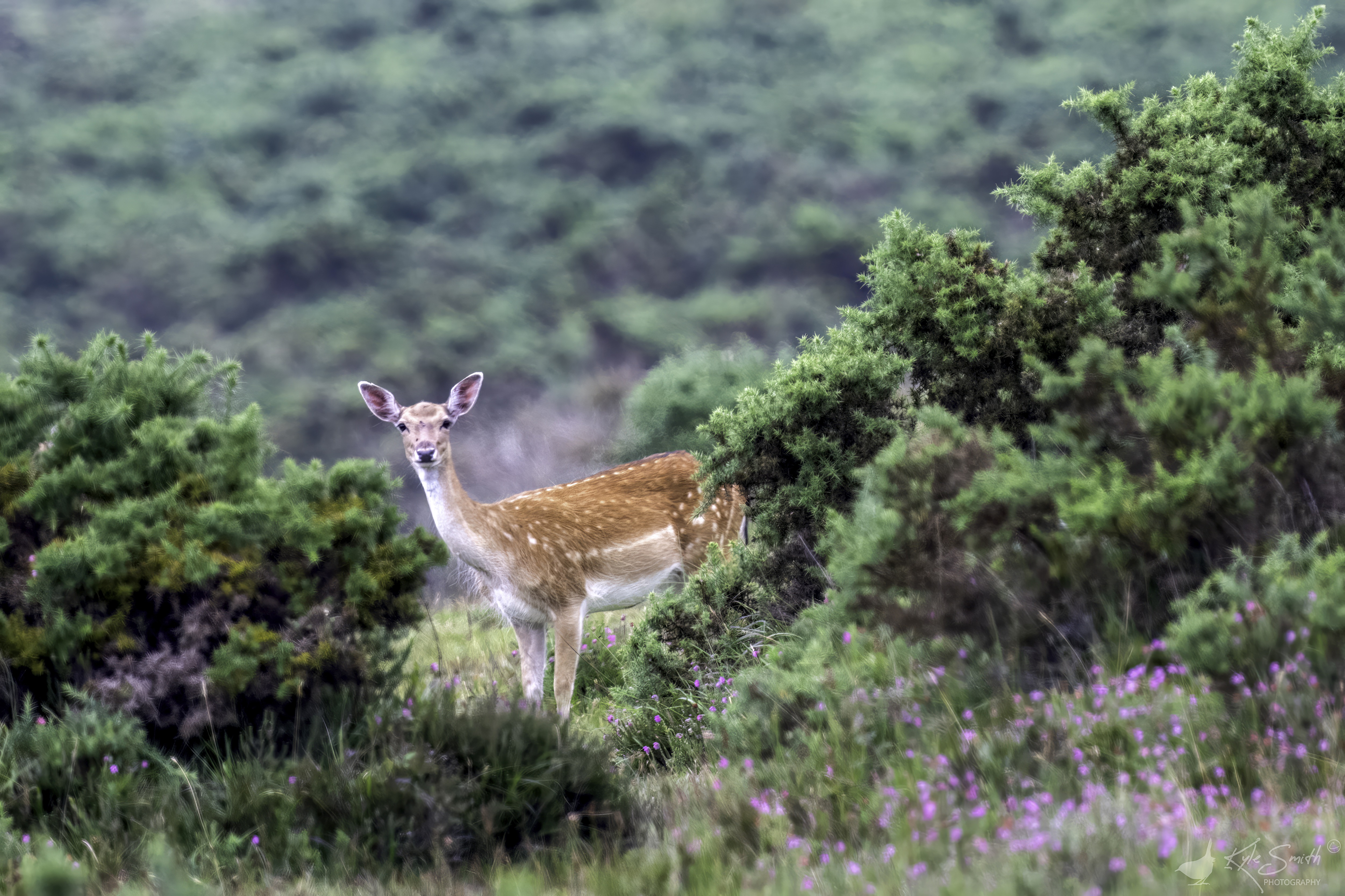
We pushed on, hoping to come across a Dartford warbler, this appearing to be great habitat for them. We continued to see meadow pipits but could see or hear a Dartford. Ahead we spotted a handful of fallow deer who appeared very curious about our presence - they were soon gone.

Fallow deer

Kev asked what to do next and I suggested walking on just a bit further to the spot the fallow deer had been, and where I thought you'd be able to look down over the valley. We stopped there with our drinks and watched as a pair of stonechats moved around the gorse bushes.

Stonechat
Stonechat

After five or ten minutes a female kestrel flew up and away, and as I scanned the nearby gorse, I picked out a juvenile Dartford warbler working through. It flew left and we watched for it to reappear, but we were then presented with an adult bird. It remained heavily obscured in the bushes, but we could follow it some of the time, eventually dropping from view. How many times to you pass habitat that you say looks ideal for Dartfords and you wonder if they are actually there? - this was one of those.

Dartford warbler

We heard a Dartford call and tried to pick it out, at further distance back from our position. The rain started to fall, and we then got onto the bird, stopping long enough for another record shot and view. We started back for the car and the rain stopped as we got halfway - we didn't add anything of note. A cracking day out with a lifer to boot.

Dartford warbler

Year list: 220